
June 20, 2026
5 Signs Your Ridglea Hills Home Has a Slab Leak
5 Signs Your Ridglea Hills Home Has a Slab Leak, practical local guidance from Shield Plumbing Fort Worth, Fort Worth's trusted plumbing tea…
Read More




A grease trap that needs pumping announces itself before the smell hits the dining room. Floor drains near the dish pit gurgle and drain slow. The three compartment sink backs up half full of gray water. A sour, rancid odor settles over the kitchen after the lunch rush, worse near the mop sink or exterior lid. Health inspectors flag the odor and the visible grease ring on the trap lid before they ever open it, and that citation goes on record.
The root cause is fats, oils and grease that never fully liquefy again once they cool in the line. Every fryer dump, every sauté pan rinse and every dish machine cycle sends warm grease into the trap, where it separates and floats as a hardening cap. Skip a scheduled grease trap pumping service and that cap thickens until it chokes the outlet baffle, forcing solids past the interceptor and into the city sewer lateral. Restaurant grease trap service intervals that stretch too long turn a routine grease interceptor cleaning into an emergency pump out during a Friday dinner rush.
Fort Worth adds a second stressor most cities do not: the expansive clay under commercial slabs. That clay swells when rain soaks it and shrinks hard in drought, and the movement is enough to shear copper lines and separate drain joints under a building. Buried grease interceptors along the dense restaurant blocks of the Near Southside and the Cultural District sit on that same clay, and the seasonal shift stresses the pipe joints and lid gaskets where the trap connects to the building's drain line. Older storefront kitchens near Fairmount, built out decades before current interceptor sizing rules, often carry undersized traps that were marginal on day one and now get outrun by soil movement on top of normal grease loading.
Wait past that point and the failure sequence is predictable. A saturated trap stops holding grease and starts passing it downstream, where it congeals in the sewer lateral and backs sewage into the kitchen. A backed up floor drain during service means a shutdown kitchen, a health department callback, and in older buildings a sewer camera bill to find where the solids lodged. Grease trap maintenance deferred by a month rarely costs a month's worth of trouble. It costs a closed kitchen on your busiest night.
If this sounds close but not quite your situation, diy vs. professional drain cleaning may be the better starting point.
Independent standards matter too, the EPA's WaterSense program sets the efficiency benchmarks we use when recommending replacement fixtures.
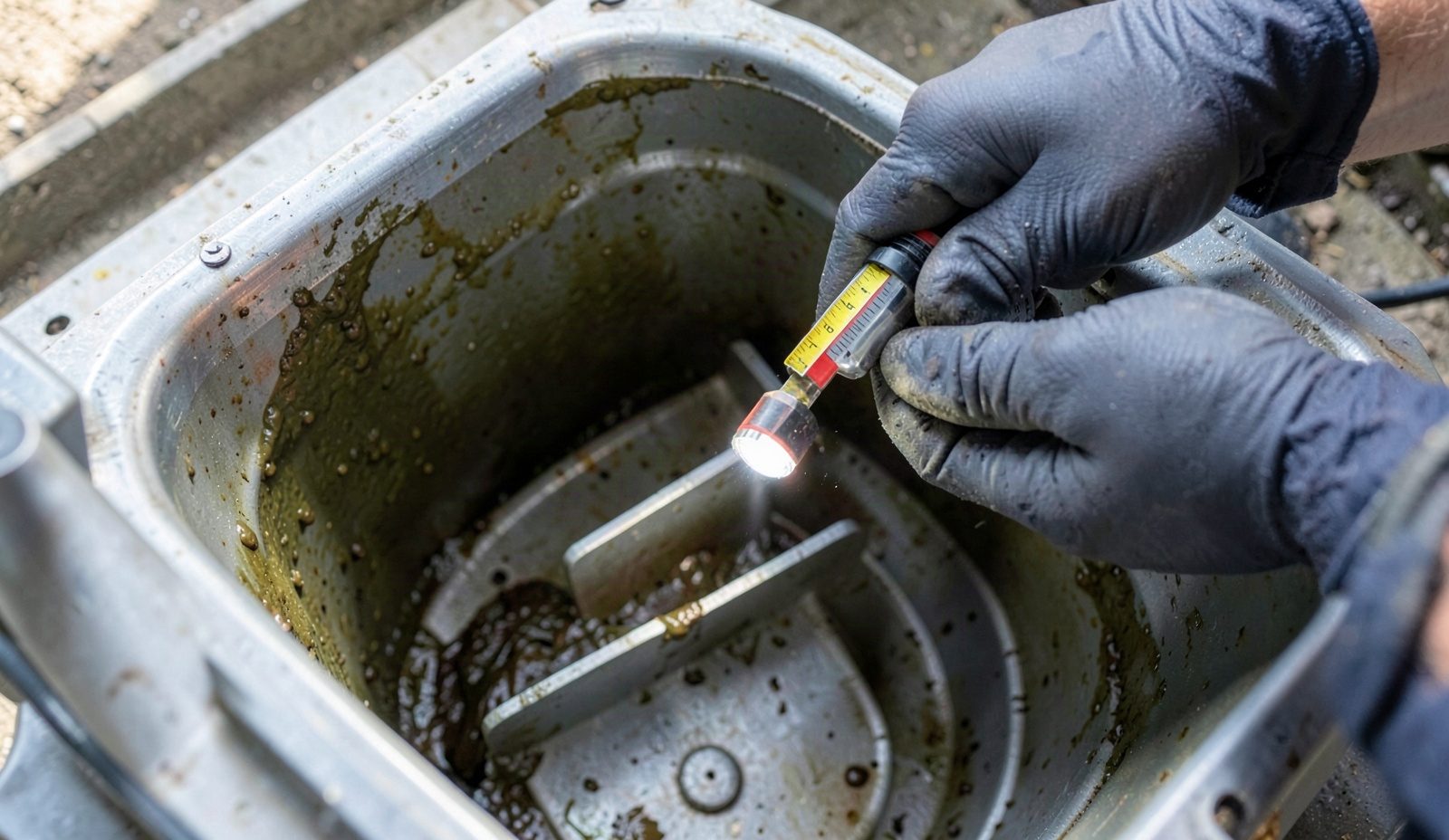
A partial skim looks like service but leaves the problem underneath. Our crews pump the interceptor down to bare walls every visit, clearing settled solids along with the floating cap, because both count toward capacity. Before we ever run a hose, the technician drops a calibrated dip stick through the inspection port and reads grease cap thickness against total liquid depth. That single reading drives the schedule. Interceptors get pumped before they reach 25 percent capacity, the standard FOG program threshold, because past that point turbulence starts carrying grease straight into the outlet tee.
Which system a kitchen runs changes the job. A passive gravity interceptor, the concrete or fiberglass box set below grade outside the building, holds hundreds of gallons and buys time between visits but needs a vacuum truck and full access to the lid every service. A point of use automatic grease removal unit like a Thermaco Big Dipper or an Endura system sits under the three compartment sink, skims itself on a timer into a small collection container, and needs that container emptied on a tighter cycle, often weekly, because it holds a fraction of the volume. We service both, but we quote them differently. A gravity interceptor job is priced on gallons pumped and hauled, an AGRU service is priced on visit frequency and container handling.
Once the tank is down, the technician jets the inlet and outlet baffles clear, checks the tee fittings for grease buildup that restricts flow, and inspects the lid gasket and hold down bolts for the seep marks that mean a reseal is coming. Every gallon pumped gets logged on a manifest for hauler disposal, the record a health inspector or a franchise auditor will ask to see. For kitchens without an interceptor yet, grease trap installation sizing is not a guess. Capacity gets calculated from fixture unit count and meal volume the way the commercial plumbing code requires, not picked off a shelf because it fit the available floor space.
See drain cleaning & rooter service for how the related work is scoped and priced.
A call to schedule starts with basic facts: seat count or unit type, last known pump date if you have it, and access details like whether the lid is indoors or under the parking lot. On arrival, the technician opens the lid, drops the dip stick, and reads grease cap thickness against total depth before touching anything else. That reading, plus a look at the baffle tees and the gasket, becomes the basis for the scope sheet the manager reviews. Nothing gets scheduled as a guess. The whole assessment usually runs under fifteen minutes for a standard interceptor.
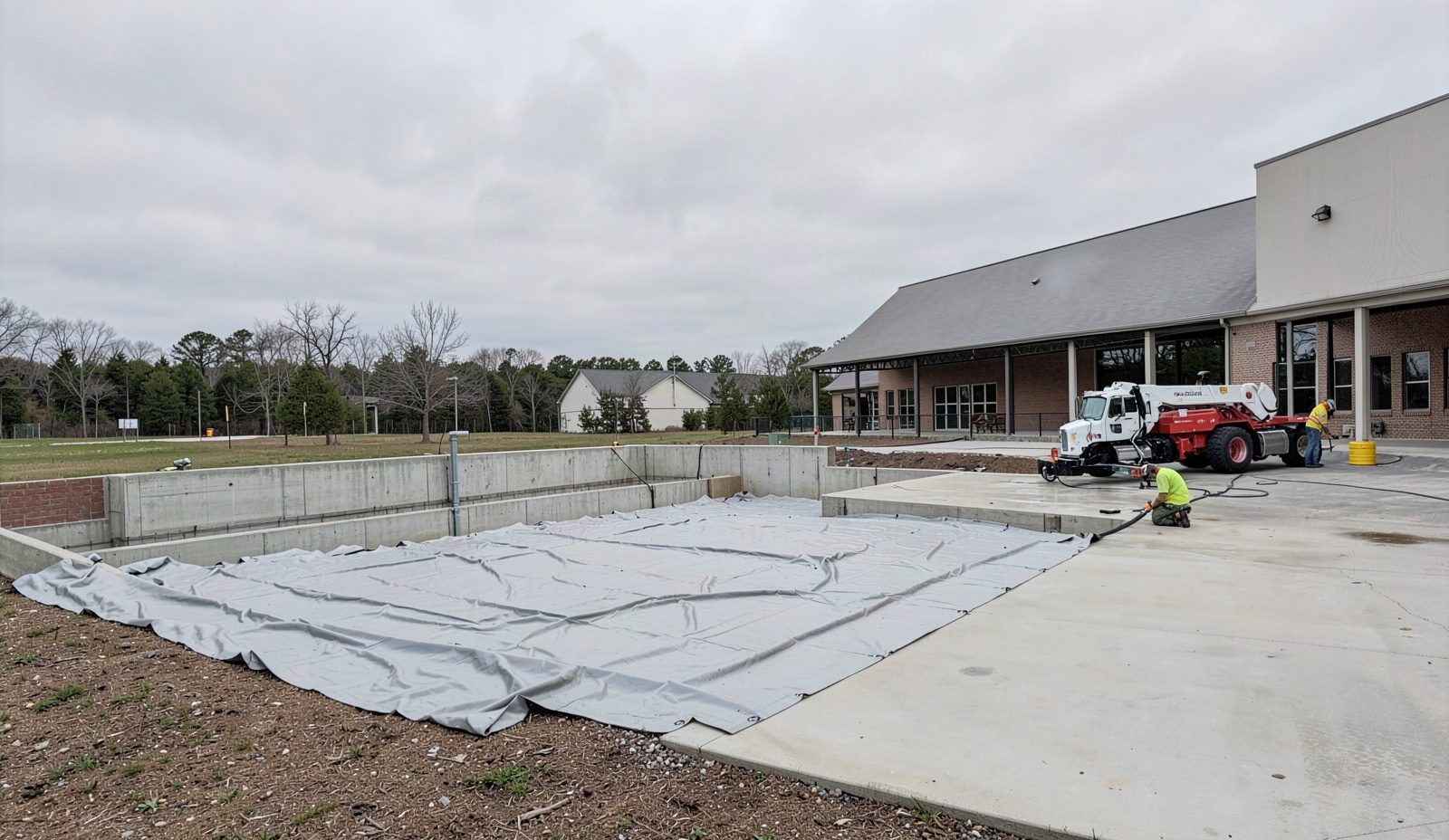
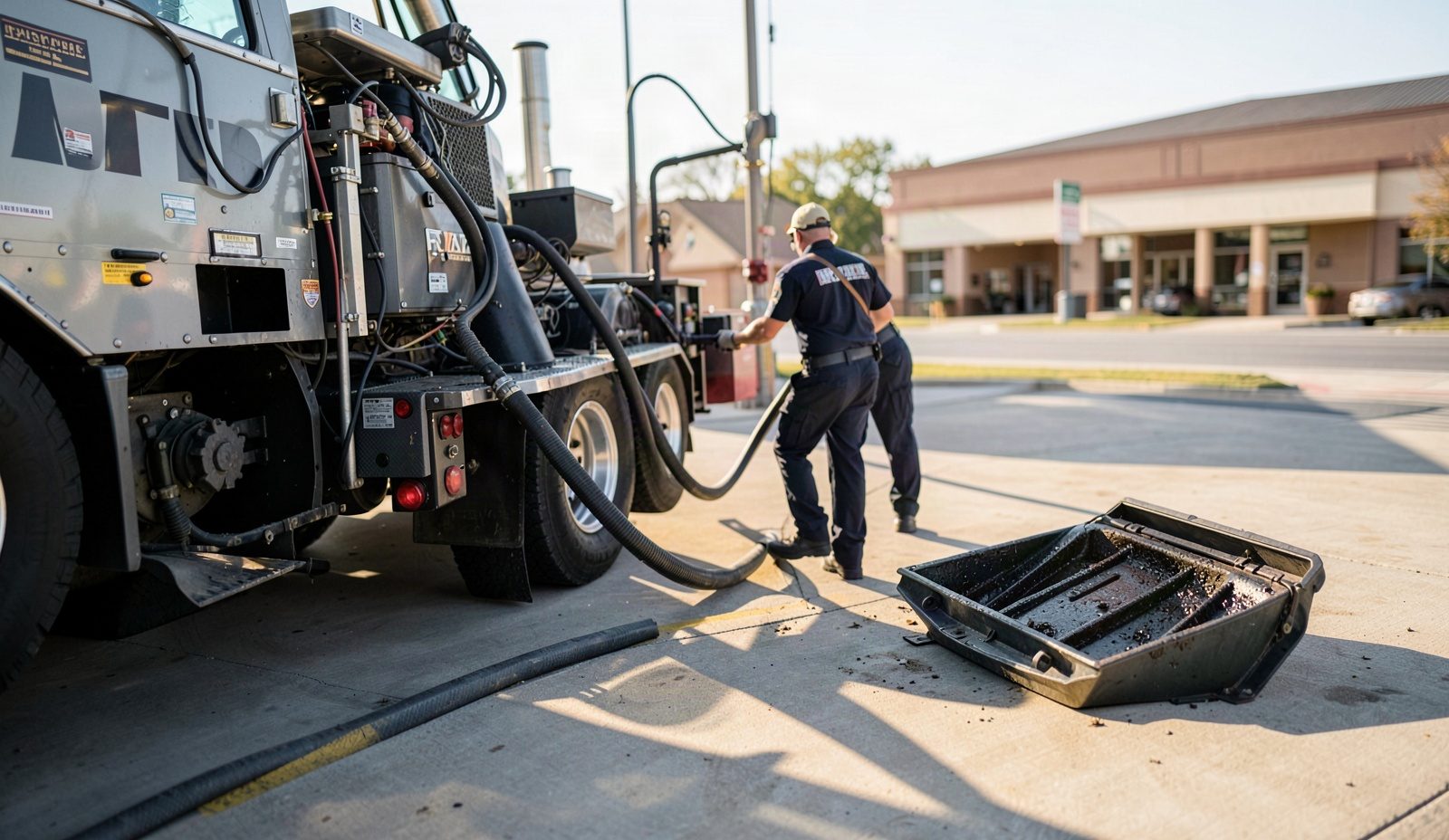
With the scope sheet approved, the truck runs suction hoses to the interceptor and pumps it to bare walls, water, grease cap and settled solids together. The technician jets the inlet and outlet baffles to clear restriction, then checks the lid gasket and hold down hardware. If the gasket is seeping or a fitting shows corrosion, that repair line item gets flagged and priced separately, and work stops on that item until the manager signs off. Containment mats stay down under the access point through the entire visit.
Before the truck leaves, the technician re-checks the dip stick reading to confirm the interceptor sits empty and reseats the lid flush with the pad. A test flush through the floor drain or three compartment sink confirms flow moved through the baffles without backing up anywhere in the line. You get a dated service record and the hauler manifest number for your health inspection file, plus the measured accumulation rate that sets the next recommended pump date instead of a guessed one. The manager gets a copy on site at the end of the visit.
Commercial grease trap work in Fort Worth falls under the 2021 International Plumbing Code as adopted by the City of Fort Worth for commercial occupancies, and that code sets the sizing, venting and access requirements an interceptor has to meet before an inspector signs off. Crews who don't work this market regularly miss the local FOG program's reporting rhythm, the manifest paperwork a health inspector expects on the spot, and the line between a routine repair and a job that needs a permit pulled first.
An out of area operator who shows up without knowing that rhythm can leave a kitchen worse off: a mis-sized replacement trap that fails its next inspection, a haul off ticket that doesn't match what the health department wants on file, or a schedule that doesn't account for how fast a high volume fryer line fills an interceptor between visits. We plan pump out frequency around what the last reading showed, instead of a generic calendar reminder, and we keep the paperwork in the format local inspectors are used to seeing.
For multi location accounts and property managers, that documentation matters as much as the pump out itself. A dated service log and manifest record gives a franchise auditor or a leasing agent proof the kitchen met its FOG obligations between health department visits, which matters when a lease renewal or an insurance review asks for it.
If your kitchen has failed an inspection over a grease trap, or you're not sure your current interceptor is sized right for your seat count, call (817) 710-3766 and talk through what a technician needs to see on site before recommending a fix.
Our page on storm drain cleaning & repair covers that side of the work in more depth.
Permit and inspection questions? Development Services is the office we coordinate with on every permitted Fort Worth job.
Routine grease trap pumping gets scheduled around your kitchen's slow hours, not ours. Most Fort Worth accounts land on a fixed cadence, weekly, biweekly or monthly, set from the dip stick reading on the last visit rather than a generic calendar. Vacuum trucks arrive inside a two hour morning or late night window depending on your service hours, and dispatch calls the manager on file if a prior stop runs long. Overflow calls get triaged the same day, ahead of routine stops on the route. If a scheduled date falls on a holiday closure or a private event, we move it to the next open service window instead of skipping the cycle.
Every pump out routes through sealed vacuum hoses run from the truck to the interceptor lid rather than open buckets carried through the kitchen. We lay containment mats under the access point and around any indoor cleanout before opening anything. Extracted grease, water and solids go straight into the truck's holding tank for hauler disposal. Nothing gets dumped or rinsed into a floor drain on site. After the pump out, the technician hoses down the lid area and the immediate pad with a degreasing rinse so the smell doesn't linger into service hours. The kitchen floor, the alley and the parking area look the same as before the truck arrived.
What drives the estimate is what the dip stick and the visual inspection find, not a flat rate by the door. Interceptor gallon capacity, how deep the grease cap has built up, whether the lid sits under a parking lot or inside a tight utility closet, and whether the baffles need jetting on top of the pump out all move the number. The technician writes the scope on site, item by item, before the truck starts any work past the standard service. A manager or owner reviews and signs that scope sheet before any add on work begins, so nothing gets billed that wasn't approved first.
Every technician who services a grease interceptor solo has already spent time on a truck under a lead tech's supervision, learning how to read a dip stick measurement and recognize a failing gasket before it leaks. Background checks run before anyone is dispatched to a commercial account. Crews get refreshed on current commercial plumbing code requirements and FOG program documentation standards on a regular cycle, not just at hire. A new tech doesn't run a route alone until a supervisor has signed off on a set number of supervised pump outs, not just a training class.
Estimates start with an onsite assessment of your interceptor. A technician measures capacity and grease cap depth with a dip stick, checks access and baffle condition, then writes the scope sheet in front of your manager before pumping past a standard cleaning. You or your manager sign off on that scope before extra work, like a gasket reseal or baffle jetting beyond routine, gets added. Property management accounts get the same scope sheet emailed with the visit's manifest number for their records.
A permit is not required for routine grease trap cleaning & pumping. Installing a new interceptor or relocating one during a remodel is different work and typically needs a permit before the job starts. Build that review time into your project timeline. A remodel that swaps in a new interceptor without accounting for permit lead time can push back your health inspection and your opening date, which costs more than the permit itself ever would.
We can't speak to another company's pricing or how they structure a quote. Our pricing depends on interceptor size, measured sludge depth, and access difficulty on the day of service, never a flat number quoted before anyone has seen the trap. Call and a technician can walk through what drives your specific number based on your kitchen's setup.
Pumping out your own grease trap is not practical or compliant. What you can do between scheduled pump outs is skim visible surface grease from an accessible lid and keep the outlet screen clear of solids, which stretches the interval between professional visits without replacing the pump out itself.
Cost depends on how often the interceptor needs pumping, and that frequency is set by grease volume rather than a fixed monthly rate. A kitchen running a heavy fryer line fills its trap faster than a coffee and pastry counter, so it gets scheduled more often and pays more over a year even at the same per visit price. The only way to get a real number is the onsite dip stick reading, not a phone estimate.
Whole house repipe cost depends mainly on square footage, pipe material and wall or slab access. A single story slab home with easy attic access costs less to repipe than a two story pier and beam house with finished ceilings below the crawlspace. Ask for a written scope walking your specific home before comparing any number, since two quotes for the same address can differ once access and fixture count get measured on site.
Commercial strips built out along Arlington Heights, Wedgwood and Ridglea Hills before current interceptor sizing rules still run kitchens on grease traps installed for a smaller menu and a smaller lunch crowd than what operates there now. Those older buildings often route the interceptor through a tight utility yard or a shared alley behind the retail row, which limits truck access to a specific angle and window, and a route planned without knowing that ahead of time costs a stop extra time it doesn't have. Narrow lot kitchens in these corridors also tend to share a single grease line with a neighboring tenant, which means a clog downstream shows up as a backup in a kitchen that didn't cause it. Servicing this stock means checking the shared line layout before pumping starts, not discovering it mid visit.
Fort Worth handles plumbing permits and inspections for commercial occupancies through the City of Fort Worth Development Services Department, and for addresses outside city limits the local building department or Tarrant County makes that call instead. Routine pumping and cleaning almost never triggers a permit review, but swapping a mis-sized interceptor for a properly sized one, or moving a trap's location during a remodel, does. Knowing which reviewer covers which district, and what that reviewer expects to see on a manifest or a scope sheet, comes from working this market call after call, not from a manual. Kitchens that lean on a crew with that standing relationship spend less time re-explaining their setup at every visit and more time getting back to service.
Explore our service area and locate Shield Plumbing Fort Worth with ease. We're proudly local and serve the surrounding neighborhoods with fast response and honest pricing. Use the map to check our coverage area, or call us and we'll confirm in seconds.
Address:
Shield Plumbing Fort Worth, 210 W 7th St, Fort Worth, TX 76102
5 Signs Your Ridglea Hills Home Has a Slab Leak, practical local guidance from Shield Plumbing Fort Worth, Fort Worth's trusted plumbing tea…
Read More
What Wedgwood Residents Should Know Before a Whole-Home Repipe, practical local guidance from Shield Plumbing Fort Worth, Fort Worth's trust…
Read More
How Fort Worth's Hard Water Is Quietly Destroying Your Water Heater, practical local guidance from Shield Plumbing Fort Worth, Fort Worth's …
Read More
The Hidden Cost of Ignoring a Dripping Faucet in Fort Worth, practical local guidance from Shield Plumbing Fort Worth, Fort Worth's trusted …
Read More