
June 20, 2026
5 Signs Your Ridglea Hills Home Has a Slab Leak
5 Signs Your Ridglea Hills Home Has a Slab Leak, practical local guidance from Shield Plumbing Fort Worth, Fort Worth's trusted plumbing tea…
Read More




Tenants notice it first. Water pressure drops on the third floor while the ground floor runs fine. A break room faucet spits rust-colored water first thing Monday morning after a weekend with no flow. Maintenance staff find a damp ceiling tile below a riser closet, or a hairline crust of white mineral buildup along a copper joint in the mechanical shaft. In older buildings near Fairmount and Arlington Heights, where storefronts were converted into offices decades ago, these complaints often show up floor by floor as the original supply lines age out together. The main commercial water line replacement candidate is usually the galvanized or early copper main feeding the building from the meter room, and it shows the same rust-colored discharge tenants report at the tap. None of this is random. It is the predictable failure pattern of a commercial pipe system reaching the end of its service life.
The soil under Fort Worth drives a lot of this. North Texas expansive clay swells with rain and shrinks in drought, and that movement is strong enough to shift a slab foundation and shear copper supply lines or separate drain joints running under the building. A riser that ran straight and true when the building went up now sits under lateral stress every time the ground cycles wet to dry. Office buildings along the Near Southside sitting on slabs poured before modern control-joint practices show this stress first at the penetrations, where a pipe passes through concrete and has zero room to move, which is why riser replacement in this part of the metro is rarely a one-time fix once the stress starts.
Ignore the first pinhole leak and the next one shows up eighteen inches away on the same riser, because the corrosion or the stress that opened the first hole is already working on the pipe around it. A single-line patch turns into a floor-by-floor commercial pipe replacement once three or four leaks appear in one stack. Wait longer and the water finds drywall, insulation, and ceiling grid before anyone sees a drip, and a routine riser replacement becomes a mold remediation and tenant relocation problem.
Property managers who patch instead of plan usually end up scheduling an emergency commercial building repipe on someone else's timeline, not theirs. Once a building reaches that point, the office building repiping project competes with active leases, elevator schedules, and tenant move-out dates instead of a budget cycle chosen in advance.
Our page on commercial backflow prevention & testing covers that side of the work in more depth.
Permit and inspection questions? Development Services is the office we coordinate with on every permitted Fort Worth job.
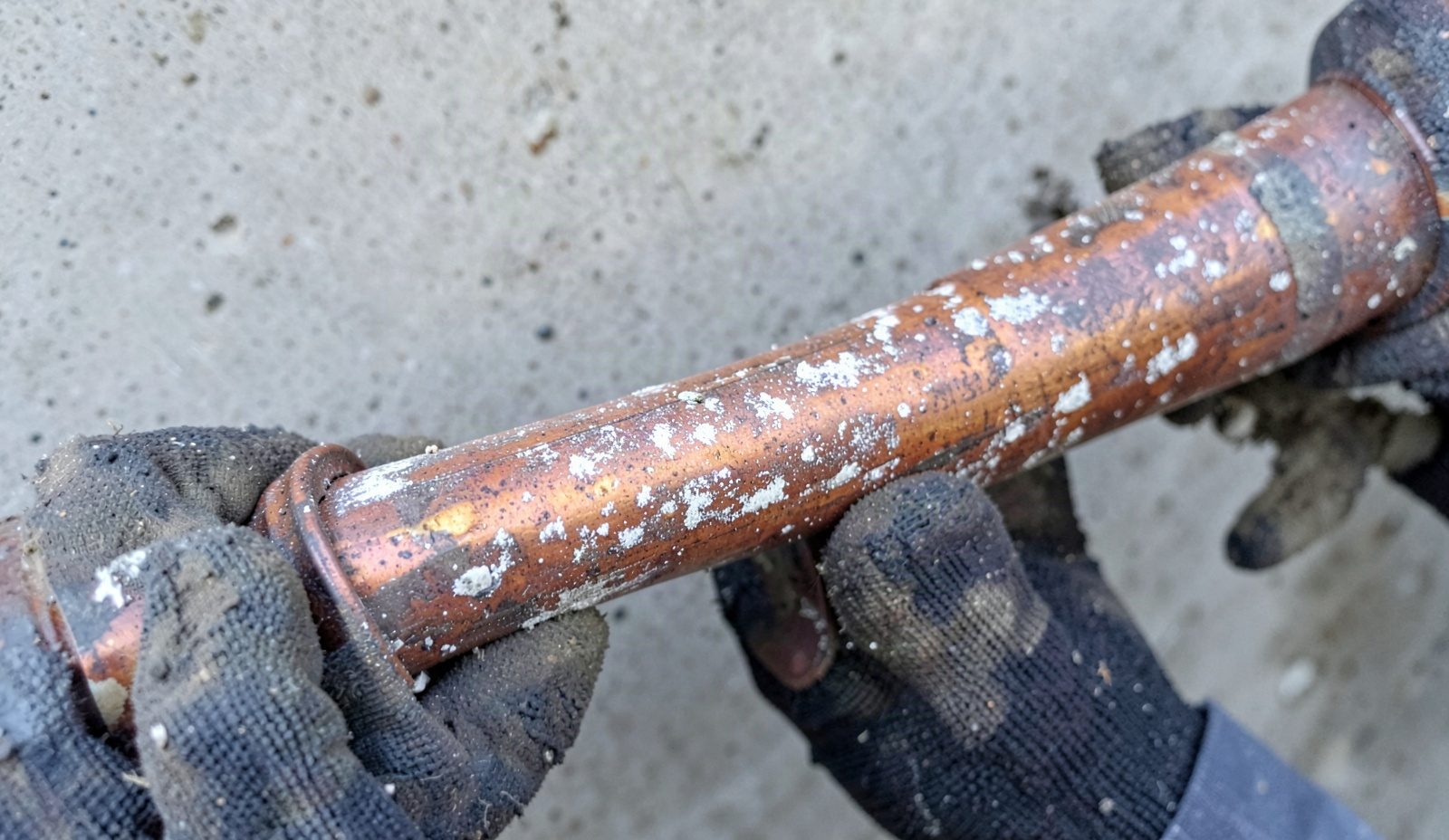
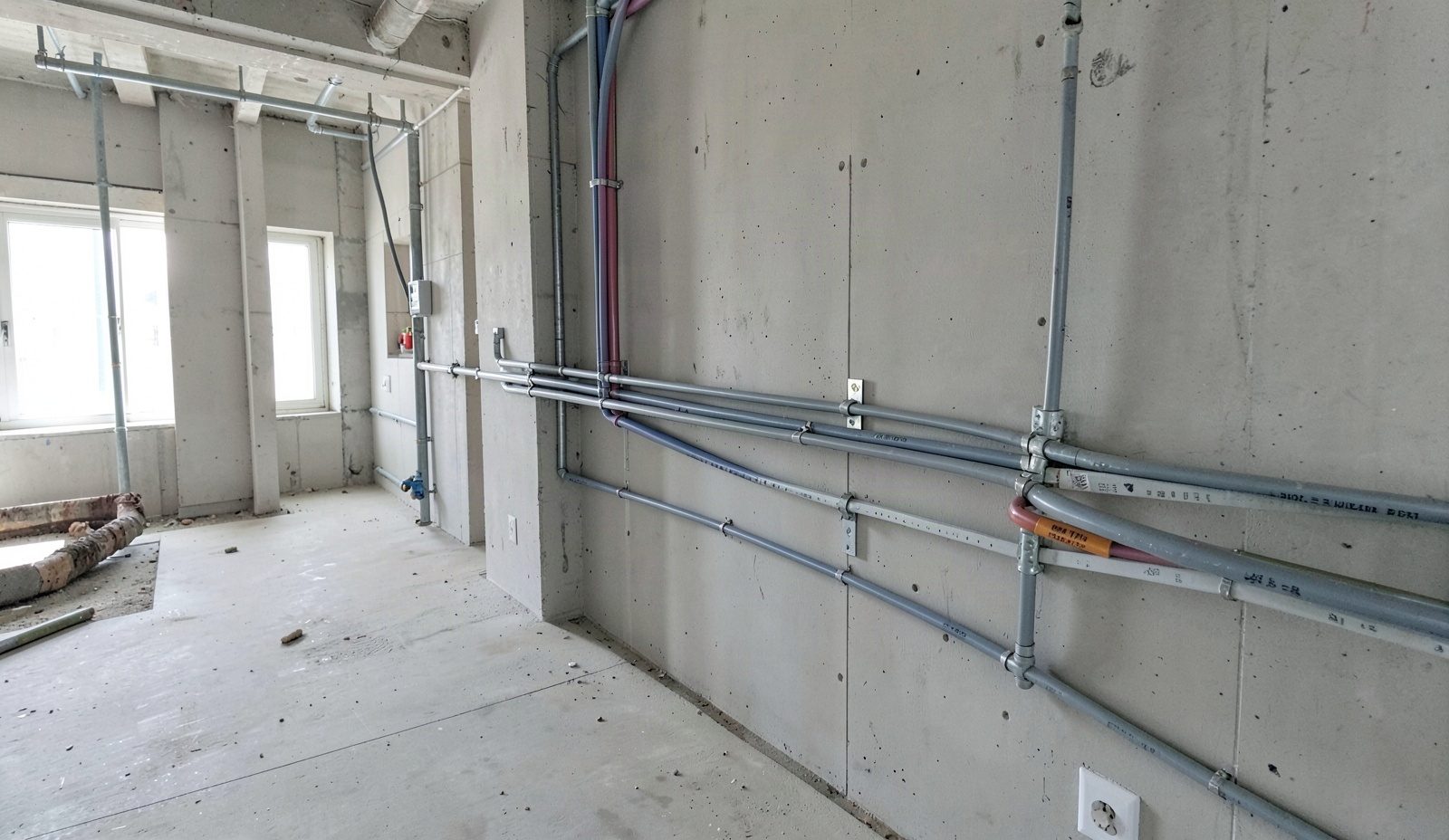
Every commercial repiping project starts with a static pressure test, not a guess. A calibrated gauge goes on the system, the building gets isolated by floor or by riser, and the line holds pressure for a set period while the technician watches for drop. A drop of more than a few pounds per square inch over that window flags a joint or a section that has already opened underneath insulation or behind a wall, long before it shows up as a visible leak. A borescope camera runs through cleanouts and accessible risers to read the inside of the pipe wall directly, and an ultrasonic thickness gauge checks copper and cast iron at multiple points along a stack to confirm how much wall material corrosion has already eaten away. None of this scope gets written on the estimate from a visual walkthrough alone.
Material choice depends on what the readings show and what the building needs from the system. PEX-A tubing expands around a joint instead of relying on a soldered fitting, which matters on a riser replacement running through a shaft with dozens of joints, and it resists the scale buildup that Fort Worth's moderately hard water leaves inside a pipe over time. Copper Type L still wins where fire-rated plenum runs require it, or where a mechanical engineer specs it for hot water risers above a certain temperature. CPVC shows up on some commercial water line replacement jobs because it installs fast and holds up chemically, but its lower burst-pressure ceiling makes it a poor match for high-rise risers carrying serious static head. We spec pipe by riser, not by habit.
Occupied buildings get phased, not shut down. Crews isolate one riser or one floor at a time so tenants on other floors keep running water while work happens. Any project that touches waste lines feeding a ground-floor kitchen or café tenant includes a grease interceptor check before demo starts, a dip-stick reading of the interceptor to confirm it sits under 25 percent solidified FOG, the standard threshold that triggers a pump-out under local grease-management programs. Interceptors above that mark get pumped first, so the crew is not cutting into a waste line full of grease. Off-hours cutovers, temporary bypass lines, and floor-by-floor scheduling keep a full commercial building repipe from ever shutting down the whole property at once.
If this sounds close but not quite your situation, commercial kitchen plumbing may be the better starting point.
Our technicians follow the workmanship standards promoted by the Plumbing-Heating-Cooling Contractors Association.
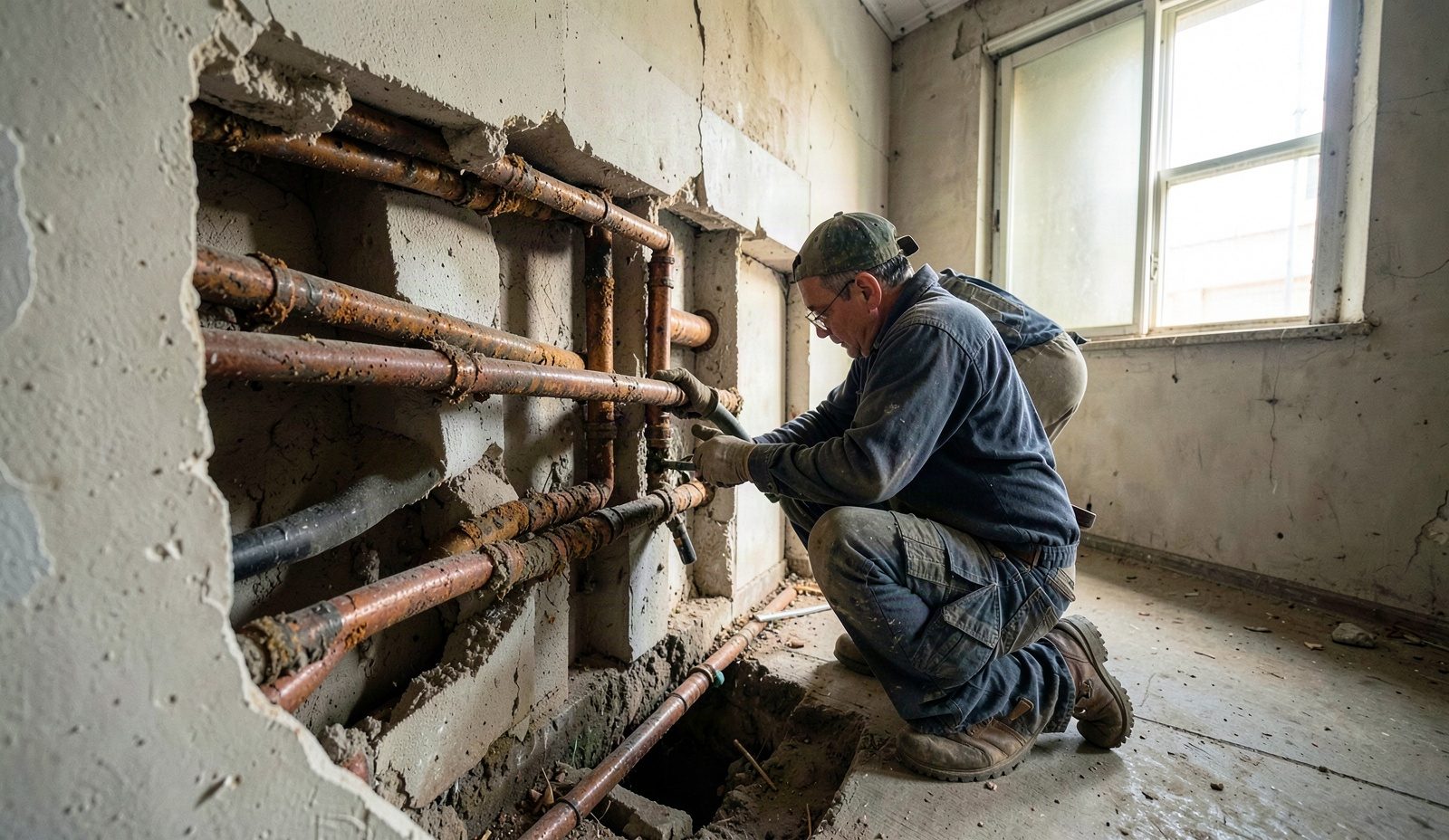
The call starts with basic facts: building size, number of floors, age of the system, and the symptom that triggered the call. A technician schedules an on-site visit and walks the mechanical rooms, riser closets, and any accessible ceiling space. The static pressure test goes on first, followed by a camera run through cleanouts where access allows. The property manager gets a plain-language readout on the spot, which risers are failing, which lines are still sound, and what the pressure and camera readings showed. That readout becomes the basis for the written scope, not a guess made from the parking lot.
Work starts only after the property manager signs off on the written quote and the phase schedule. Crews isolate the riser or floor under work, protect finished surfaces, and run new PEX-A, copper, or CPVC lines based on the spec for that section. Any decision that comes up mid-job, an unexpected cast iron drain section, a shaft that is tighter than the drawings showed, gets a phone call and a signed change order before work continues. Tenants on other floors keep normal water service while the isolated section is down.
Before any wall or ceiling closes, the new lines get a second pressure test to confirm the readings hold at the same threshold used during diagnosis. A camera pass checks joint quality on any run where visual inspection is not possible after closeout. The property manager walks the finished space with the technician, reviews before-and-after photos, and receives written documentation of the pressure readings and materials installed, useful for insurance files or lease compliance records. Fixtures get turned on floor by floor to confirm flow and drainage before the crew leaves the site.
Commercial repiping in Fort Worth falls under the 2021 International Plumbing Code as adopted by the City of Fort Worth for commercial occupancies, and that code governs everything from pipe sizing and material approval to backflow prevention at the water line replacement. A crew that does not work this code daily can misapply a fixture unit calculation or miss a required air gap, and that mistake surfaces at final inspection, not before. We scope every riser and water line replacement against the current adopted code before the first pipe gets cut, so the project passes inspection on the first visit instead of the third.
Pre-1970 buildings across the metro were plumbed with galvanized steel supply lines and cast iron drains, and both are now at or past the end of their rated service life. A lot of Fort Worth's older commercial stock, converted storefronts, small office buildings, mixed-use blocks, still carries that original galvanized main behind a wall or under a slab. Knowing that history changes the plan. A crew unfamiliar with the metro's building ages will spec a repair where the correct answer is a full commercial building repipe, and a crew that skips the history lesson entirely will underestimate how much of the drain system is cast iron and due for replacement alongside the supply lines.
Hiring an out-of-area operator for a Fort Worth commercial job carries real risk. A crew unfamiliar with the local permit review process can submit a scope that gets kicked back for missing information, adding weeks to a schedule a property manager already committed to a tenant. A crew unfamiliar with the local water chemistry can spec a pipe wall thickness that scales faster than expected. Local experience means the scope, the material list, and the permit application are built around what actually holds up in this specific water and this specific soil, not a generic national spec sheet.
See commercial plumbing contractors for how the related work is scoped and priced.
Booking starts with a call to (817) 710-3766, where we ask about the building's occupancy schedule before setting a date. Most commercial repiping happens in phases scheduled around business hours, tenant lease terms, and any after-hours access restrictions the property manager sets. We give a two-hour arrival window for the crew's first visit and confirm it the day before by phone. If a delivery delay or an access issue shifts the schedule, we call the property contact directly instead of leaving a message and hoping. Multi-floor projects get a written phase schedule up front, so building management knows which riser is down and when, floor by floor.
Every access point gets floor protection before a tool comes out, ram board over finished flooring, plastic containment walls around any ceiling grid that has to come down, and negative-air containment when a wall cavity opens near an occupied suite. Corridors stay clear for tenant traffic during business hours. Debris, cut pipe, old fixtures, and packaging get bagged and hauled off site the same day, not staged in a hallway overnight. When a phase wraps, the work area gets swept and wiped down before the crew leaves, so a tenant walking back into a break room or restroom sees a finished space.
The written quote reflects scope, how many risers or water lines need replacement, access, whether pipe runs through finished ceilings, tight shafts, or an open mechanical room, material, PEX-A, copper Type L, or CPVC depending on the application, and condition, how far corrosion or scale has already progressed based on the pressure test and camera findings. A technician walks the building, documents findings with photos, and presents the quote before any pipe is cut. Nothing changes mid-project without a signed change order, so a property manager approving the work knows the number before crews mobilize.
Every technician goes through a background check before being assigned to a commercial site. Ongoing training keeps the crew current on the locally adopted plumbing code cycle, since a code detail missed in the field costs time at inspection. New technicians work paired jobs under a senior tech and complete a field competency review, checked against actual pressure test and joint quality standards, before they run a commercial repipe solo. That review looks at joint prep, test readings, and documentation quality, not just speed.
The right call depends on how much of the system has already failed, not the price of one visit. A single confirmed leak on an otherwise sound copper riser usually justifies a spot repair. Three or more leaks on the same stack, or a pressure test showing wall loss across multiple sections, points toward full replacement, because patching keeps sending a crew back to the next failure point on the same line. A technician bases that recommendation on pressure and camera readings, not a flat rule.
An estimate starts with an on-site walkthrough of every riser, water line, and access point in the building. The technician runs the pressure test and camera inspection, documents findings with photos, and builds a written scope around what the readings actually show, not a flat per-floor rate. Property managers get that written quote before any pipe is cut, with material and phase options spelled out. Call (817) 710-3766 to schedule the walkthrough that starts the process.
Cost depends on how many risers and water lines need replacement, how hard they are to access, and what material the building needs. A project confined to one shaft with open ceiling access costs less to execute than one running through finished suites on multiple floors. Corrosion severity found during the pressure test and camera inspection also shifts the scope up or down. A technician builds the actual number from those site-specific findings during the walkthrough, not from a general square-footage rate.
Duration depends on the building's floor count, occupancy restrictions, and how many risers need replacement. A single-riser project in a small office building can wrap in a matter of days once work starts. A multi-floor repipe phased around business hours and tenant access windows runs longer, sometimes several weeks, because only one section comes offline at a time. The phase schedule set during the quote gives the property manager a realistic timeline before work begins.
A full commercial repipe is rarely a same-day project because of the scope, isolating risers, protecting finished space, and testing before closeout. What can happen same day is emergency isolation of a failed line and a temporary repair that stops the leak while a phased replacement gets scheduled. That stabilization keeps a building operating while the permanent scope is planned around occupancy.
Coverage depends on the policy language and the cause of the failure, not the age of the pipe. Sudden pipe bursts are often covered as accidental damage, while gradual failure from corrosion or scale buildup is frequently excluded as a maintenance issue. A property manager should confirm specifics directly with the carrier before assuming either way applies to a given claim.
Pricing for any specific outside provider is not something we track or quote here. What we can tell you is that commercial repiping costs in Fort Worth move with scope, access, and material, the same variables that shape any written quote. Call (817) 710-3766 for a site-specific walkthrough and a written number for your building instead of a general estimate that will not match your actual pipe condition.
The February 2021 freeze burst pipes across Tarrant County by the tens of thousands, and most of those failures were supply lines run through attics and exterior walls, the same locations many older commercial buildings still route their mains and branch lines. That event changed how a repiping plan gets built here: any line still running through an unconditioned attic or an uninsulated exterior wall gets flagged for rerouting or added insulation during the same project, not left in place to fail again the next hard freeze. Fort Worth's water is also moderately hard, and the scale it deposits inside a pipe narrows the working diameter over years, which is why a riser replacement scope includes checking wall thickness even on sections that have never visibly leaked. Material specs account for both conditions, not just the corrosion a technician can already see.
Full commercial repiping and any structural pipe work typically requires a permit through the City of Fort Worth Development Services Department for addresses inside city limits, while properties outside city limits route through the local building department or Tarrant County. That permit review checks pipe sizing, material approval, and backflow protection against the adopted commercial code before an inspector ever sets foot on site. Office parks near Wedgwood and Ridglea Hills, along with converted retail and studio space in the Cultural District, mix building eras on the same block, sometimes a 1960s slab next to a 2000s build-out, so the permit file and the as-built drawings matter as much as the pipe itself. Getting that paperwork right the first time keeps a phased project moving on the schedule a property manager already committed to tenants.
Explore our service area and locate Shield Plumbing Fort Worth with ease. We're proudly local and serve the surrounding neighborhoods with fast response and honest pricing. Use the map to check our coverage area, or call us and we'll confirm in seconds.
Address:
Shield Plumbing Fort Worth, 210 W 7th St, Fort Worth, TX 76102
5 Signs Your Ridglea Hills Home Has a Slab Leak, practical local guidance from Shield Plumbing Fort Worth, Fort Worth's trusted plumbing tea…
Read More
What Wedgwood Residents Should Know Before a Whole-Home Repipe, practical local guidance from Shield Plumbing Fort Worth, Fort Worth's trust…
Read More
How Fort Worth's Hard Water Is Quietly Destroying Your Water Heater, practical local guidance from Shield Plumbing Fort Worth, Fort Worth's …
Read More
The Hidden Cost of Ignoring a Dripping Faucet in Fort Worth, practical local guidance from Shield Plumbing Fort Worth, Fort Worth's trusted …
Read More