June 20, 2026
5 Signs Your Ridglea Hills Home Has a Slab Leak
5 Signs Your Ridglea Hills Home Has a Slab Leak, practical local guidance from Shield Plumbing Fort Worth, Fort Worth's trusted plumbing tea…
Read More




A failing process line rarely announces itself with a flood. It shows up as a hiss at a flanged joint, a rust bloom on insulation jacketing, a pressure gauge that will not hold steady overnight, or a batch line running slower than the flow meter says it should. Maintenance techs on plant plumbing maintenance rounds learn to trust their nose before their eyes. A sour, metallic smell near a threaded fitting usually means the pipe wall has thinned enough to weep before it splits.
The same expansive clay that shears copper supply lines and separates drain joints under Fort Worth houses does the same work under commercial slabs. Facilities near Fairmount and Arlington Heights sit on soil that swells with spring rain and pulls back hard in a dry August, and a slab that lifts a quarter inch over one season puts real shear load on a buried header. A threaded joint that tolerated that movement for a decade can crack in a single wet-to-dry cycle, and the leak that follows often starts underground where nobody sees it until the concrete stains or a floor drain backs up.
Cold snaps do their own damage. The February 2021 freeze burst pipes across Tarrant County by the tens of thousands, and most of those failures were supply lines running through attics and exterior walls, the same exposed, poorly insulated runs common on loading docks, mezzanines, and rooftop equipment pads at industrial sites. A pipe that froze once and thawed without visible rupture is not off the hook. Ice expansion micro-cracks the pipe wall from the inside, and that hairline damage often surfaces as a pinhole leak months later, usually during the next hard freeze.
None of this gets cheaper by waiting. A pinhole leak in a process line contaminates product, drips onto electrical gear, or drives up a water bill nobody can explain. Left alone, a hairline crack in a caustic or hot-water line becomes a full-bore failure that shuts down a line for cleanup instead of a scheduled repair window. Industrial pipe fitting done reactively, on an emergency call at 2 a.m., costs more in downtime than a planned process piping repair ever will.
More detail on burst pipe repair is on its own page.
Your local utility, Payment options, publishes service and water-quality information every Fort Worth homeowner should know.
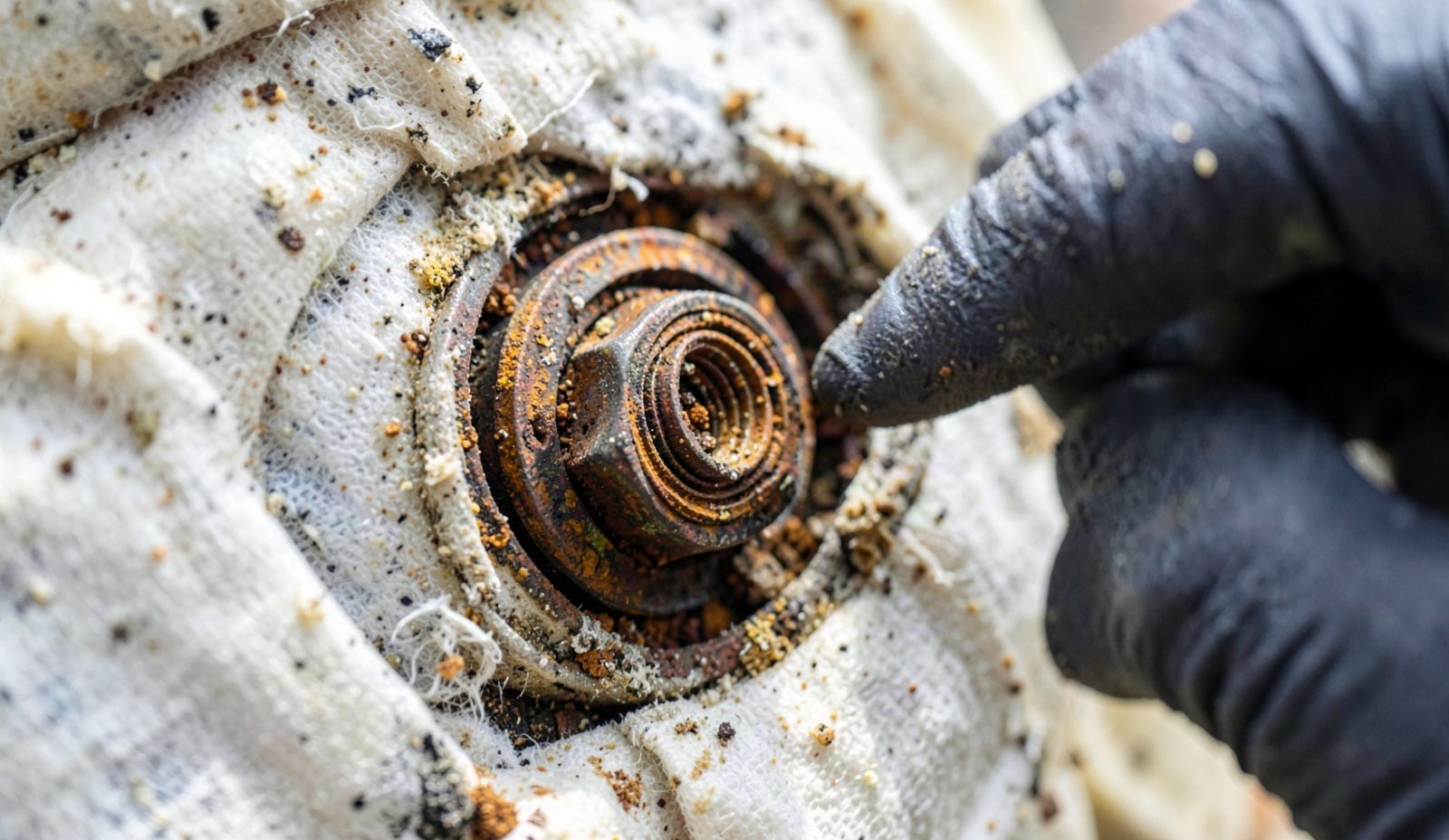
Every industrial pipe repair call starts with a pressure and material assessment before a wrench ever touches a fitting. Our industrial pipefitters check the pipe schedule and material stamped on the original mill certificate or as-built drawing, then run an ultrasonic thickness gauge across the suspect section. That reading gets compared against the pipe's nominal wall thickness, not a guess. A wall reading trending toward the structural minimum for that schedule calls for a section replacement, not another patch weld that will fail again in the same spot.
Material selection depends on what is actually flowing through the line. Schedule 40 carbon steel handles most compressed air and low-pressure water runs at a lower material cost, but it corrodes faster in humid, oxygen-rich environments than 316 stainless, which resists chloride attack and holds up in wash-down areas and caustic exposure. Schedule 80 PVC works for many drain and low-temperature process lines but degrades above roughly 140 degrees Fahrenheit of continuous exposure, which rules it out near boilers or steam traps. For a buried header that needs replacing without a full trench excavation, we compare cured-in-place pipe lining against pipe bursting. CIPP lining preserves the existing pipe as a host and cures a resin liner inside it, while pipe bursting fractures the old pipe outward and pulls a new one through, a better fit when the old line has collapsed rather than just corroded.
Joining method matters as much as the pipe itself. Victaulic-style grooved mechanical couplings let a maintenance team disassemble a section in minutes for future modification, while butt-weld fusion joints on carbon steel or stainless deliver a permanent, higher-pressure-rated joint that requires cutting out and re-welding for any change later. On any facility with a grease interceptor in the line, we check the log and the fill level with a dip stick before starting nearby work, because interceptors that go unpumped past the standard FOG-program threshold of 25 percent capacity push solids downstream and mask a real pipe problem as a slow drain. Fort Worth's water runs moderately hard, and a hardness test on a heat-traced or hot process line often shows scale buildup on fittings well before the pipe itself is due for replacement, a distinction that changes whether the fix is a descale or a full section swap.
Our page on frozen pipe thawing & repair covers that side of the work in more depth.
We install and service equipment from major manufacturers like Rheem to manufacturer specifications.
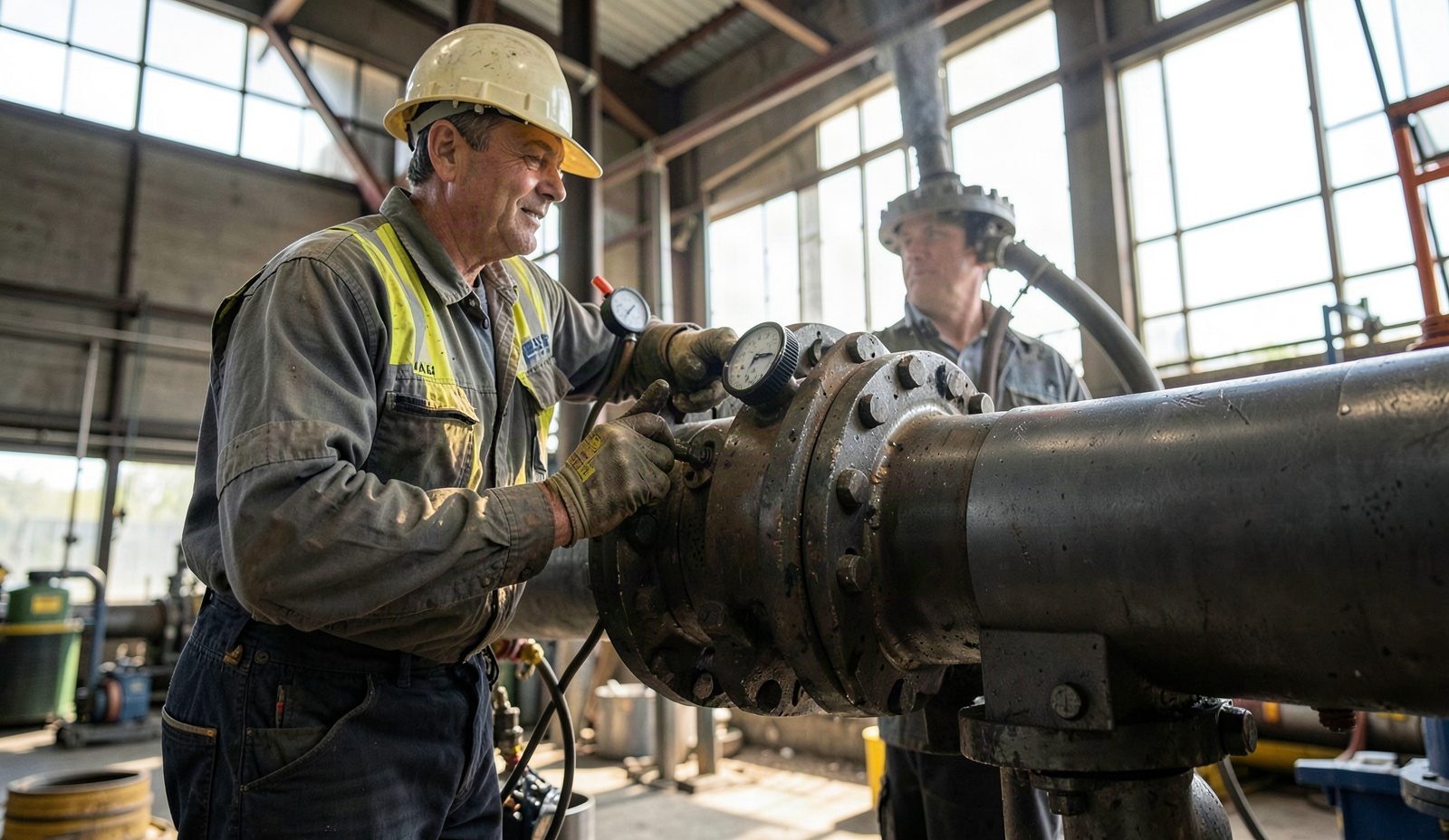
You describe the symptom, the flow loss or pressure drop, and the line's function when you call. On site, the technician walks the run, checks pressure gauges and any visible corrosion, and takes ultrasonic thickness readings at the suspect section. You see the actual reading compared against the pipe's rated wall thickness, not a verbal guess, and get a plain explanation of what failed and why before any tools come out.
Once you approve the written scope, the crew isolates the line, protects surrounding equipment and surfaces, and begins the repair using the material and joining method specified in the quote, whether that is a welded section replacement, a mechanical coupling swap, or a lining application. Any change in scope once the pipe is opened up, such as finding more corrosion than expected, gets confirmed with you before work continues.
Before the crew leaves, the repaired section gets pressure tested to confirm it holds at the line's operating pressure with no drop over the test period. The technician walks the repair with you, points out what was replaced, and leaves documentation of the materials and readings for your maintenance file. Any interceptor, drain, or fixture disturbed during the work gets checked for normal flow before the visit closes out.
Commercial process piping in Fort Worth falls under the 2021 International Plumbing Code as adopted by the City of Fort Worth for commercial occupancies, and that code governs pipe sizing, material approval, and backflow protection on any repair that touches a potable or process line tied into the building's main system. An out-of-area crew that has never pulled a permit here does not know which fittings the local plan reviewer will flag or how the inspection sequence runs on a multi-building site, and a rejected inspection stalls a repair far longer than the original leak would have.
Facilities built before 1970 across the metro were commonly plumbed with galvanized steel supply lines and cast iron drains, both now at or past the end of their service life. Galvanized pipe narrows internally as zinc coating flakes and mineral scale build up, cutting flow rate long before the pipe fails outright, and cast iron drains develop bottom-of-pipe corrosion that a camera inspection catches well before a collapse. A crew unfamiliar with these materials often misdiagnoses reduced flow as a clog and reaches for a drain snake instead of recognizing pipe degradation that needs a section replacement.
Hiring an operator with no local track record carries real risk beyond a bad repair. A technician who does not understand Fort Worth's freeze exposure will insulate a repaired line the same way he would in a milder climate, leaving it vulnerable to the next hard freeze. A crew unfamiliar with the local plan review process may skip a required permit application on a repair that qualifies as more than like-for-like, a decision that belongs to the City of Fort Worth Development Services Department, not the contractor. Working with a crew that already knows the local code cycle and the common failure patterns in this soil and this water reduces the number of callbacks and the number of surprises during an inspection.
If this sounds close but not quite your situation, apartment complex plumbing may be the better starting point.
Price-checking is smart: marketplaces like Thumbtack publish typical cost ranges you can hold any quote against, including ours.
Booking starts with a call to (817) 710-3766, where we ask about the process line, the flow rate you have lost, and any production windows you need to protect. Most industrial pipe repair visits get scheduled within a defined arrival window, not a vague half-day guess, so your maintenance lead can plan around the shutdown. If a prior job runs long or parts need sourcing for an unusual pipe schedule, we call ahead with a revised window instead of leaving your crew waiting on the floor.
Before any cutting or welding starts, we lay drop cloths and containment barriers around the work area to keep metal shavings, weld spatter, and pipe dope off equipment and product surfaces. Any cut sections of old pipe, insulation, or packaging get bagged and hauled off site rather than left in a bin near your production line. On sites with active hot work permits, we coordinate fire watch and ventilation with your safety officer before striking an arc near any flammable storage.
The estimate reflects pipe material and schedule, access difficulty (buried, overhead, or behind fixed equipment), the extent of corrosion or scale found once the section is exposed, and whether the repair qualifies as like-for-like or triggers a permit review. We write the scope and materials into a quote before any cutting begins, and we walk through it with whoever signs off on plant maintenance spending, so nothing gets billed that was not approved first.
Every technician goes through a background check before dispatch to a client facility, standard for anyone working unsupervised around production equipment. Techs complete ongoing training as the plumbing code cycle updates, covering changes to backflow prevention, venting, and material approvals that affect industrial work. New hires shadow a senior pipefitter on process piping repairs and complete supervised field evaluations before they run a solo call on a plant floor.
Cost depends on pipe material, access, and how much of the line is damaged, not a flat number. A short section repair on exposed Schedule 40 steel costs far less than a buried cast iron replacement requiring excavation. Get a specific figure by having a technician inspect the actual line, since online cost guides rarely account for local material and permit requirements. Call (817) 710-3766 to schedule an assessment for your facility's specific piping.
JB Weld can slow a small, low-pressure leak on a dry pipe for a short time, but it is not a permanent process piping fix. It does not bond reliably to a wet or pressurized surface, and it breaks down under sustained heat or chemical exposure common in industrial lines. Treat it as a stopgap to buy hours, not a substitute for a proper section repair or coupling replacement done by an industrial pipefitter.
Epoxy pipe repair cost depends on the pipe diameter, the length needing lining, and how much surface prep the corroded section requires, not a set rate per foot. A short spot repair costs far less than a full cured-in-place lining run through a buried header. A technician needs to see the pipe's condition and diameter before quoting the actual scope of an epoxy application.
Epoxy lining can fix a leaking pipe when the pipe wall still has enough structural integrity to support the liner, but it cannot fix a collapsed or severely corroded section. It works well for pinhole leaks and general wall thinning in an otherwise sound line. A pipe that has lost too much wall thickness needs a section replacement instead, which a thickness gauge reading confirms before any lining decision is made.
Industrial pipe repair cost in Fort Worth depends on pipe material, line pressure rating, access conditions, and whether the work qualifies as a permitted modification under the City of Fort Worth's adopted plumbing code. A rooftop or exposed line repair typically runs less than a buried header replacement requiring excavation and permit review. A written quote follows an on-site inspection, not a phone estimate, since scope changes once a section is opened.
Most single-section industrial pipe repairs take a few hours from isolation to pressure test sign-off, depending on access and material. A buried header replacement or a run requiring excavation and backfill can take a full day or longer. Facilities with tight production windows can request off-shift scheduling to limit downtime during the actual repair.
Industrial pipe repair on process lines is not a do-it-yourself project once pressure, chemical exposure, or code-regulated backflow protection is involved. A misjudged weld or an unpermitted modification on a line tied into the building's potable system creates a code violation and a safety risk that outweighs any savings. Facility staff can safely monitor gauges and report symptoms, but the repair itself belongs to a trained industrial pipefitter.
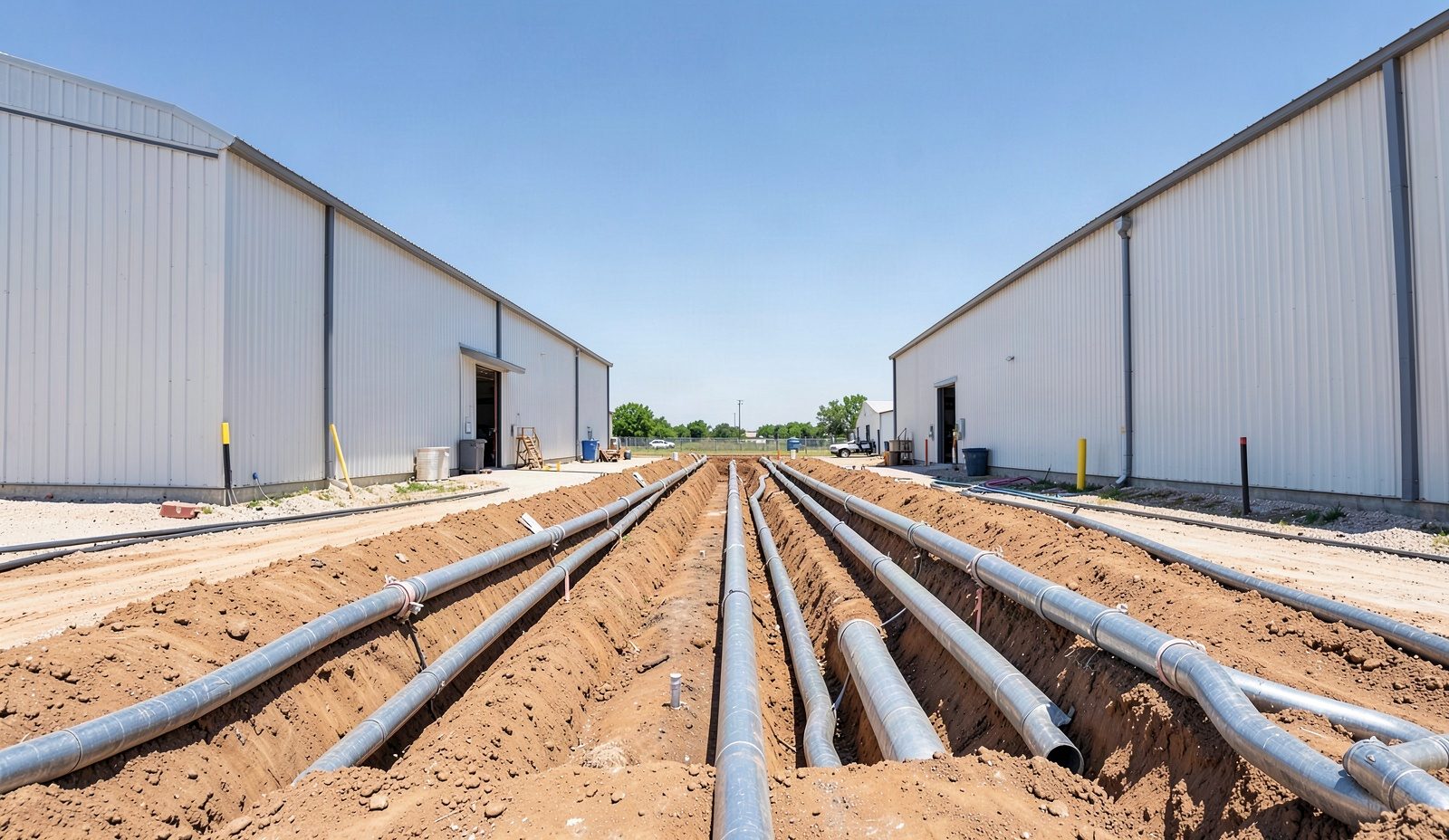
Buried process piping between buildings on a Fort Worth industrial site faces a different challenge than a single indoor run. Header trenches connecting production buildings near the Near Southside and Wedgwood areas cross the same expansive clay that moves seasonally across the metro, and a rigid buried joint without an expansion loop or flexible coupling eventually cracks under that repeated ground movement. Slab-on-grade warehouse construction, common across older Fort Worth industrial corridors, transmits that same soil movement straight into floor-mounted equipment connections. Planning a repair here means accounting for how the ground under the slab behaves across a full year, not just fixing the visible crack.
Any industrial pipe repair that goes beyond a like-for-like fitting swap, such as rerouting a line or replacing a section under a slab, needs a permit reviewed by the City of Fort Worth Development Services Department for Fort Worth addresses, or the local building department or Tarrant County for facilities outside city limits. Inspectors in this area expect to see backflow prevention devices tested and documented on any process line tied into potable water, a requirement that catches out crews unfamiliar with local cross-connection control rules. Facility managers near the Cultural District and Ridglea Hills who have worked with local pipefitters before know to ask for that documentation upfront, because it protects them during their own insurance and lender reviews.
Explore our service area and locate Shield Plumbing Fort Worth with ease. We're proudly local and serve the surrounding neighborhoods with fast response and honest pricing. Use the map to check our coverage area, or call us and we'll confirm in seconds.
Address:
Shield Plumbing Fort Worth, 210 W 7th St, Fort Worth, TX 76102
5 Signs Your Ridglea Hills Home Has a Slab Leak, practical local guidance from Shield Plumbing Fort Worth, Fort Worth's trusted plumbing tea…
Read More
What Wedgwood Residents Should Know Before a Whole-Home Repipe, practical local guidance from Shield Plumbing Fort Worth, Fort Worth's trust…
Read More
How Fort Worth's Hard Water Is Quietly Destroying Your Water Heater, practical local guidance from Shield Plumbing Fort Worth, Fort Worth's …
Read More
The Hidden Cost of Ignoring a Dripping Faucet in Fort Worth, practical local guidance from Shield Plumbing Fort Worth, Fort Worth's trusted …
Read More