

June 20, 2026
5 Signs Your Ridglea Hills Home Has a Slab Leak
5 Signs Your Ridglea Hills Home Has a Slab Leak, practical local guidance from Shield Plumbing Fort Worth, Fort Worth's trusted plumbing tea…
Read More




You shut off the kitchen faucet and the wall answers back with a sharp knock. Run the washing machine and a valve somewhere behind the drywall starts rattling pipes when water runs, a fast metallic clatter that stops the second the water does. That is classic water hammer noise, the shockwave from a column of water slamming to a stop against a closed valve. Some houses add a second symptom, a low hum that rises and falls with flow rate, usually humming water pipes caused by a loose strap or a partially closed valve vibrating against a stud.
Fort Worth sits on expansive clay that swells with rain and shrinks in drought. That movement is not cosmetic. It shifts the slab enough to shear copper supply lines and pull drain joints apart under the house, and a pipe that no longer sits square in its hanger vibrates and knocks every time pressure changes. Homes in Fairmount and Wedgwood, built on lots that have gone through decades of this wet-dry cycle, show it as pipes knocking in wall cavities near exterior walls where the slab edge moves the most.
The February 2021 freeze added a second failure pattern across Tarrant County. Supply lines run through attics and exterior walls burst by the tens of thousands that week, and many of the lines that did not burst still cracked their insulation or loosened their hanger straps as the copper contracted and expanded. Years later, those loosened straps are exactly what turns ordinary water flow into a knock you can hear from the next room, especially in older sections of the Near Southside where supply runs were never re-strapped after the freeze.
None of this quiets down on its own. A knock that shows up once a week under specific conditions becomes a knock every time a toilet fills. A hairline crack at a stressed solder joint becomes a pinhole leak inside a wall cavity you cannot see. Left long enough, a shifting drain joint separates fully, and what started as an annoying noise turns into a slab leak or a ceiling stain. The noise is the early warning. The repair gets more invasive the longer you wait past it.
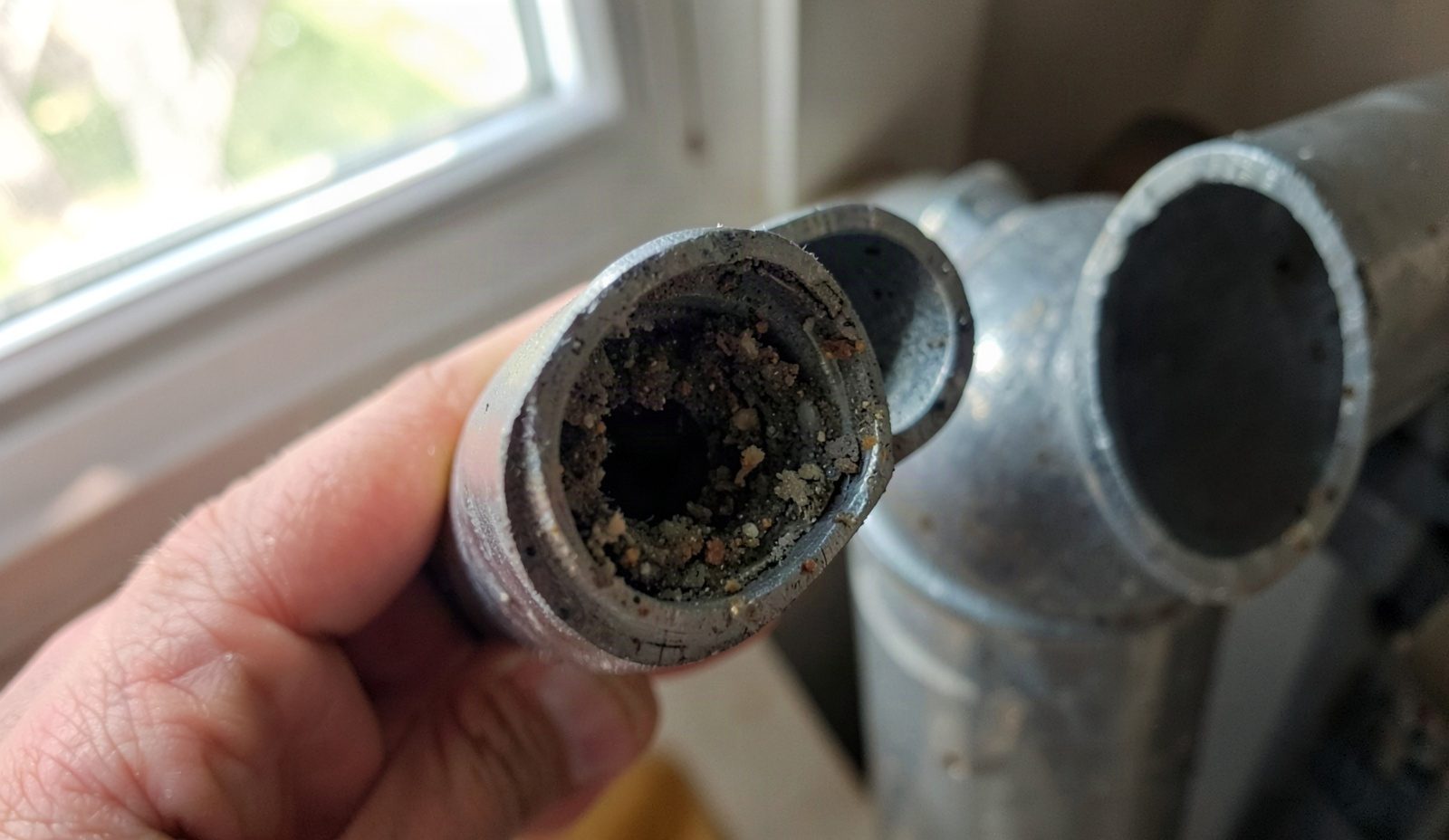
More detail on sediment buildup in pipes is on its own page.
Permit and inspection questions? Development Services is the office we coordinate with on every permitted Fort Worth job.
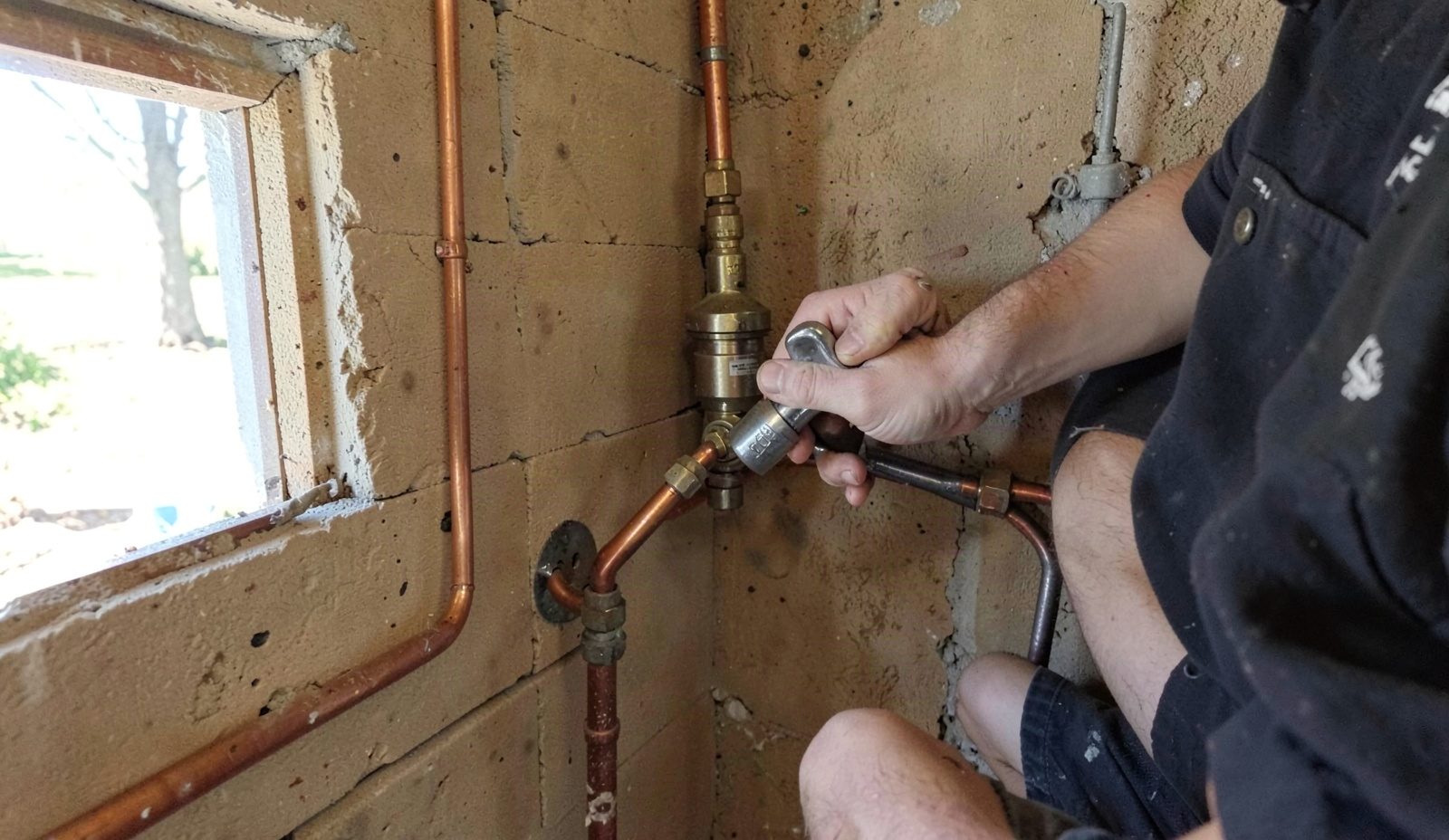
The first instrument on every noisy pipe call is a pressure gauge threaded onto an outdoor spigot, not a stethoscope on the wall. Static water pressure read at that hose bib tells us more in thirty seconds than an hour of guessing. Under the plumbing code, anything reading above 80 psi calls for a pressure-reducing valve, per Section 604.8 of the International Plumbing Code, and high static pressure is the single most common driver of both water hammer noise and the hum you hear when a fixture is running. A reading in the 90s or higher means the noise is a symptom of a system-wide pressure problem, not a bad valve.
Once pressure is ruled in or out, we isolate which fixture triggers the knock. Shutting a washing machine solenoid valve or a quick-close ice maker valve creates the sharpest hammer because those valves close in a fraction of a second, and a plumbing system with no air cushion anywhere near that valve has nowhere to absorb the shock. This is where the fix matters as much as the diagnosis. A mini-rester, the small air chamber some Fort Worth homes still have, works for a few months before the trapped air dissolves into the water and the knock comes back. A mechanical piston-style arrestor, the kind built by Sioux Chief or Watts and rated under the Plumbing and Drainage Institute's PDI-WH201 standard, uses a sealed piston instead of trapped air, and it holds that cushion for the working life of the pipe rather than a season.
For humming and rattling that tracks with flow rate rather than a single valve closing, we check strap spacing and pipe support along the run, because a copper line spanning more than the code-allowed distance between hangers flexes and buzzes against framing every time water moves through it. We also check for a partially closed gate valve, which throttles flow enough to create turbulence and a whine, versus a fully open ball valve that runs quiet. Matching the fix to the actual mechanism, pressure, valve timing, or unsupported pipe run, is what keeps a repair from becoming a repeat call six months later.
Our page on how to prevent frozen pipes covers that side of the work in more depth.
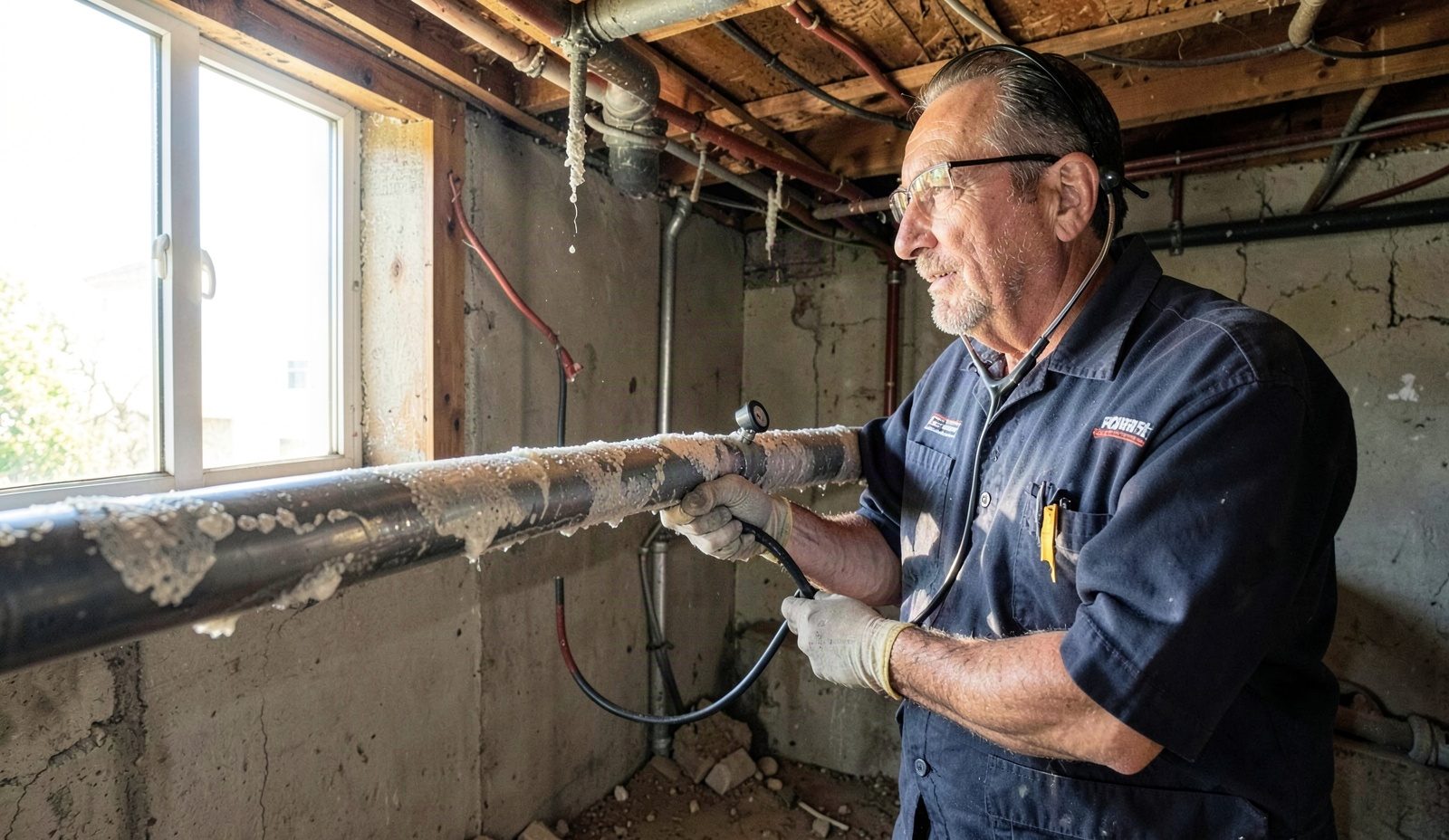
You describe the noise, when it happens, and which fixture seems to trigger it, and that narrows the visit before anyone arrives. On site, the technician reads static pressure at an outdoor spigot, runs each fixture to reproduce the sound, and checks strap spacing and pipe material at the nearest access point. You hear the reasoning in plain terms: what the gauge read, which valve triggered the knock, and whether the pipe itself is copper, PEX, or aging galvanized.
Once you approve the written quote, work starts with surface protection at every access point. Depending on the diagnosis, that means installing a mechanical water hammer arrestor near the triggering valve, adding a pressure-reducing valve if static pressure read high, or re-strapping an unsupported run at code-spaced intervals. If a wall has to open, you approve the cut location first. Nothing beyond the diagnosed scope happens without a separate conversation and a separate approval.
Before any tool is packed up, the technician reruns the same fixtures that triggered the original noise and rechecks pressure at the same outdoor spigot used for the diagnosis, confirming the reading now falls where it should. You walk the repair with the technician, hear the fixtures run quiet, and get a plain explanation of what was replaced or adjusted. Any opened wall section is documented with photos before it closes back up, useful if you ever need the record.
Fort Worth operates under its own plumbing code, based on the International Plumbing Code, and the requirements for pressure control, pipe support, and material substitution are not identical to the code in the next county over. A technician who works one week in Fort Worth and the next in a different jurisdiction is guessing at requirements he should know cold. Getting the pressure-reducing valve sizing wrong, or strapping copper at the wrong interval, does not just risk a failed inspection. It risks a repeat noise complaint from the exact repair you paid to fix.
Housing stock age changes the job as much as code does. Pre-1970 neighborhoods across the metro were plumbed with galvanized steel supply lines and cast iron drains, and both materials are now at or past the end of their rated service life. Galvanized pipe corrodes from the inside, narrowing the bore and raising water velocity through the remaining opening, which is exactly the condition that produces a whistle or a hum a newer copper or PEX system would not. Recognizing galvanized pipe by its threaded fittings and dull gray finish, rather than assuming every noisy line is a strapping problem, is the difference between a fifteen-minute fix and a repipe conversation.
Structural repair work, including replacing a section of supply line inside a wall or altering drain routing, typically requires a permit, while a minor like-for-like valve or strap repair often does not. The final call on which category a job falls into belongs to the permitting authority, not to whoever is holding the wrench. An out-of-area crew unfamiliar with that line risks leaving you responsible for unpermitted work discovered at resale, a liability a homeowner should never inherit from a five-minute noise complaint.
If this sounds close but not quite your situation, cold water sandwich effect may be the better starting point.
Booking starts with a phone call, not a form, and you get an arrival window measured in hours, not a vague morning-or-afternoon guess. If a prior job runs long, you get a call before your window starts, with an updated time, not a no-show. Noisy pipe calls get worked into the same-day schedule when the line is open, because a knock that is getting louder rarely waits politely for next Tuesday. You will know who is coming and roughly when before the technician ever pulls up.
Any access point, whether it is an attic hatch, a wall cavity, or a crawlspace entry, gets floor runners and drop cloths before a tool comes out. Drywall dust and old pipe insulation go into a sealed bag on site, not left in a pile for you to sweep up. If a section of wall has to open to reach a strap or a joint, the opening is cut clean and sized to the repair, not oversized for convenience. When the technician leaves, the work area looks like someone who respects the house was in it.
The estimate reflects what the pressure test and inspection find, not a flat rate that ignores your specific pipes. Access matters most: a strap fix in an open attic costs less labor than the same fix behind finished drywall in a Wedgwood bungalow. Material condition matters too, since a galvanized line often needs more than a spot repair once it is opened up. You get the written number before anything is cut or replaced, and nothing proceeds past diagnosis until you approve it.
Every technician passes a background check before being scheduled into a home. Training on the current plumbing code cycle happens on a recurring basis, not once at hiring, because code requirements and material standards change. New technicians shadow a lead on live jobs, including pressure testing and arrestor installation, before they are cleared to run a noisy pipes call alone. That field competence check happens on real houses, not in a classroom, so the first solo call is not the first time the tools have been in their hands.
A sudden change usually means something shifted, not that the pipe wore out gradually. A recently installed appliance with a fast-closing solenoid valve, a spike in municipal line pressure, or a slab movement event from a recent rain after a dry stretch can all turn a quiet system loud within days. Shield Plumbing Fort Worth checks static pressure and inspects the newest fixture on the line first, since sudden onset points to a recent change rather than years of gradual wear.
This falls under the city's general noise ordinance rather than a plumbing-specific rule, and the current hours are set by the City of Fort Worth, not by any plumbing code. Pipe noise itself is a mechanical issue inside your home, not a nuisance covered by that ordinance. If banging or humming is disturbing your household at any hour, that is a maintenance issue worth calling a plumber about regardless of what time it happens.
Yes, once the noise is consistent rather than a one-time fluke. A single bang after a long vacation when pipes were sitting full and cold is often nothing. A knock that repeats every time a specific fixture runs signals water hammer, high pressure, or an unsupported line, all of which get worse and more expensive to reach the longer they run unaddressed inside a wall or under the slab.
Noisy pipes come from one of a few mechanical causes: a valve closing fast enough to create a pressure shockwave, water pressure running above the level fixtures are built for, a pipe vibrating against loose framing, or internal scale narrowing the bore and speeding up flow. Fort Worth homes commonly show a mix of these, since older strapping loosens over time and mineral buildup accumulates on its own separate timeline.
Same-day service is available across Fort Worth and Tarrant County when the schedule has an open slot, which it often does for a diagnostic-first call like a noise complaint. Call (817) 710-3766 early in the day to get the best chance at a same-day window, since afternoon slots fill first on weekdays.
Some causes are DIY-fixable, others are not. Adding foam pipe insulation around an accessible, exposed line or tightening a loose strap you can see and reach are reasonable homeowner tasks. Diagnosing high system pressure, sizing a pressure-reducing valve, or opening a finished wall to reach a knocking line behind drywall calls for pressure-testing tools and code knowledge most homeowners do not have on hand.
Fort Worth water runs moderately hard, and the mineral scale it deposits does not stay confined to a water heater's heating element. That same scale builds up inside pipe walls over years, narrowing the interior bore just enough to raise water velocity through the restriction, which is a direct contributor to the hum some homeowners near Ridglea Hills and Arlington Heights notice building over several seasons rather than appearing overnight. On a slab-on-grade foundation, the kind found under most of the metro's mid-century construction, that narrowed, scaled line also has less room to flex, so any vibration transmits straight into the slab and the wall framing instead of dissipating. Material selection has to account for both realities, not just the noise complaint itself.
Structural plumbing work in Fort Worth, including repiping a wall section or relocating a drain line, falls under the review of the City of Fort Worth Development Services Department, which is the only office with authority to approve that scope inside city limits. A minor strap repair or arrestor installation usually does not trigger that review, but the department, not the technician, makes that determination on borderline jobs. Homes in the Cultural District and along the Near Southside corridor, many built before current spacing and support standards existed, come up against that determination more often than newer construction. A crew that knows which repairs clear that threshold and which do not keeps you out of a permitting problem discovered later, often at the worst possible time, a home sale.
Explore our service area and locate Shield Plumbing Fort Worth with ease. We're proudly local and serve the surrounding neighborhoods with fast response and honest pricing. Use the map to check our coverage area, or call us and we'll confirm in seconds.
Address:
Shield Plumbing Fort Worth, 210 W 7th St, Fort Worth, TX 76102
5 Signs Your Ridglea Hills Home Has a Slab Leak, practical local guidance from Shield Plumbing Fort Worth, Fort Worth's trusted plumbing tea…
Read More
What Wedgwood Residents Should Know Before a Whole-Home Repipe, practical local guidance from Shield Plumbing Fort Worth, Fort Worth's trust…
Read More
How Fort Worth's Hard Water Is Quietly Destroying Your Water Heater, practical local guidance from Shield Plumbing Fort Worth, Fort Worth's …
Read More
The Hidden Cost of Ignoring a Dripping Faucet in Fort Worth, practical local guidance from Shield Plumbing Fort Worth, Fort Worth's trusted …
Read More