

June 20, 2026
5 Signs Your Ridglea Hills Home Has a Slab Leak
5 Signs Your Ridglea Hills Home Has a Slab Leak, practical local guidance from Shield Plumbing Fort Worth, Fort Worth's trusted plumbing tea…
Read More




A sink that drains slowly rarely gets better on its own. Water sits in the bowl for ten or twenty seconds after you pull the stopper. In the shower, you notice it first at your ankles, water climbing instead of disappearing before you finish rinsing. A bathtub that won't drain at all, with standing water still there an hour later, means the blockage has moved past the trap and into the branch line. Add a gurgling sound when the toilet flushes nearby, or a faint sulfur smell rising from the drain, and you're looking at a system problem across more than one fixture.
A hair clogged drain is the most common reason a shower slows down. Hair wraps around the crossbar of the strainer and catches soap scum, forming a rope that thickens with every shower until the opening left is smaller than a pencil. On sinks, the same soap-and-grease film builds slower but reaches the same result, a sink drains slowly because the pipe's effective diameter has shrunk well before anything fully blocks it.
Fort Worth adds a cause most cities don't deal with at this scale. North Texas expansive clay swells with rain and shrinks in drought, and that movement shifts slab foundations enough to shear copper supply lines and pull drain joints apart under the house. In bungalow-era streets around Fairmount and Arlington Heights, that soil movement has been working on the same pipe joints for decades, and a joint that's shifted even a quarter inch changes the pipe's slope enough to leave standing water instead of a clean flow to the sewer main.
Fort Worth's moderately hard water adds mineral scale to the inside of pipe walls the same way it scales a water heater's heating element, and in homes built before 1970 that scale builds on top of decades of rust inside cast iron drain lines already near the end of their service life. Ignore the slow drain long enough and it stops being a slow drain: sewage backs up into the lowest fixture in the house, a cracked cast iron joint leaks under the slab, or a bathtub that won't drain at all during a shower leaves standing gray water on the floor. Each of those costs more time and disruption to fix than a slow drain fix handled early.
Our page on discolored or rusty water covers that side of the work in more depth.
Independent standards matter too, the EPA's WaterSense program sets the efficiency benchmarks we use when recommending replacement fixtures.
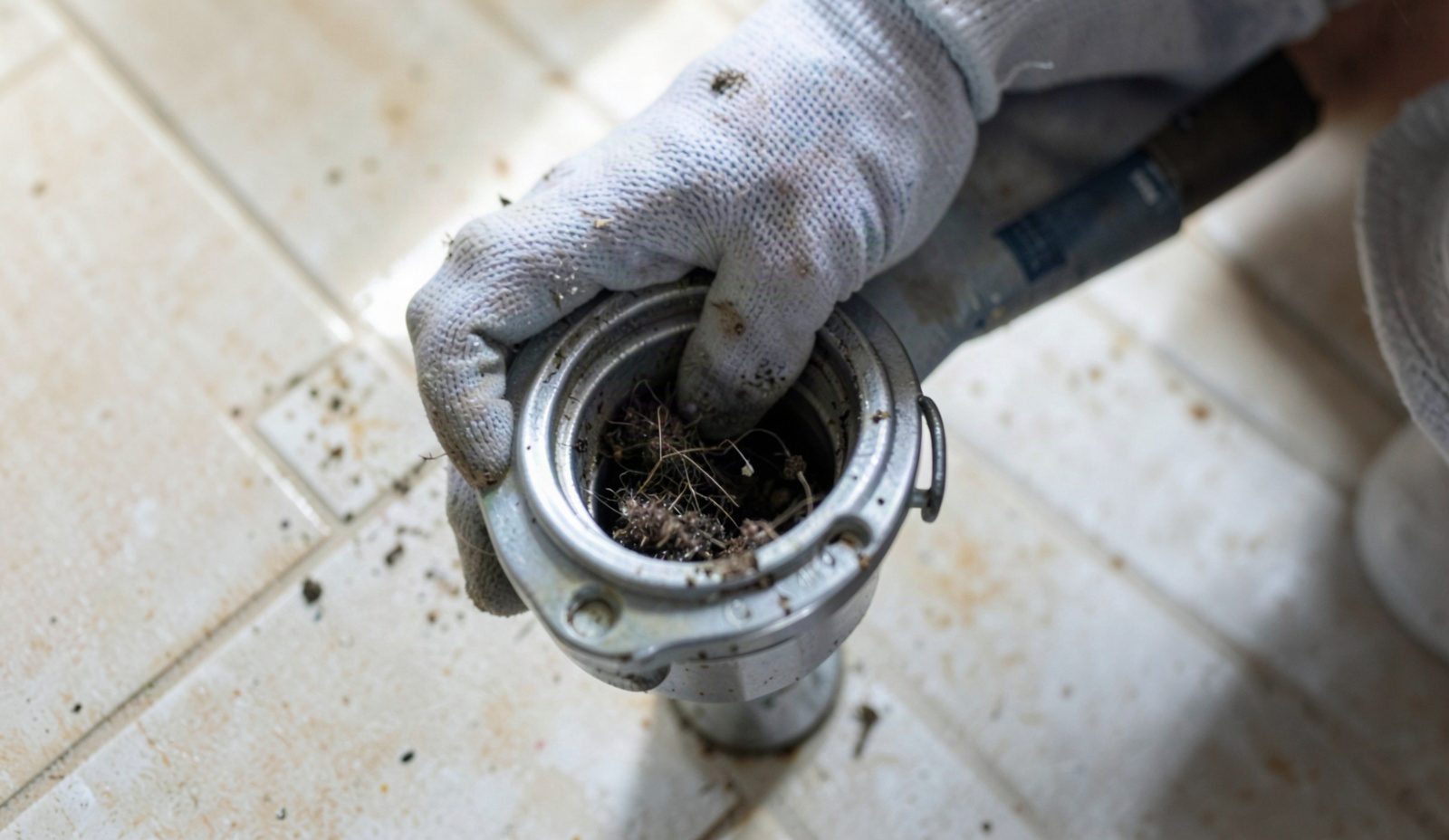
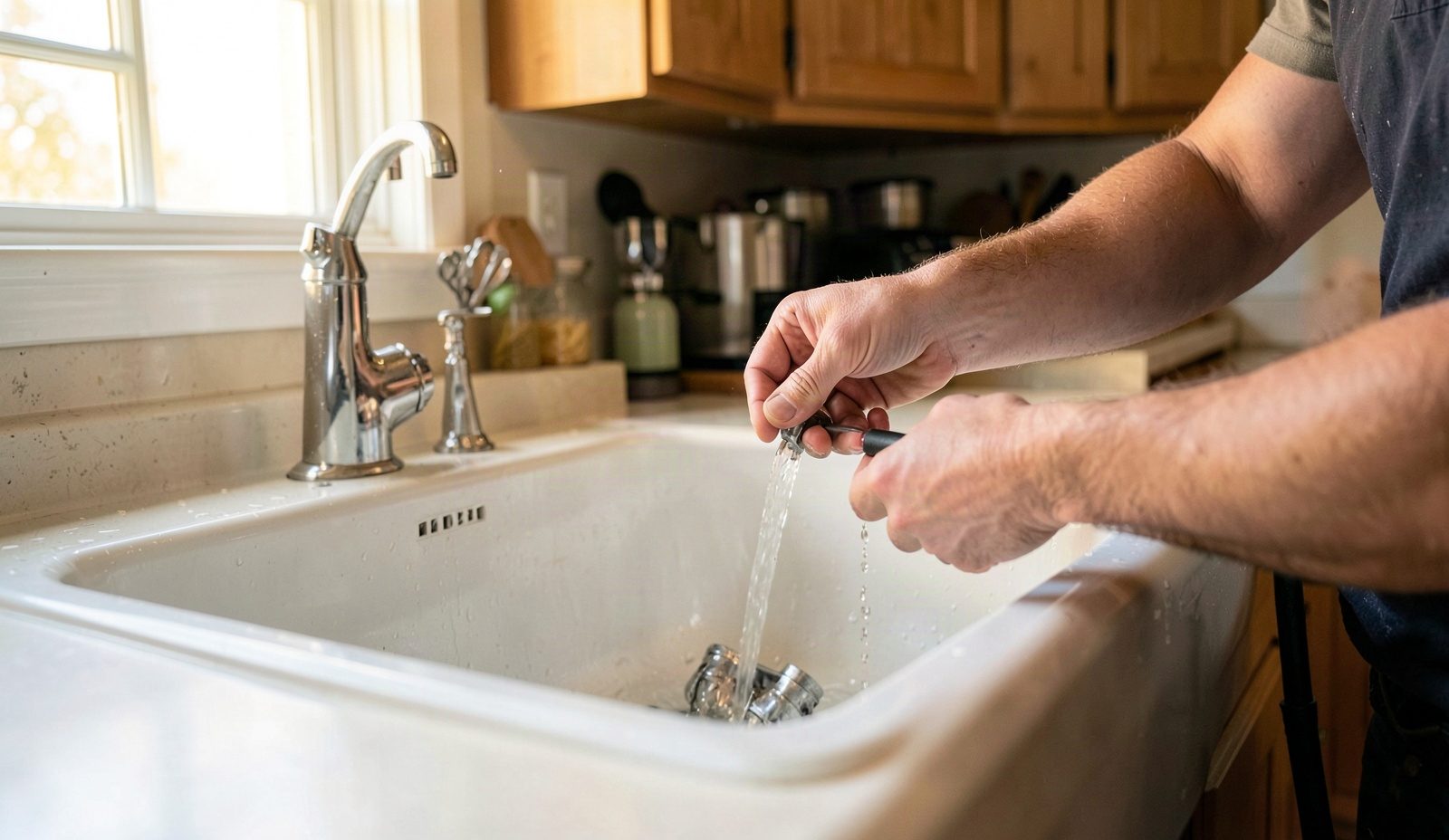
Every slow drain call starts with opening the trap, before any chemical gets poured down the line. We pull the P-trap under the sink or unscrew the shower strainer and look at what's actually inside with a flashlight and a mirror, because a hair mass looks different from a grease film and gets treated differently. If the trap is clear, the next step is a sewer camera, a fiber-optic lens on a push cable that runs down the 1.5 inch or 2 inch branch line and shows the pipe wall on a monitor in real time, whether it's PVC, cast iron, or older galvanized steel.
A cable machine with a spinning head clears a hair clog fast. It's the right tool for a single blocked trap or a branch line with a soft obstruction. It is the wrong tool for scale built up along the inside of an old cast iron line, because a cable head cuts a channel through the buildup and leaves the rest of the scale on the pipe wall, which slows again within months. Hydro-jetting, a hose that fires water at pressures up to 4,000 psi through a rotating nozzle, scours the full circumference of the pipe and strips scale and grease film back to bare pipe wall, which is why we reach for it on any line a camera shows coated more than about a quarter of its diameter.
We also read static water pressure at an outdoor spigot with a gauge on every service call, since a slow drain complaint sometimes hides a whole-house pressure problem that's stressing every joint in the system. Section 604.8 of the International Plumbing Code, adopted into the City of Fort Worth plumbing code, requires a pressure-reducing valve once static pressure at the fixture tops 80 psi. A house running that hot on pressure is a house where drain joints and supply connections fail faster, whether the immediate complaint is a slow shower drain or something else entirely.
If this sounds close but not quite your situation, dripping faucets & leaks may be the better starting point.
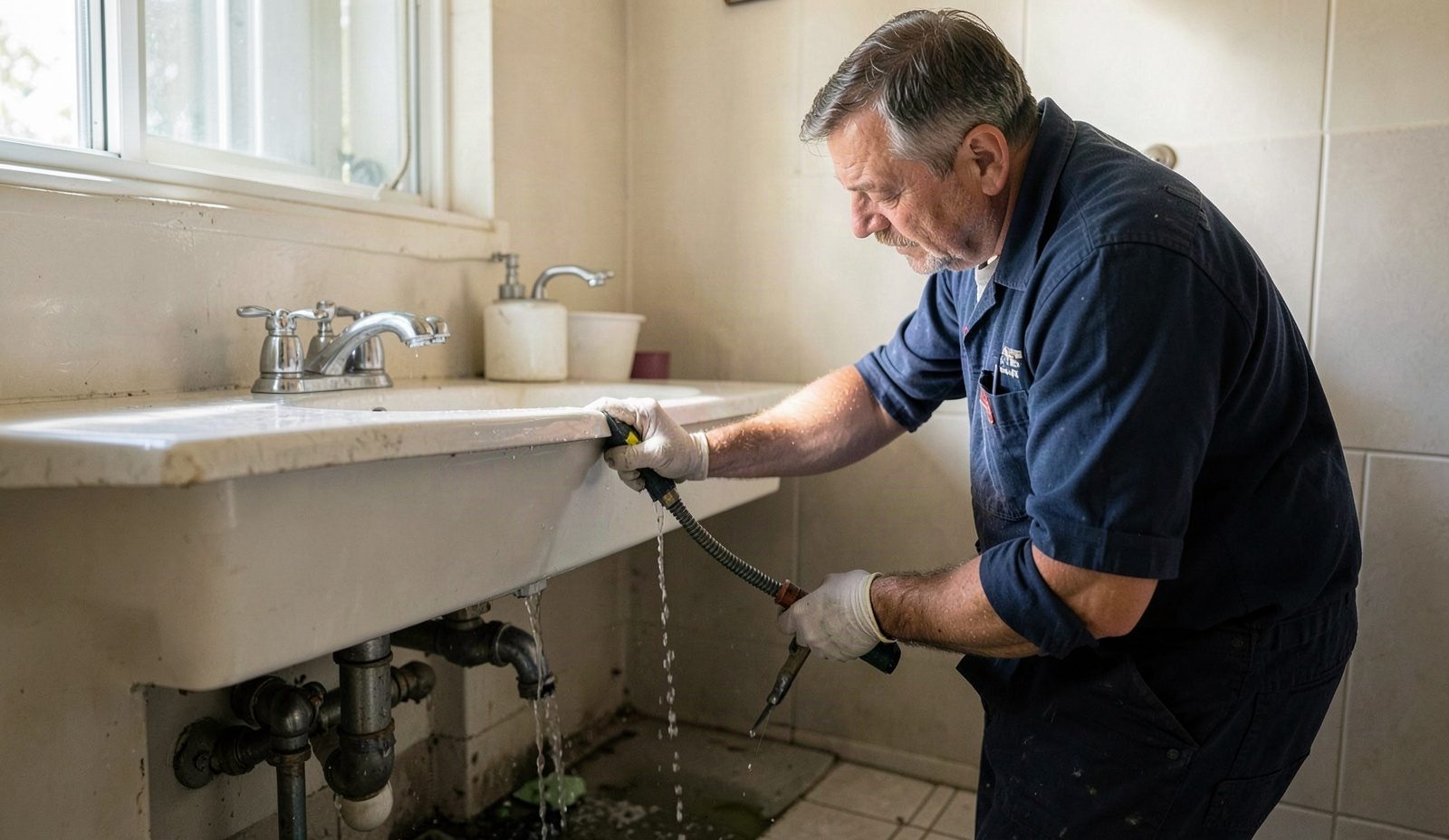
You call and describe what you're seeing, a sink drains slowly, a shower backing up, a tub that won't empty. We ask when it started and whether more than one fixture is affected, since that changes what we expect to find. On site, the technician opens the trap, checks the strainer for a hair clog, and runs a camera down the line if the trap is clear. You see the same monitor feed the technician does, showing the actual condition inside your own pipe.
Once the camera shows what's causing the slow drain, we write the scope and the price and get your approval before touching a tool to the pipe. Floors and cabinets around the work area get covered first. Depending on what the line needs, that's a cable machine for a hair clog, hydro-jetting for scale and grease buildup, or a trap and tailpiece replacement if the fitting has corroded through. Any decision beyond the original scope, like a section of pipe that needs cutting out, stops for your sign-off first.
Before we call the job finished, we run water through the fixture and time how fast it clears, then run the camera back through the line to confirm the pipe wall is genuinely clean, since a channel cut through debris can still flow for a few weeks before slowing again. We walk you through what the camera showed, what we did about it, and the condition of the rest of the line, especially if it's older cast iron or galvanized steel. You get that information plainly, in person, before we pack up the truck.
Drain work in Fort Worth runs inside a code framework built for this ground. The City of Fort Worth plumbing code, based on the International Plumbing Code, sets requirements for drain slope, vent sizing and cleanout placement that a crew unfamiliar with the metro can get wrong on a repair. A branch line repaired at the wrong slope drains slower than the clog it replaced, and that mistake doesn't show up until months later when the same complaint comes back.
The February 2021 freeze burst pipes across Tarrant County by the tens of thousands, and most of those failures were supply lines in attics and exterior walls, not drains. Crews who worked through that event learned the difference between a supply-side emergency and a drain-side complaint fast, and that same read carries over. Knowing whether a slow drain is a trap clog, a bellied line, or a symptom of a bigger foundation issue takes the kind of pattern recognition that comes from working this specific ground.
An out-of-area operator without local experience tends to default to chemical drain cleaner and a quick cable pass, a combination that can pit galvanized steel and pinhole a thin cast iron joint. Shield Plumbing Fort Worth crews check the pipe material before choosing a tool, because the fix that's safe for PVC can shorten the life of an older cast iron line. Call (817) 710-3766 to talk through what a camera inspection would show in your specific line before any tool touches the pipe.
More detail on cold water sandwich effect is on its own page.
Permit and inspection questions? Development Services is the office we coordinate with on every permitted Fort Worth job.
Call and we schedule a two hour arrival window for the same day or next, depending on when you call and what's already on the board. Dispatch calls or texts thirty minutes out so you're not waiting around all afternoon. If a prior job runs long, we tell you before your window starts, and we offer the next open slot the same day when one exists. Slow drain calls get triaged ahead of routine maintenance, since standing water in a shower or a bathtub that won't drain is a use-of-fixture problem, not something that waits comfortably for a week.
We lay down drop cloths from the door to the fixture and wear shoe covers inside the house. Any water pulled from a clogged trap or a jetting pass goes straight into a wet-vac before it can soak into subfloor or cabinet bottoms. Old pipe sections, corroded trap arms and scale debris go into a job bucket for haul-away, never left in a yard or a driveway. Before we leave, we wipe down the vanity, the tub surround and the floor around the work area, and the only sign we were there is a drain that empties the way it's supposed to.
The estimate depends on what the trap check and camera find. A single-fixture hair clog costs less time than a branch line coated in scale or a bellied section that needs excavation. Access matters too, a crawlspace cleanout is faster to reach than a slab penetration. We write the scope and the price before any cutting, drilling or jetting starts, and you approve that written quote before the technician moves past the diagnostic stage. If the camera finds something beyond the original call, like root intrusion further down the line, we stop and explain it before adding it to the job.
Every technician passes a background check before being dispatched into a customer's home alone. Ongoing training covers the current plumbing code cycle adopted in Fort Worth, including drain slope and venting requirements alongside tool handling. New techs ride alongside a senior plumber on drain calls until they can read a sewer camera feed correctly, choose between a cable machine and a jetter without guidance, and diagnose a slow drain's root cause on their own. That competency check happens before they carry a truck and a schedule on their own.
Slow drainage without a visible clog usually means a partial obstruction farther down the line, often at a blocked vent or a narrowing point past the trap. A clogged vent stack creates negative pressure that pulls water down slower than gravity alone would, and it often shows up as a gurgle right before the sink finally empties. Grease film narrowing the pipe past the trap causes the same symptom. A camera run past the trap, not another bottle of drain cleaner, is what actually finds it.
The fix depends on where the slowdown starts, and clearing both fixtures correctly means finding that point first. If the shower and a nearby sink slow down together, the shared branch line is usually the cause, and clearing each trap separately won't fix it since the real obstruction sits downstream of both. A cable machine handles a soft clog quickly, while hydro-jetting clears scale that's narrowed the shared line over years.
A shower drain slows down most often because hair wraps around the strainer crossbar and traps soap scum until the opening narrows to less than a pencil's width. Standing water reaching ankle depth within a couple of minutes of turning off the water usually points past the strainer to the trap itself. A gurgling sound as the water finally drains means air is forcing its way past a nearly full trap. Pulling the strainer and checking by flashlight shows which stage you're dealing with.
Removing the strainer and pulling out the hair mass by hand or with a plastic hook tool clears the first and most common obstruction. Avoid pouring chemical drain cleaner down an older cast iron or galvanized line, since the same chemical that dissolves hair can pit the metal underneath. If pulling hair doesn't restore normal flow within a day, the blockage sits farther down and needs a cable machine or camera look.
Clearing a single hair-clogged drain typically takes under an hour once a technician is on site. A full branch line diagnosis with a sewer camera and hydro-jetting runs longer, often two to three hours, especially if the line needs to be accessed through a crawlspace cleanout. A bellied or cracked line found during the camera inspection changes the timeline further, since that shifts the job from clearing to repair. The technician gives you a time estimate after the camera pass.
Clearing a simple hair clog yourself is realistic with a plastic hook tool or a hand auger fed a few feet down the drain. Chemical drain cleaner is riskier than it looks: it can pit older galvanized pipe and cast iron drains without necessarily clearing the obstruction causing the slowdown, and it does nothing for a bellied line. If the fixture is still slow after removing visible hair, the problem sits farther down and needs a camera to find.
A good plumber runs a camera before recommending a repair, rather than guessing from symptoms alone over the phone. Ask whether they check pipe material before choosing a tool, since cast iron, galvanized steel and PVC each respond differently to a cable machine or a chemical cleaner. A written scope and price before work starts is a fair test of any Fort Worth plumber you're considering. Local experience with the metro's older housing stock and soil movement issues matters here.
Slow drains in Fort Worth aren't only a hair-and-soap problem. Decades of soil settling under slab foundations cause branch lines to sag, or belly, in the middle, creating a low spot where water and waste sit instead of flowing to the cleanout. That's common under homes in Wedgwood and Ridglea Hills, built in the decades when slab specifications and pipe bedding practices were less exacting than they are now. Warm, humid North Texas summers also speed up biofilm growth inside shower drains, the slick bacterial layer that thickens a hair clog into something closer to a solid mass within weeks. A repair plan here has to account for pipe material, slope history and soil behavior together instead of clearing whatever blocks the line today, because a cable pass that ignores a bellied section only buys a few months before the same call comes back.
Any full drain line replacement or relocation in Fort Worth goes through the City of Fort Worth Development Services Department, which reviews the scope and inspects the finished work before it's covered back up. A simple cleanout snake-through or trap swap typically doesn't need that review, but cutting into a slab or rerouting a branch line does, and the permit record protects you if the same line causes trouble again later. That oversight matters more in dense, older sections like the Near Southside and the Cultural District, where duplexes and converted buildings often share drain stacks and where an inspector needs to confirm a repair doesn't affect a neighboring unit's line. Working inside that process is what keeps a drain repair from becoming a dispute with a downstream neighbor or a problem at resale.
Explore our service area and locate Shield Plumbing Fort Worth with ease. We're proudly local and serve the surrounding neighborhoods with fast response and honest pricing. Use the map to check our coverage area, or call us and we'll confirm in seconds.
Address:
Shield Plumbing Fort Worth, 210 W 7th St, Fort Worth, TX 76102
5 Signs Your Ridglea Hills Home Has a Slab Leak, practical local guidance from Shield Plumbing Fort Worth, Fort Worth's trusted plumbing tea…
Read More
What Wedgwood Residents Should Know Before a Whole-Home Repipe, practical local guidance from Shield Plumbing Fort Worth, Fort Worth's trust…
Read More
How Fort Worth's Hard Water Is Quietly Destroying Your Water Heater, practical local guidance from Shield Plumbing Fort Worth, Fort Worth's …
Read More
The Hidden Cost of Ignoring a Dripping Faucet in Fort Worth, practical local guidance from Shield Plumbing Fort Worth, Fort Worth's trusted …
Read More