
June 20, 2026
5 Signs Your Ridglea Hills Home Has a Slab Leak
5 Signs Your Ridglea Hills Home Has a Slab Leak, practical local guidance from Shield Plumbing Fort Worth, Fort Worth's trusted plumbing tea…
Read More




No hot water in the house rarely happens without warning signs first. The water runs lukewarm for a few seconds, then turns cold mid-shower. Hot water ran out faster than it used to, sometimes in under five minutes for a tank that used to last twenty. You might hear a low rumble or popping from the tank, a sign sediment is baking onto the bottom of the vessel and blocking heat transfer to the water above it.
A water heater not heating at all points to a handful of specific failures. On electric units, a tripped high-limit switch or a burned-out lower element cuts heat production entirely, even though the tank still fills and drains fine. On gas units, a pilot light keeps going out for one of three reasons: a weak thermocouple, a draft pulling flame off the burner, or a clogged pilot orifice starving it of gas. Water not getting hot even with the burner lit often means the dip tube inside the tank has cracked, letting cold water mix straight into the hot outlet before it ever heats.
Fort Worth adds its own layer to these failures. North Texas expansive clay swells with rain and shrinks in drought, moving slab foundations enough to shear copper supply lines and separate drain joints under the house, a movement that can starve a water heater of incoming pressure or cause it to draw air. In older sections of Fairmount and Wedgwood, many homes still run galvanized steel supply lines installed before 1970, and decades of internal rust buildup narrow the pipe diameter enough to choke flow into the water heater long before the unit itself fails.
Ignoring the problem does not stabilize it. A dip tube that keeps failing lets more cold water bypass the tank, which the thermostat compensates for by running the burner or elements longer, accelerating wear on both. A cracked thermocouple left unrepaired eventually shuts the gas valve down completely, leaving the house with zero hot water instead of a slow decline. And a slab-shifted supply line that keeps working loose under stress does not reseal itself. It eventually opens into a full leak under the house, often discovered only after the ceiling below stains or the water bill spikes.
Our page on high water bills covers that side of the work in more depth.
Our technicians follow the workmanship standards promoted by the Plumbing-Heating-Cooling Contractors Association.
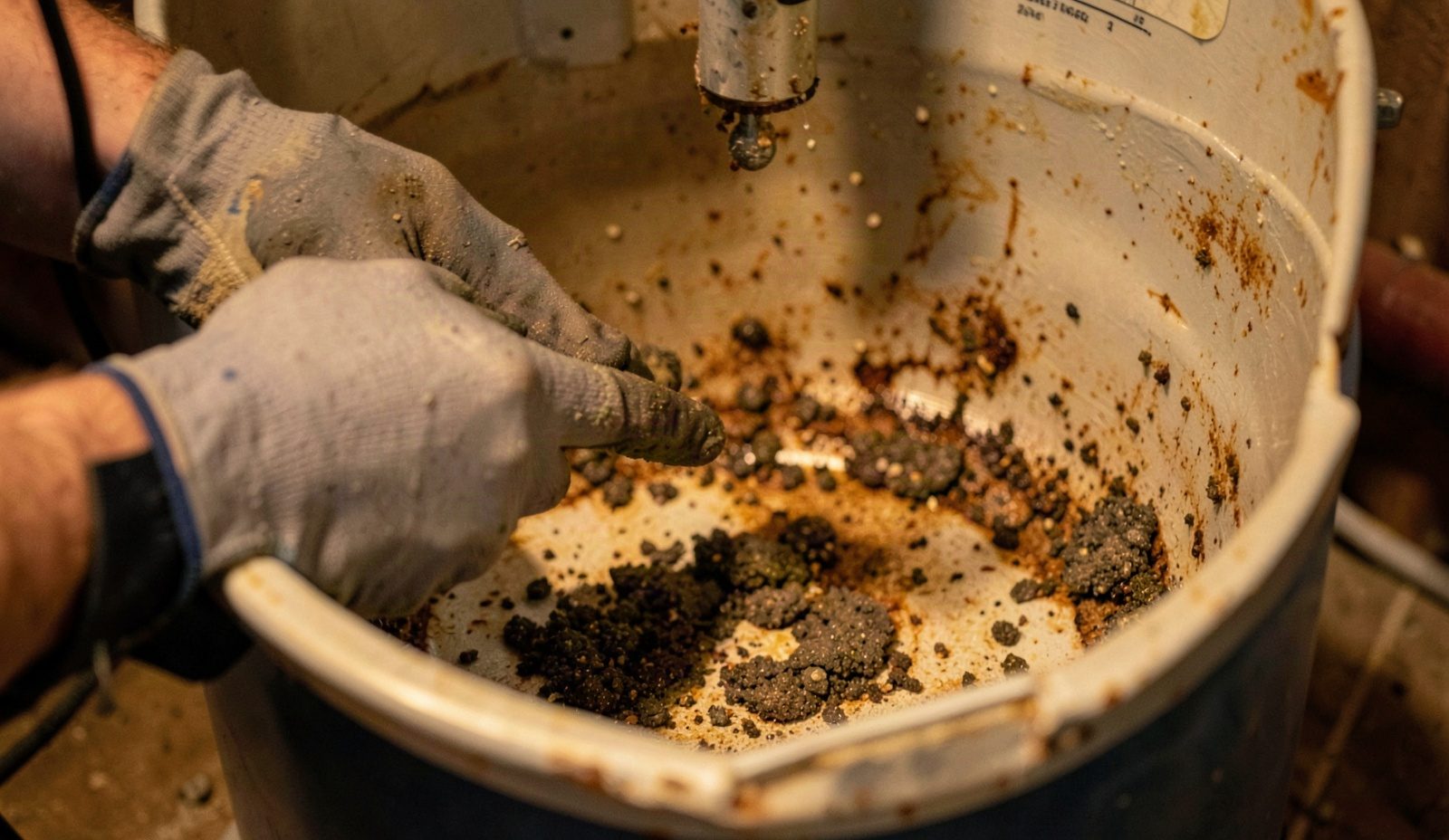
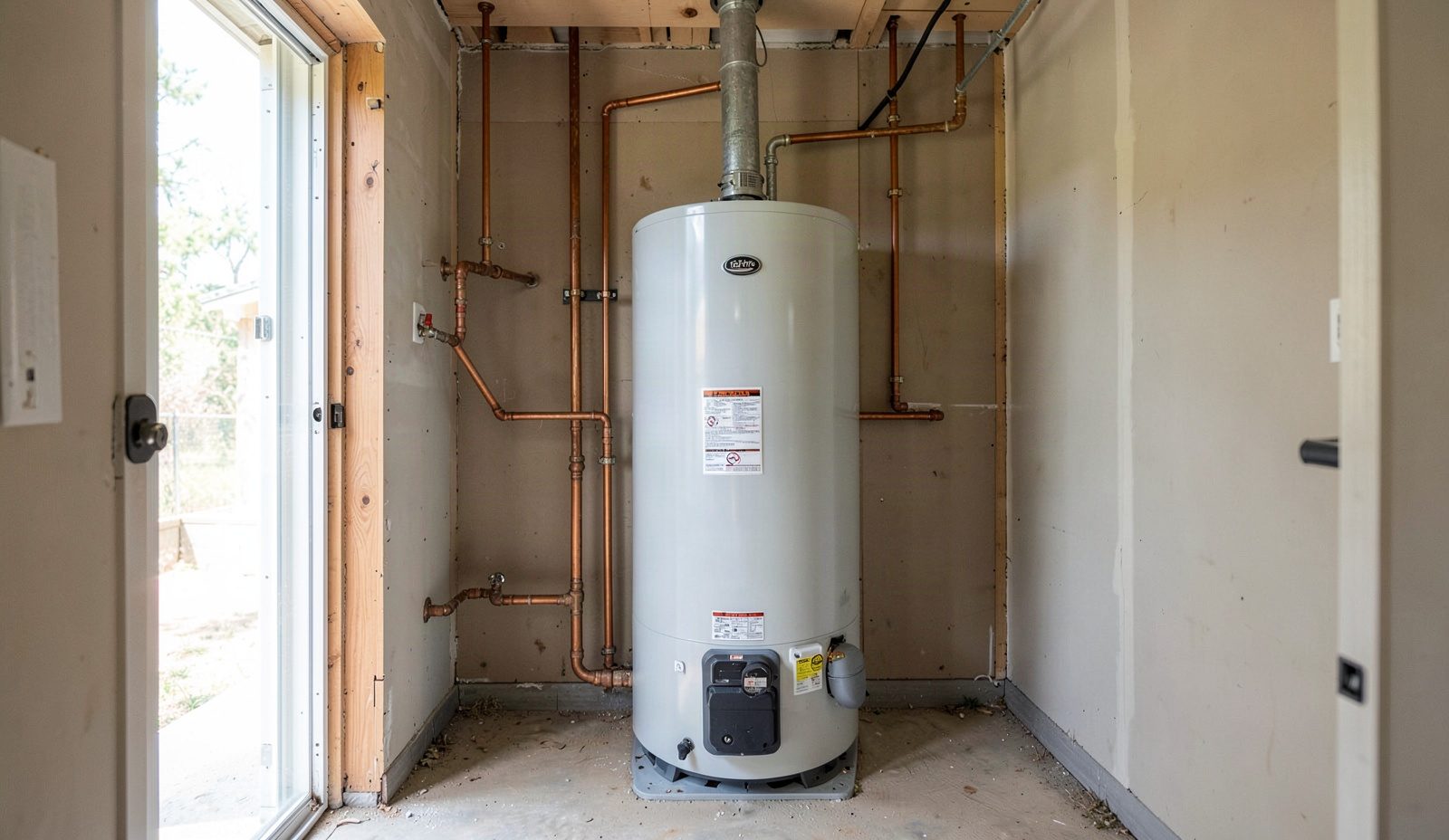
Every no hot water diagnosis starts the same way, ruling out the simple before chasing the complex. The technician confirms power at the breaker or gas at the shutoff valve, checks the thermostat set point against a target of 120 to 125 degrees Fahrenheit, and inspects the tank exterior for rust weeping or moisture at the base. Fort Worth water is moderately hard, and the scale it leaves on heating elements is checked next by pulling the lower access panel and looking for a chalky white crust coating the element, the leading reason local tanks fail years before their rated life.
From there the test gets instrumented. A multimeter across a suspect electric element should read within the manufacturer's resistance range, typically 10 to 16 ohms for a standard 4500 watt element, and anything reading infinite resistance means the element is open and dead. On gas units, a millivolt meter clipped to the thermocouple should read above 25 millivolts with the pilot lit. A reading below that number means the flame is not generating enough current to hold the gas valve open, which is why the pilot light keeps going out every time it is released. A pressure gauge threaded onto an outdoor spigot rounds out the sequence, and a reading above 80 psi flags a pressure problem that stresses the tank and its fittings regardless of what else is wrong.
When the tank itself is the failure point, the repair-versus-replace call comes down to real numbers, not guesswork. A Rheem Professional Classic tank recovers roughly 40 to 50 gallons per hour depending on input size, while an AO Smith Signature Premier in the same class runs a comparable recovery rate with a different anode configuration built for hard water areas like this one. For households considering a switch to tankless, a Rinnai RUC98 delivers about 9.8 gallons per minute at a 70 degree rise, while a Navien NPE-240A runs closer to 9.5 gallons per minute with a wider modulating range, a difference that matters for a house running two showers and a washing machine at once.
See cold water sandwich effect for how the related work is scoped and priced.
Permit and inspection questions? Development Services is the office we coordinate with on every permitted Fort Worth job.
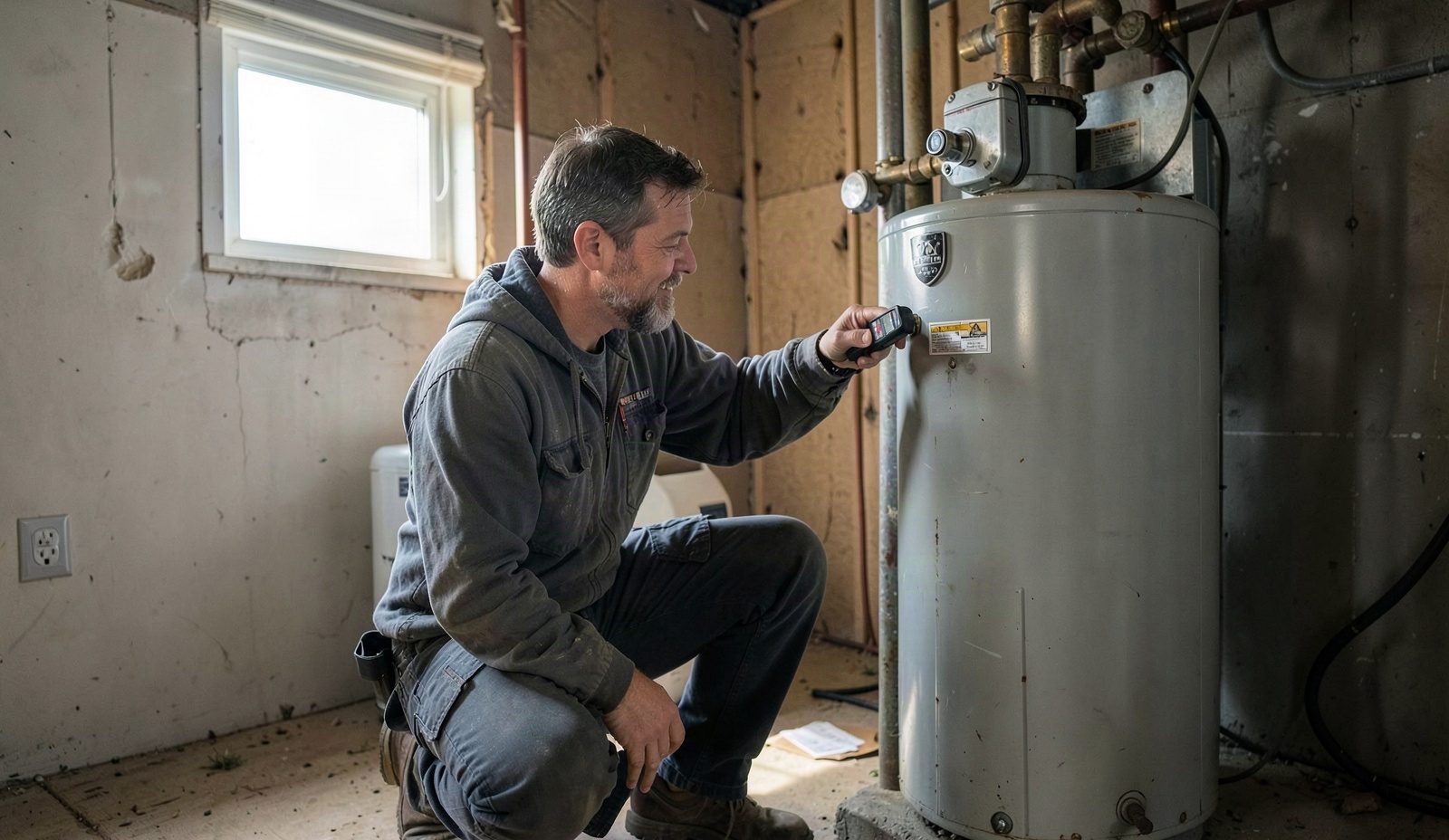
The visit starts with the call to (817) 710-3766, where dispatch asks what you have noticed, cold water only, a pilot that will not stay lit, or water that runs out fast, so the technician arrives with the right parts on the truck. On site, the technician checks the breaker panel or gas shutoff, reads the thermostat set point, and inspects the tank base and fittings for moisture. For gas units, the technician watches the pilot light through a full lighting cycle. You see the technician working around the unit itself first, before any tools come out, confirming what fails and what still works.
Once the failure point is confirmed, the technician writes up the repair, whether that is a heating element, thermocouple, gas control valve, or a full tank swap, and walks through it with you before touching anything further. Floor protection goes down, the water supply is isolated at the union or shutoff, and the tank drains through a hose routed to a floor drain or outside. If the supply line itself is compromised from foundation movement, the technician cuts back to sound copper or transitions to PEX before reconnecting, rather than patching a line under continued stress.
Before closing anything up, the technician restores power or gas, relights the pilot if applicable, and times how long it takes the tank to reach a stable output temperature at the nearest fixture. A second check at the farthest fixture in the house confirms the hot water is actually reaching every tap, not just the one closest to the heater. The technician reviews the readings with you, points out anything worth watching, such as a valve nearing the end of its life, and leaves the area clear of tools and packaging before heading out.
Fort Worth plumbing work falls under the City of Fort Worth plumbing code, based on the International Plumbing Code, and pressure-related repairs are not optional add-ons under that code. Section 604.8 of the International Plumbing Code requires a pressure-reducing valve once static pressure exceeds the code's set threshold, and a technician who skips that step on a water heater replacement leaves the homeowner with equipment that fails inspection if the city ever checks it.
Housing stock shapes the job as much as code does. Bungalows in Arlington Heights and other early-1900s sections of the city often have a water heater closet added decades after original construction, with venting and gas lines run to fit the space rather than the appliance. A technician unfamiliar with these retrofits can misread a draft problem as a bad thermocouple, replacing a working part while the real issue, a blocked or undersized vent, keeps starving the pilot of air.
An out-of-area operator without local calibration risks two things: missing a code-required upgrade like a pressure-reducing valve or expansion tank, and misjudging how local soil movement or old piping factors into a diagnosis. A technician who works Fort Worth homes regularly reads these patterns the way a longtime resident reads the weather, and that pattern recognition is what keeps a first repair from missing the actual cause.
More detail on discolored or rusty water is on its own page.
The U.S. Department of Energy's water heating guide is a solid primer on operating costs if you want to dig into the numbers yourself.
Calling (817) 710-3766 gets you a scheduled arrival window, not a vague all-day wait. Most no hot water calls in the Fort Worth area get a same-day or next-morning slot with a two-hour window, and the technician calls or texts thirty minutes out. If a prior job runs long, the office calls to reset the window before it passes, rather than leaving you checking the clock. Emergency situations, like a leaking tank actively flooding a closet, move to the front of the schedule the same day.
The technician lays down a floor runner from the entry to the water heater location before touching a tool, and a drain pan or wet-vac catches any water released during element or tank removal. Old parts, scale deposits, and packaging go straight into a haul-away bag, not the curb. On attic units, plywood walk boards protect the ceiling drywall below from foot traffic. When the job wraps, the work area looks the way it did before the visit, minus the problem that brought the technician there.
Scope, access, and the condition of existing lines set the price, not a flat number quoted over the phone. A tank swapped in an easy-access closet costs less to diagnose and repair than a unit crammed into a low attic requiring extra time and safety gear. Corroded shutoff valves, undersized gas lines, or a missing expansion tank required by current code add to the scope. The technician writes every line item down before starting so you approve the actual work, not an estimate that changes after the fact.
Every technician passes a background check before working in a customer's home, standard for anyone entering Fort Worth properties unsupervised. New hires spend a training period paired with a senior technician, running real diagnostic calls under direct observation before taking calls alone. Ongoing training covers updates to the locally adopted plumbing code as they roll out, so a technician recommending a pressure-reducing valve or expansion tank is applying the current standard, not a rule learned years ago and never revisited.
A no hot water diagnosis usually takes 30 to 60 minutes on site. Tank units are faster to check since the likely failure points, elements, thermocouple, dip tube, are all accessible from outside the tank. Tankless units take longer because the technician has to pull an error code from the remote controller and check the flow sensor and heat exchanger, adding another 20 to 30 minutes. Attic installations add setup time for safety gear before any testing starts.
No, the diagnostic visit itself does not require a permit. Replacing the water heater is a different matter and typically does require a permit and a follow-up inspection, a threshold the city's building department sets based on the scope of work, not the diagnosis stage. A repair that swaps a single part on the existing unit, like an element or thermocouple, generally falls under routine maintenance rather than permitted work.
Cost depends on the type of water heater, how accessible it is, and how many tests the failure requires to isolate. A tank unit in an easy-access closet with an obvious failed part costs less to diagnose than a tankless unit in an attic needing a full combustion and flow analysis. Call Shield Plumbing Fort Worth at (817) 710-3766 for a straight answer on your specific setup before any work starts.
Some causes are DIY-friendly, but most are not. Cleaning a clogged aerator or showerhead with vinegar solves a single-fixture problem in minutes, and anyone can check whether the main shutoff valve is fully open. Diagnosing a failing pressure-reducing valve, a slab leak, or corroded galvanized pipe requires a gauge reading and often cutting into a wall or foundation, which is where a homeowner attempt usually causes more damage than it fixes.
Cost depends on pipe material, line length, number of access points, and whether the fix is a chemical treatment or mechanical clearing. A single-fixture enzyme treatment costs less than a whole-house cable run or jetting job on a main line under a slab. Call (817) 710-3766 and a technician can walk through what typically drives the price for your specific drain before scheduling a camera inspection.
A sudden change usually means something shifted, not that the pipe wore out gradually. A recently installed appliance with a fast-closing solenoid valve, a spike in municipal line pressure, or a slab movement event from a recent rain after a dry stretch can all turn a quiet system loud within days. Shield Plumbing Fort Worth checks static pressure and inspects the newest fixture on the line first, since sudden onset points to a recent change rather than years of gradual wear.
Fort Worth sits on expansive clay across most of Tarrant County, and that soil does not stay still through a normal year. The February 2021 freeze burst pipes across Tarrant County by the tens of thousands, and most of those failures were supply lines run through attics and exterior walls, exactly where a water heater's cold-water feed often runs on its way in from the street. Homes near the Near Southside and the Cultural District mix century-old construction with recent infill, so a technician working one block might find copper reworked decades ago and the next find original iron pipe still in service. That range means no two no hot water calls in this city get treated with the same assumptions about what is behind the wall or under the slab, and a technician has to confirm pipe material and routing before deciding how to fix what is actually there.
Replacing a water heater outright in Fort Worth typically requires a permit reviewed by the City of Fort Worth Development Services Department, since the work touches gas or electrical connections and a venting system the city has an interest in inspecting. A straightforward repair, swapping an element or a thermocouple on the same appliance, usually does not rise to that level. Homeowners in older neighborhoods sometimes assume a past renovation already brought the plumbing up to current standards, but a permit pulled decades ago for a kitchen remodel says nothing about whether the water heater venting or the pressure regulation on the line meets today's requirements. A technician who checks local permit history and current code side by side, rather than assuming either one, is the difference between a repair that passes a future inspection and one that gets flagged the next time the city looks at the property.
Explore our service area and locate Shield Plumbing Fort Worth with ease. We're proudly local and serve the surrounding neighborhoods with fast response and honest pricing. Use the map to check our coverage area, or call us and we'll confirm in seconds.
Address:
Shield Plumbing Fort Worth, 210 W 7th St, Fort Worth, TX 76102
5 Signs Your Ridglea Hills Home Has a Slab Leak, practical local guidance from Shield Plumbing Fort Worth, Fort Worth's trusted plumbing tea…
Read More
What Wedgwood Residents Should Know Before a Whole-Home Repipe, practical local guidance from Shield Plumbing Fort Worth, Fort Worth's trust…
Read More
How Fort Worth's Hard Water Is Quietly Destroying Your Water Heater, practical local guidance from Shield Plumbing Fort Worth, Fort Worth's …
Read More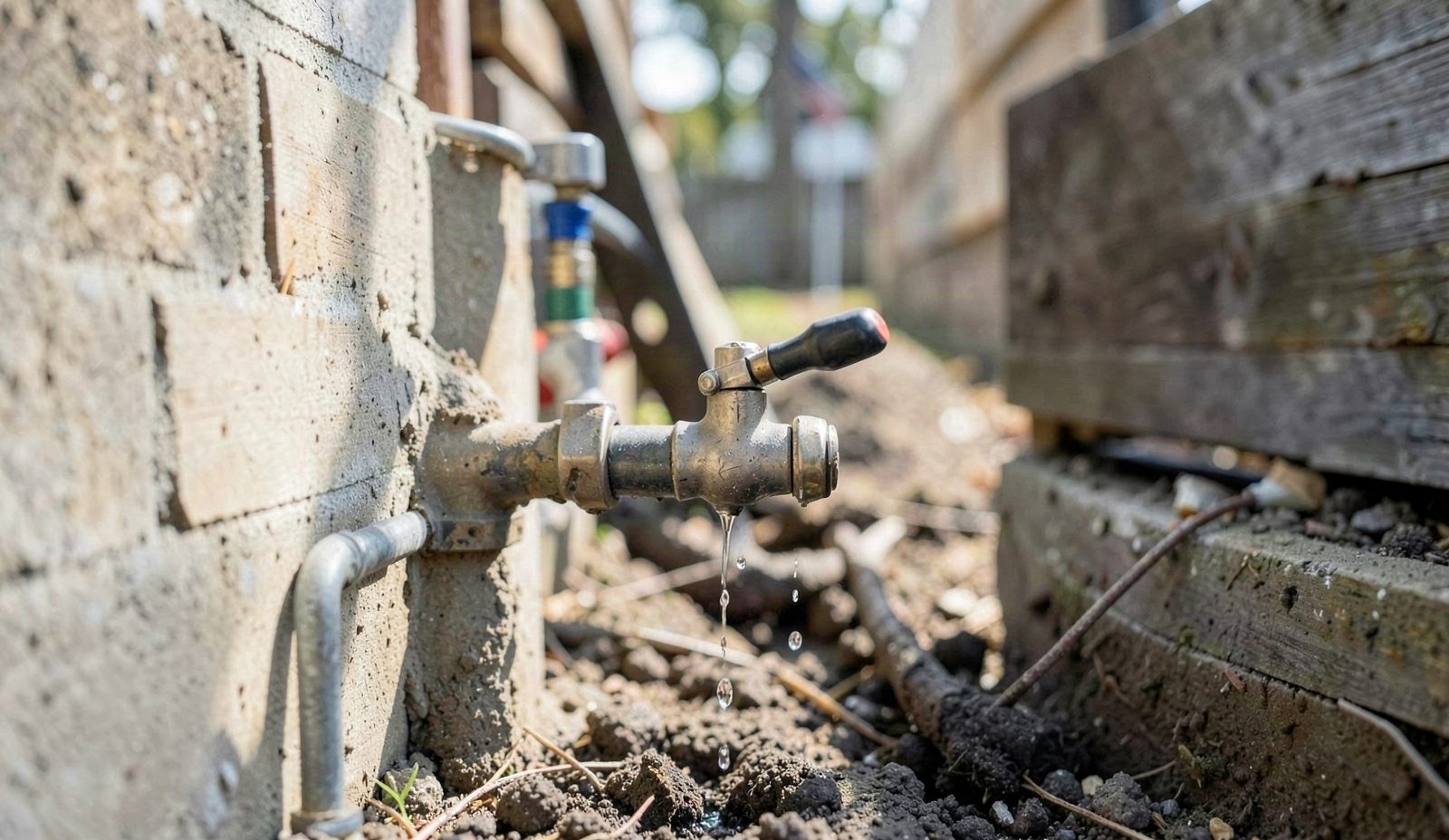
The Hidden Cost of Ignoring a Dripping Faucet in Fort Worth, practical local guidance from Shield Plumbing Fort Worth, Fort Worth's trusted …
Read More