
June 20, 2026
5 Signs Your Ridglea Hills Home Has a Slab Leak
5 Signs Your Ridglea Hills Home Has a Slab Leak, practical local guidance from Shield Plumbing Fort Worth, Fort Worth's trusted plumbing tea…
Read More




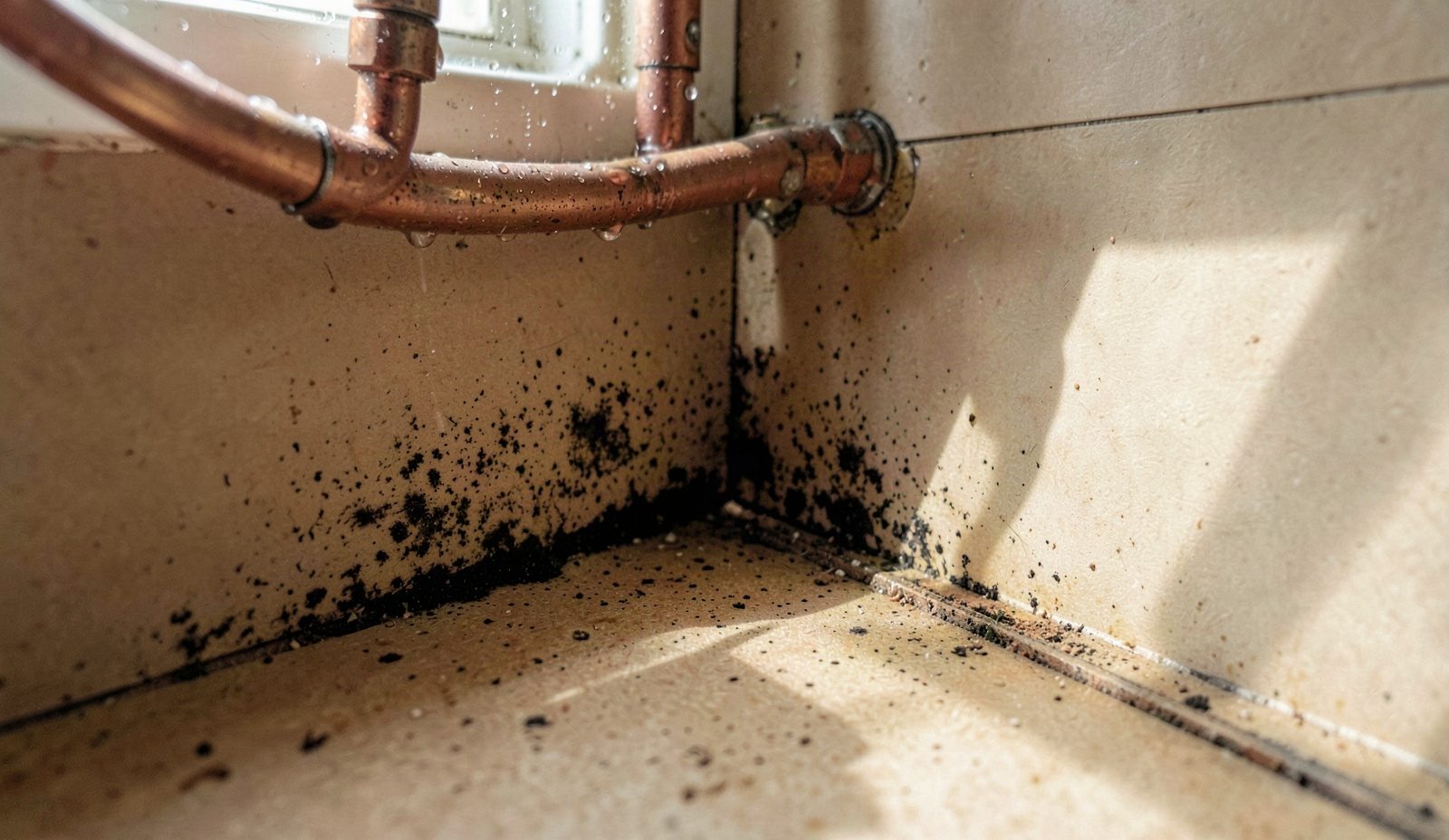
Open the cabinet under your bathroom sink and the smell hits before you see anything. That damp, earthy odor is the first sign of mold under sink cabinetry, usually followed by dark speckling in the back corners or along the cabinet floor where water pools and never fully dries. By the time you spot black mold in bathroom cabinets on the visible surface, the particleboard behind it has likely already started to swell, delaminate, or feel soft under a fingernail press.
The mechanism is almost always the same. A slip joint on the P-trap seeps a few drops per hour, a supply line fitting weeps behind the shutoff valve, or condensation from a cold supply line collects on the cabinet floor with nowhere to evaporate because the enclosed space has no airflow. That slow, steady moisture is enough to turn ordinary dust and soap residue into a mold colony within days. This is plumbing leak mold, not surface grime, and wiping the front panel with bleach does nothing to reach the source feeding it.
Fort Worth's ground adds its own pressure to this problem. North Texas expansive clay swells when it rains and shrinks hard during drought, and that constant movement is enough to shift a slab foundation, shearing copper supply lines and separating drain joints under the house. A shifted joint under a slab can send water sideways under a cabinet for weeks before a stain ever reaches the wall. In older sections of the city like Fairmount, Arlington Heights, and the Near Southside, many homes still run on original galvanized steel supply lines and cast iron drains from before 1970, both materials now well past their service life and prone to pinhole leaks and internal corrosion nobody sees until the cabinet floor is already wet.
Waiting on this problem does not buy time, it spends it. Swollen particleboard stops supporting cabinet hardware. Mold spreads from the cabinet interior into the drywall behind it, and once drywall paper is colonized, cutting it out becomes the only fix. What starts as a simple slip joint tightening turns into a cabinet rebuild, a drywall patch, and a mold remediation job, all because a musty smell under sink got ignored for one more season.
More detail on discolored or rusty water is on its own page.
The U.S. Department of Energy's water heating guide is a solid primer on operating costs if you want to dig into the numbers yourself.
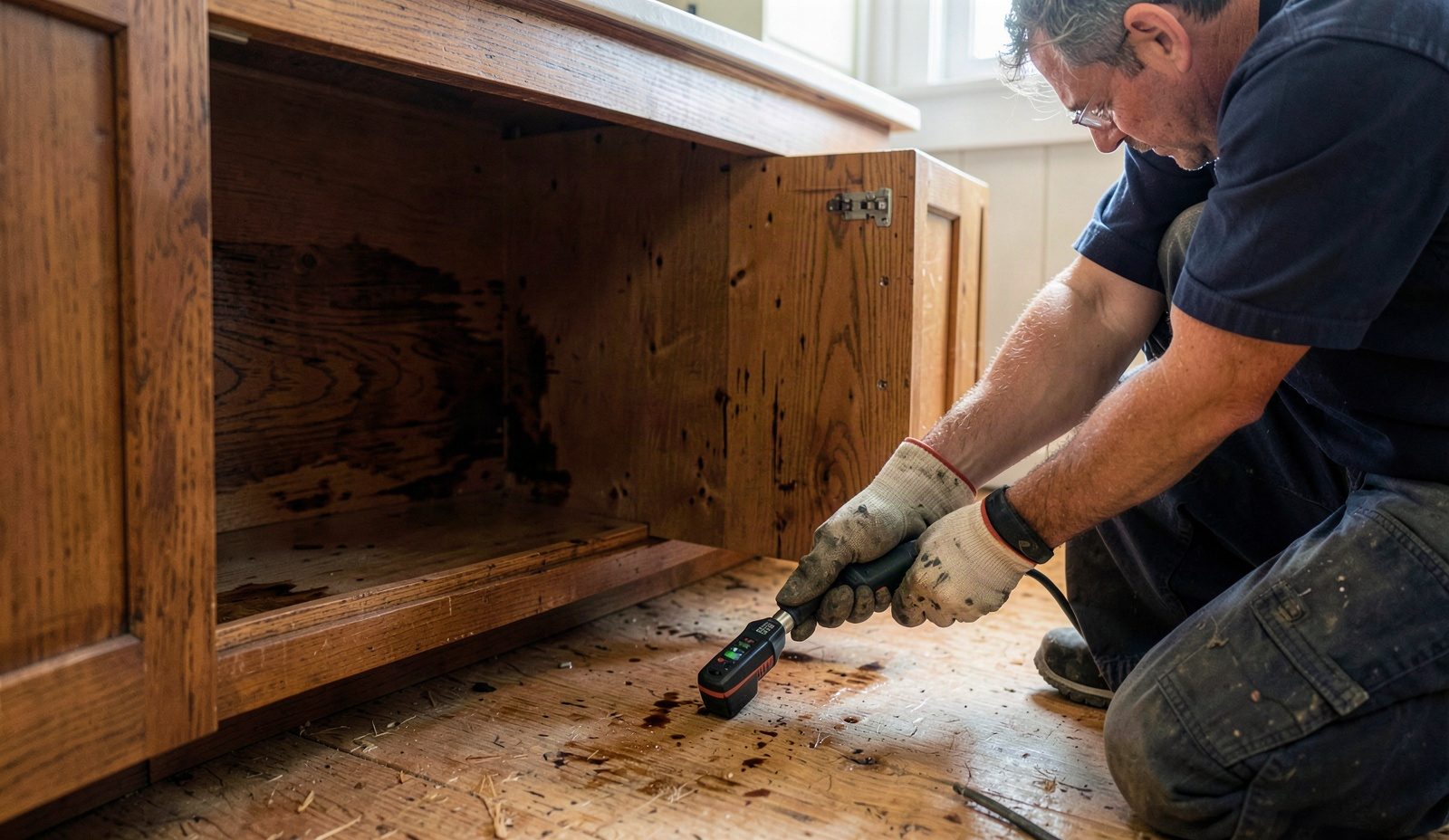
Every visit starts with a moisture reading, not a guess. A pinless moisture meter goes against the cabinet floor, the back panel, and the adjoining wall stud where accessible. A reading above 20 percent moisture content flags an active water source still feeding the problem. A reading under 12 percent tells us the wood is dry and the odor is trapped humidity from poor airflow, a very different repair than an active leak. We follow that meter with a flashlight and inspection mirror on every P-trap slip joint, tailpiece washer, and supply line ferrule, looking for the white capillary staining that shows exactly where water has been traveling.
Pressure is the variable most homeowners never think to check, and it is often the real driver behind repeat leaks. We read static water pressure at an outdoor spigot with a calibrated gauge. Section 604.8 of the International Plumbing Code requires a pressure-reducing valve once static pressure exceeds 80 psi, and in practice, pressure running that high stresses every compression fitting and supply line connection under every sink in the house. A cabinet that keeps growing mold after repeated repairs often traces back to this exact number, not a bad seal.
Once the source is confirmed, the repair materials matter as much as the diagnosis. Braided stainless steel supply lines carry a higher burst rating and longer practical service life than the chrome-plated copper risers still found under most vanities installed before the 1990s, and we replace like for like only when the existing risers test sound under pressure. When the cabinet base itself has taken damage, marine-grade plywood or PVC-based cabinet floor panels resist the swelling that standard particleboard and MDF cannot tolerate, which matters in a humid bathroom where the next slow leak is a matter of when, not if.
Our page on dripping faucets & leaks covers that side of the work in more depth.
Independent standards matter too, the EPA's WaterSense program sets the efficiency benchmarks we use when recommending replacement fixtures.
You describe what you're seeing, the smell, the discoloration, whether the cabinet floor feels soft, and dispatch schedules an arrival window based on severity. On site, the technician opens the cabinet, runs a moisture meter across the floor and back panel, and inspects every fitting and joint with a flashlight and mirror. You get a plain explanation of what the readings mean and where the water is likely coming from before anything gets discussed about repair.
Once the source is confirmed, you receive a written, itemized quote covering the plumbing fix and any cabinet material replacement needed. Work does not start until you approve it. The surrounding area gets protected with drop cloths, the water supply gets isolated at the nearest shutoff, and the technician replaces the failed fitting, joint, or supply line, then addresses damaged cabinet material with moisture-resistant panel where the original particleboard has swollen beyond repair.
Before leaving, the technician restores water pressure and watches every reworked joint and connection under pressure for several minutes, checking for weeping at threads and slip fittings. A follow-up moisture reading confirms the cabinet floor and adjoining wall are within a dry range. You get a walkthrough showing what was replaced and why, along with straightforward notes on what to watch for as the repaired area finishes drying over the following days.
Work on plumbing tied to a fixture or cabinet rebuild in Fort Worth falls under the City of Fort Worth plumbing code, based on the International Plumbing Code, and knowing which repairs count as like-for-like versus which trigger a structural review changes how a job gets planned from the first call. A technician who does not work this metro regularly does not know that distinction, and it shows up later as a repair that has to be reopened.
The February 2021 freeze burst pipes across Tarrant County by the tens of thousands, and most of those failures were supply lines run through attics and exterior walls, not under sinks. Crews who came in from outside the area during that freeze often patched the visible break and left the surrounding fittings untouched, and homeowners are still finding the secondary damage from those rushed jobs years later in the form of cabinet mold traced back to a stressed fitting nobody rechecked. Knowing the local failure pattern means checking those adjacent connections as a matter of routine, not an afterthought.
Every technician who works a job solo has passed a background check and completed current training on the active plumbing code cycle before being sent out without direct oversight. That training gets checked against real field conditions, not just a classroom test, before a tech carries a service van alone. Hiring a company unfamiliar with Fort Worth's mix of pre-1970 supply line materials and expansive clay foundation movement means paying for a diagnosis built on assumptions from a different city's housing stock. Call (817) 710-3766 and describe what you're seeing under the cabinet, and a technician can tell you what to check before anyone arrives.
See cold water sandwich effect for how the related work is scoped and priced.
Permit and inspection questions? Development Services is the office we coordinate with on every permitted Fort Worth job.
Calls booked before early afternoon are typically routed to a same-day or next-day window, depending on how the day's route is already loaded. You get a two-hour arrival window the morning of the visit, not a vague all-day wait. If a prior job runs long, dispatch calls you with an updated window before your slot passes, so you are not left checking the clock. Mold behind a cabinet rarely qualifies as a true emergency, but active dripping or a soaked subfloor moves you up the schedule the same day you call.
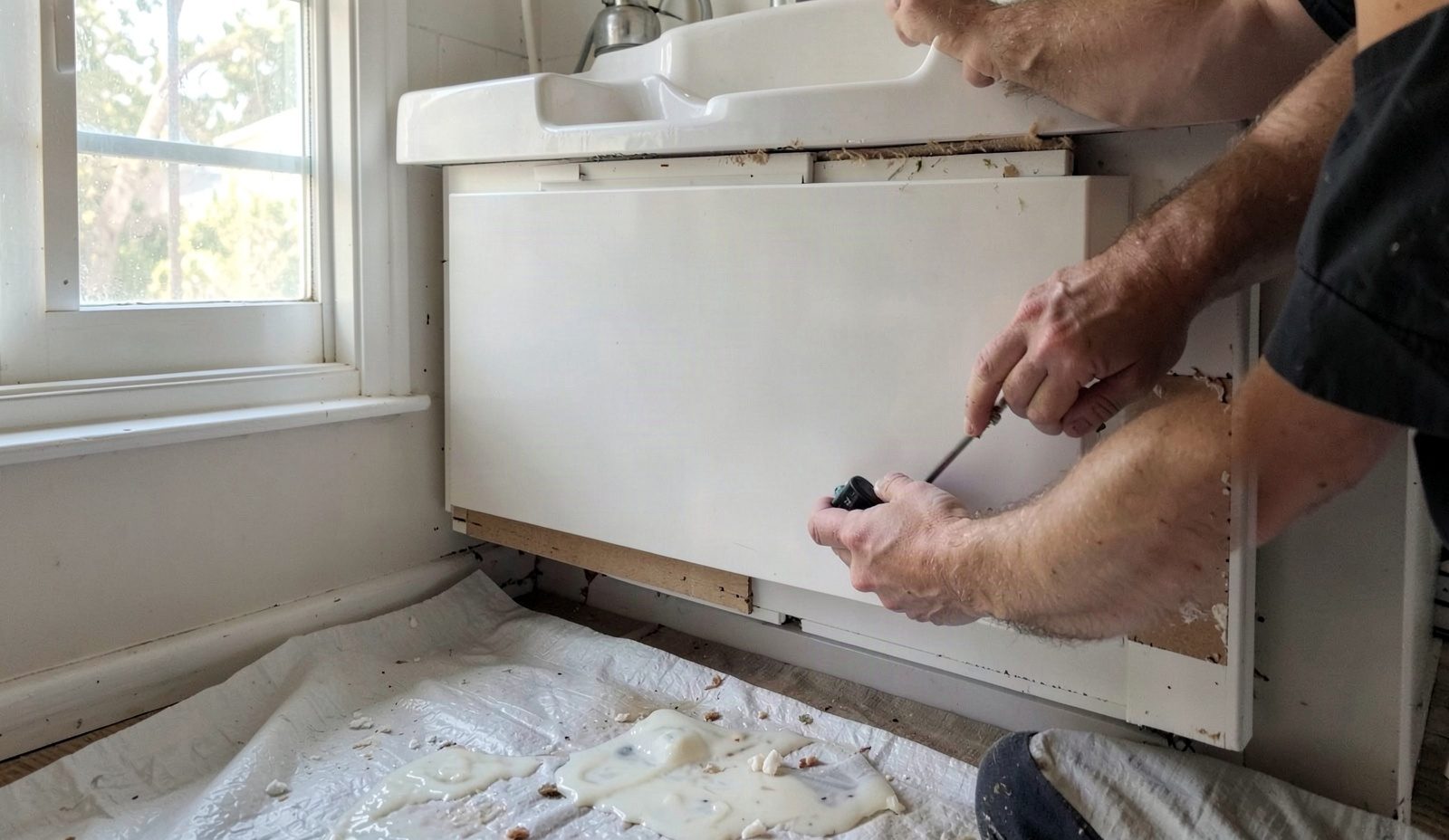
Before any cabinet panel comes out, the surrounding floor and adjoining cabinetry get covered with drop cloths and painter's plastic to catch debris and standing water. Cut particleboard, moldy drywall scraps, and old supply lines get bagged and hauled out the same visit, not left in a pile by the curb. Tools stay on a mat, not the vanity top. When the technician leaves, the bathroom looks like someone worked there carefully, with vacuumed debris and wiped-down surfaces, not like a demolition happened.
The estimate reflects what the moisture meter and visual inspection actually find, not a flat rate guess. Scope depends on how far the mold has spread, whether the cabinet floor needs full replacement or spot repair, how accessible the shutoff valves and drain lines are, and what supply line materials are already in place. You get a written, itemized quote broken out by task before any cutting or replacement starts, and you approve each line before the technician proceeds. Nothing gets added to the job without your sign-off first.
Every technician completes a background check before being placed on a solo route. Continuing education on the current plumbing code cycle happens on a set schedule, not left to chance, and covers changes to fixture connections, venting, and pressure requirements as they get adopted locally. Before a new technician works a job alone, a senior tech reviews their diagnostic process on live calls, checking how they read a moisture meter and trace a leak source, not just how fast they finish. That review happens before independent dispatch, not after a complaint.
Mold grows in bathroom cabinets when moisture sits on an enclosed, poorly ventilated surface long enough to feed it. In most Fort Worth homes, the moisture comes from a slow drip at a P-trap slip nut, a weeping supply line fitting, or condensation on a cold supply pipe with no airflow to dry it. The cabinet interior traps humidity that would evaporate quickly in an open room, so even a small leak becomes a colony within days.
It depends on how far the moisture has penetrated the material. Surface mold on a sealed, painted cabinet panel often cleans off and the panel dries out fine once the leak is fixed. Particleboard or MDF that has swollen, softened, or started delaminating is structurally compromised and needs replacement, since sanding or sealing over damaged pressed wood does not restore its strength or stop the mold from returning underneath.
Mold in a bathroom cabinet can irritate airways, eyes, and skin for people with allergies, asthma, or weakened immune systems, and the reaction gets worse the longer the exposure continues. The bigger practical concern is what mold signals underneath it, an active water source slowly destroying cabinet material and potentially the subfloor. Addressing the leak removes both the mold's food source and the moisture problem behind it.
No product kills mold instantly on porous material like particleboard or drywall paper, since the roots grow into the surface, not just on top of it. An EPA-registered disinfectant or a diluted hydrogen peroxide solution works on sealed, non-porous surfaces like tile and painted wood. Bleach whitens mold stains on the surface but does not penetrate porous cabinet material, which is why the mold often returns within weeks if the underlying leak is not repaired first.
Shield Plumbing Fort Worth diagnoses the water source with a moisture meter and pressure gauge before quoting any cabinet repair, instead of replacing panels and hoping the smell does not return. Technicians document readings so you know exactly what triggered the mold, not a guess. That diagnostic-first process matters most on repeat mold cases, where a prior repair addressed the visible damage but missed the fitting or joint still feeding the problem.
Coverage depends on the cause of the leak, not the mold itself. A sudden pipe burst is typically covered, while gradual leaks tied to worn fittings or deferred maintenance are usually excluded as a maintenance issue rather than a covered loss. Adjusters generally require documentation of when the leak was discovered and its likely cause, which is why a written diagnostic report from the repair visit matters for any claim you file.
You can wipe surface mold off sealed, non-porous cabinet panels yourself with a mild disinfectant. You cannot fix the plumbing leak feeding it without diagnosing and repairing the actual fitting, joint, or supply line, and porous particleboard or MDF that has absorbed moisture cannot be fully sanitized by scrubbing. Cleaning the surface without fixing the source just delays the mold's return.
Estimates depend on what the moisture meter and visual inspection find during the initial visit, not a flat rate. A technician checks the leak source, the extent of cabinet material damage, and access to the shutoff valve and drain lines, then provides a written, itemized quote before any cutting or replacement starts. You approve each line item before work begins, and nothing changes without your sign-off.
Fort Worth's summer humidity does not stay outside. Air conditioning keeps interior air cool while attic and wall temperatures climb, and that gap causes condensation on cold supply lines running to bathroom fixtures, moisture that collects on cabinet floors with nowhere to go in an enclosed space. Slab-on-grade construction, common across mid-century neighborhoods like Wedgwood and Ridglea Hills, means a floor-level leak has no crawlspace to drain into and no subfloor cavity to dry through, so water sits directly against the cabinet base. Many of these ranch-style homes were built with a single vanity cabinet serving the whole bathroom, with minimal ventilation designed into the cabinetry itself, which is exactly the kind of enclosed, humid, low-airflow space mold needs to establish quickly once a leak starts.
Repairs limited to the existing fixture connection, like replacing a supply line or resealing a P-trap, typically do not require a permit. Work that touches the structure, such as replacing a rotted subfloor section under a cabinet, generally does, and the City of Fort Worth Development Services Department is the office with final authority on that call for Fort Worth addresses. Neighborhoods like the Cultural District mix century-old construction with recent infill development, and a technician working that area needs to recognize the difference between a original cast iron drain stub and a recently updated PVC line before deciding what the repair actually requires. Local familiarity with that mix is what keeps a straightforward leak repair from turning into a permitting delay.
Explore our service area and locate Shield Plumbing Fort Worth with ease. We're proudly local and serve the surrounding neighborhoods with fast response and honest pricing. Use the map to check our coverage area, or call us and we'll confirm in seconds.
Address:
Shield Plumbing Fort Worth, 210 W 7th St, Fort Worth, TX 76102
5 Signs Your Ridglea Hills Home Has a Slab Leak, practical local guidance from Shield Plumbing Fort Worth, Fort Worth's trusted plumbing tea…
Read More
What Wedgwood Residents Should Know Before a Whole-Home Repipe, practical local guidance from Shield Plumbing Fort Worth, Fort Worth's trust…
Read More
How Fort Worth's Hard Water Is Quietly Destroying Your Water Heater, practical local guidance from Shield Plumbing Fort Worth, Fort Worth's …
Read More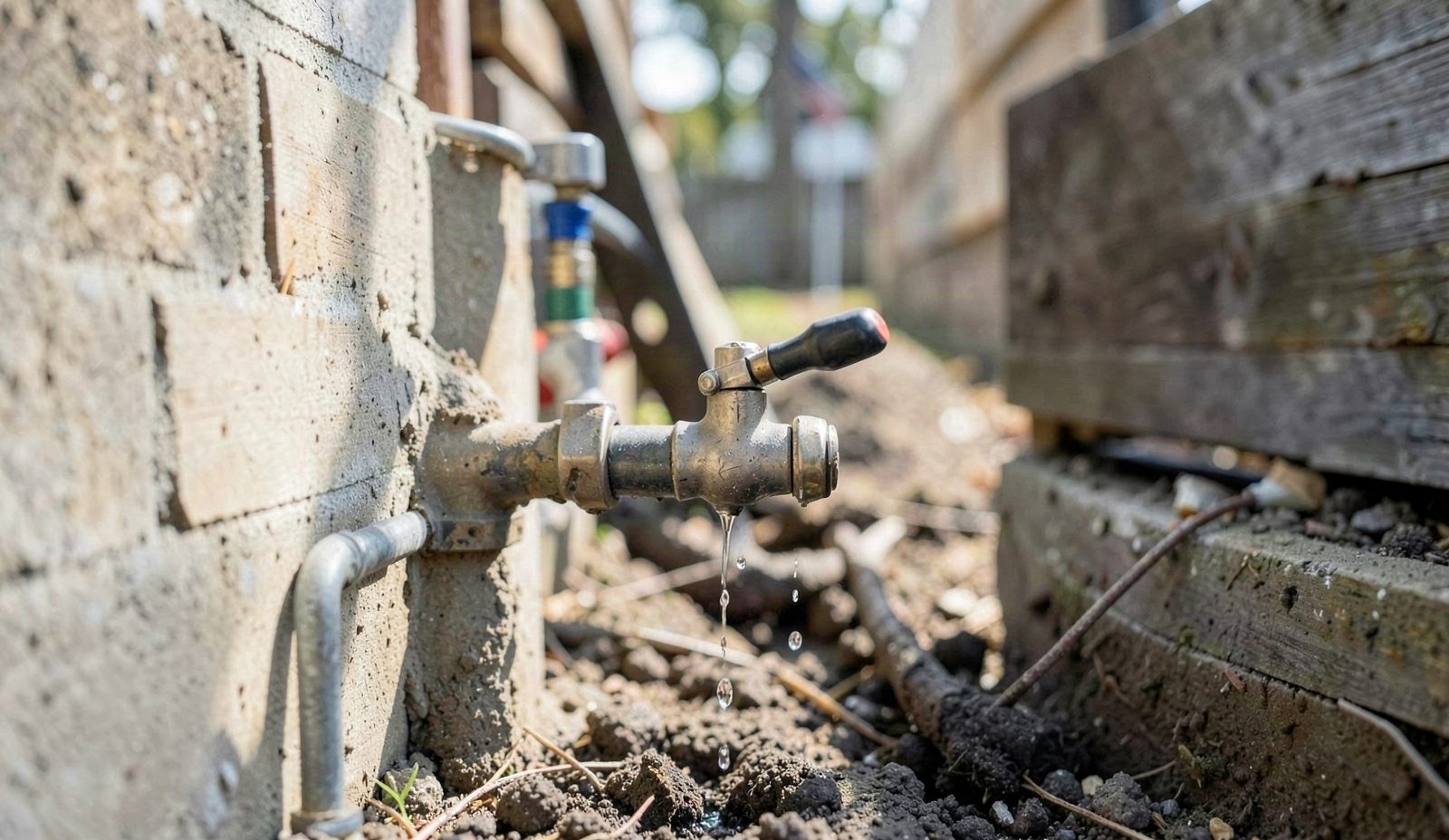
The Hidden Cost of Ignoring a Dripping Faucet in Fort Worth, practical local guidance from Shield Plumbing Fort Worth, Fort Worth's trusted …
Read More