
June 20, 2026
5 Signs Your Ridglea Hills Home Has a Slab Leak
5 Signs Your Ridglea Hills Home Has a Slab Leak, practical local guidance from Shield Plumbing Fort Worth, Fort Worth's trusted plumbing tea…
Read More




You turn on the shower and get a rush of hot water, then a cold slap thirty seconds later. The unit clicks twice and throws an error code on its front panel before shutting down. That is not a fluke. It is the tankless heat exchanger telling you something specific failed inside it, and ignoring the code turns a repair into a replacement.
Fort Worth sits on expansive clay that swells after a heavy rain and shrinks hard during a dry August. That movement shifts the slab under the house enough to shear the copper water and gas lines feeding your tankless unit, especially in older bungalows around Fairmount and Arlington Heights where original supply runs were never designed to flex. A hairline gas line crack near the unit will trip the flame sensor and shut the whole system down as a safety measure, not a malfunction.
The February 2021 freeze burst pipes across Tarrant County by the tens of thousands, and most of those failures were supply lines run through attics and exterior walls, exactly where many instant hot water systems get mounted for venting access. Homes in the Near Southside with units tucked into unconditioned attic space or exterior utility closets are still running on lines patched after that freeze, and a second hard freeze finds the weak repair first.
Waiting past the first error code costs more than a service call. Mineral scale that starts as a light readout warning hardens against the heat exchanger walls, and a heater that could have been cleared with a routine tankless water heater flush ends up needing the exchanger replaced outright. A cracked gas line ignored for a season becomes a carbon monoxide risk, not just a lukewarm shower.
More detail on water heater repair & installation is on its own page.
Your local utility, Payment options, publishes service and water-quality information every Fort Worth homeowner should know.
Every tankless heater repair call starts with a static pressure reading, not a guess. A technician connects a gauge to an outdoor spigot before touching the unit. A reading above 80 psi means the pressure-reducing valve is undersized or missing, and it explains recurring pinhole leaks and premature valve wear that homeowners often blame on the heater itself. A reading in the normal range points the diagnosis toward the heat exchanger, the venting, or the gas supply instead of the pressure system.
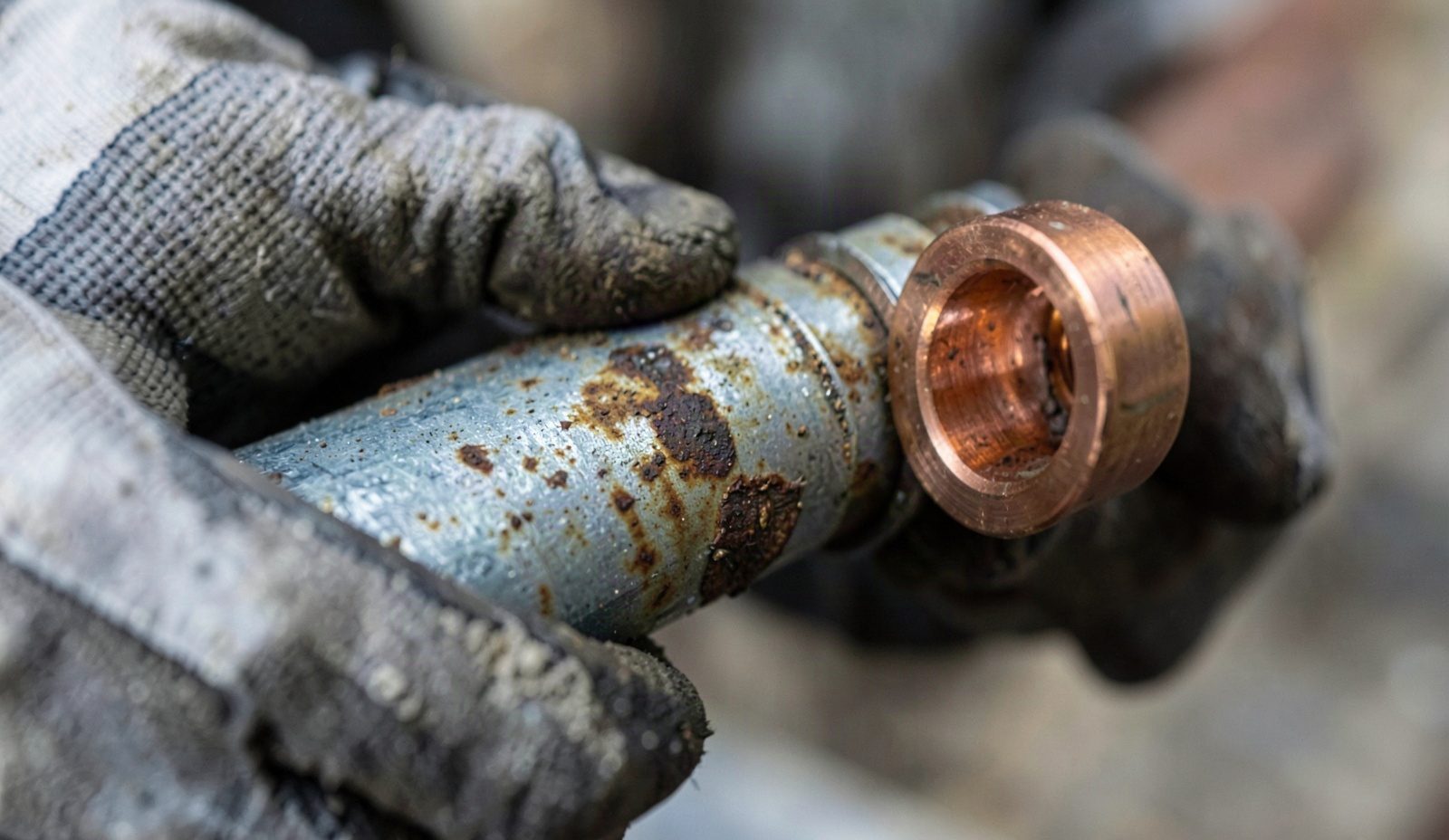
Fort Worth water runs moderately hard, and the scale it leaves on heating elements is a leading reason local water heaters fail years before their rated life. On a tankless unit that scale collects inside the heat exchanger's narrow copper coil, not a tank, so a technician checks the flow-rate readout against the unit's rated gallons per minute. A drop of even 10 to 15 percent from the nameplate rating on a unit under five years old signals scale restriction and calls for a descaling flush with a submersible pump and vinegar or a manufacturer-approved solution circulated through the service valves, not just a rinse.
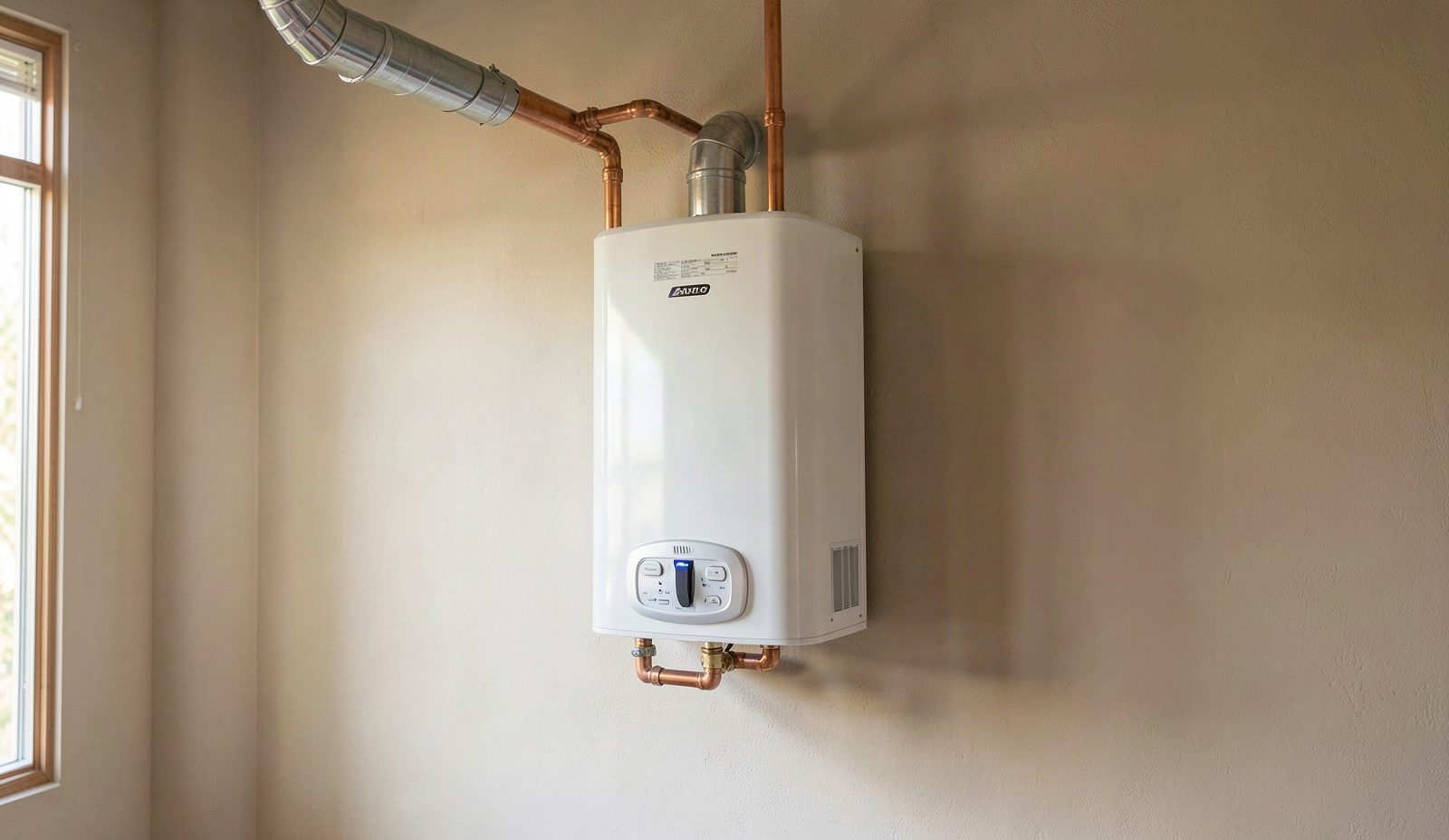
Brand and venting choice change the math on every tankless water heater installation. A Rinnai Sensei or Navien NPE series unit condenses exhaust gas and vents with PVC, which costs less to run through an exterior wall than the stainless steel Category III venting a non-condensing Rheem Performance Platinum unit requires. Condensing units also produce mildly acidic condensate that needs a neutralizer kit before it drains, a detail a technician checks against the local plumbing code before signing off on a new instant hot water system.
Our page on commercial water heater systems covers that side of the work in more depth.
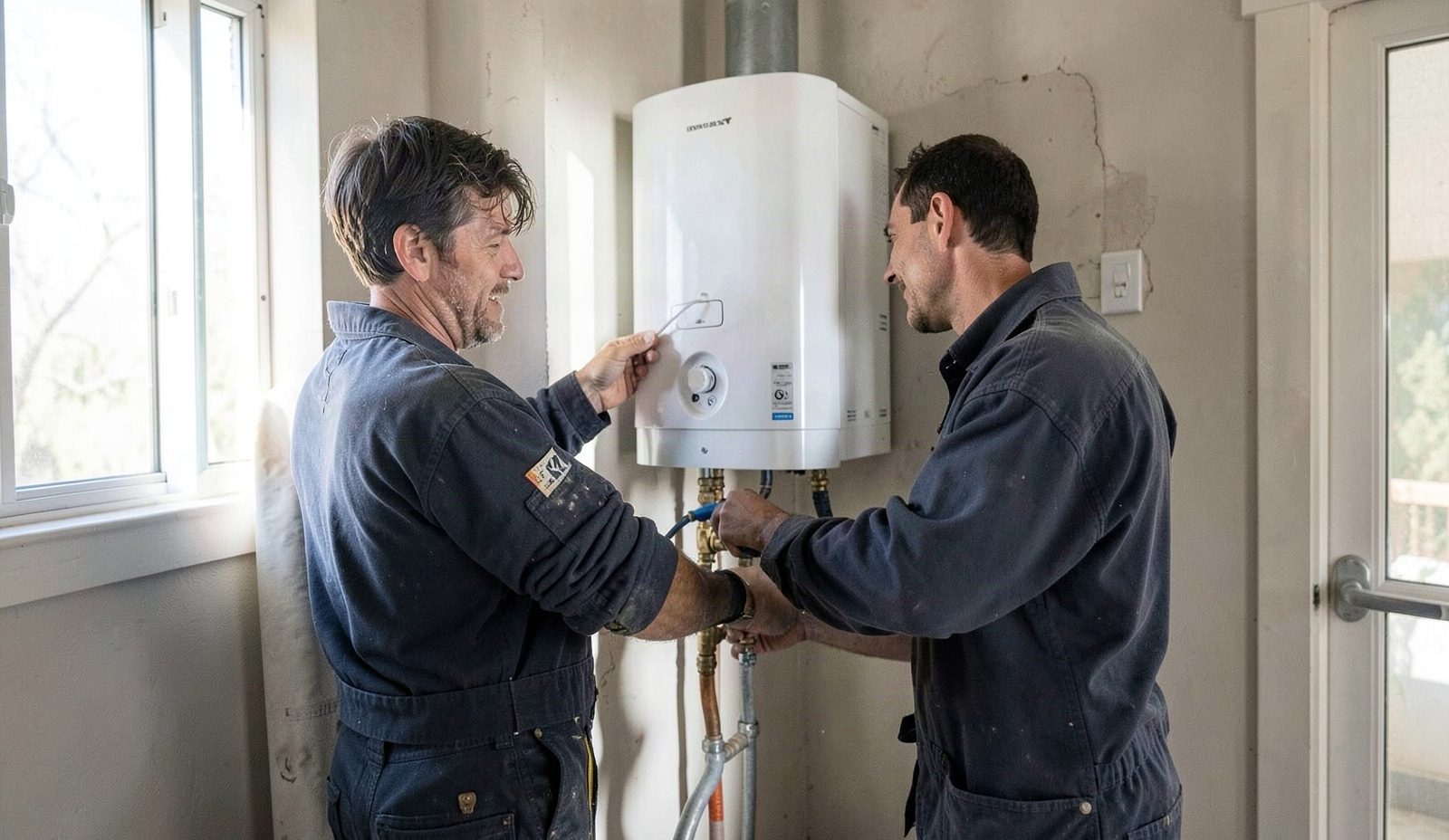
You describe the symptom on the phone: cold bursts, an error code, no hot water at all. A technician arrives in the scheduled window with a pressure gauge, manometer and flow meter. They read static pressure at an outdoor spigot, check the unit's error history, and inspect the venting termination and gas line for obvious damage. You get a plain explanation of what the readings mean before any tool comes out for repair, along with a written diagnosis you can ask questions about.
Once you approve the written quote, the technician protects the work area with runners and drop cloths, then shuts off water and gas supply to isolate the unit safely. Work proceeds based on the diagnosis: a descaling flush through the service valves, a heat exchanger or gas valve swap, or a full new tankless water heater installation with updated venting. Any change in scope, like discovering undersized gas piping mid-job, gets a phone call to you before work continues.
Before the technician packs up, they re-check static pressure, confirm flow rate against the unit's rated gallons per minute, and test for gas leaks at every reconnected fitting with an electronic sniffer. They walk you through the reset error log, show you the pressure-reducing valve setting if one was installed, and leave written documentation of the work performed and the readings taken, useful if you ever need it for a future service call or inspection.
The City of Fort Worth plumbing code, based on the International Plumbing Code, governs how a tankless unit gets vented, gas-piped and pressure-regulated in this city, and Section 604.8 of the International Plumbing Code specifically requires a pressure-reducing valve wherever static pressure at the fixture exceeds 80 psi. An installer who skips that step passes an inspection failure straight to you, along with the premature fitting wear that follows unregulated pressure.
Full tankless installations and any gas line modification typically require a permit, and minor like-for-like repairs often do not. The City of Fort Worth Development Services Department makes that call for Fort Worth addresses, and a technician who has pulled permits there before knows which drawings and clearances the reviewer wants before the first inspection, not after a rejected one.
Pre-1970 neighborhoods across the metro were plumbed with galvanized steel supply lines and cast iron drains, both now at or past the end of their service lives. Tying a new tankless unit into galvanized supply without addressing the internal corrosion first restricts flow before the water ever reaches the heat exchanger, and a technician unfamiliar with that housing stock will chase a phantom heater problem for hours instead of testing the supply line first. An out-of-area crew unfamiliar with this pattern, or with the city's inspection expectations, leaves you carrying the risk of a failed inspection or a callback that never gets scheduled. Call (817) 710-3766 to talk through what your home's plumbing era means for the install.
If this sounds close but not quite your situation, emergency water heater repair may be the better starting point.
You call (817) 710-3766 and get a scheduled window, not a vague callback promise. Same-day slots are available for active leaks or a heater that has shut down completely, and standard installs or flushes book within a set window you agree to on the call. If a prior job runs long, dispatch calls you directly with an updated arrival time before your window passes, so you are never left checking the driveway without word. You get a name and an estimated arrival time before the truck leaves for your address, not just a time range.
Floor runners go down from the entry point to the work area before any tool comes out, covering hardwood, tile and carpet alike. Drop cloths catch drips under the unit during flushing or removal, and old fittings, packaging and scale sediment leave in sealed containers rather than your trash bin. On installs involving attic or crawlspace access, technicians wear boot covers indoors and reset any insulation disturbed during the line run. When the work finishes, the space looks like nobody worked there, aside from the new equipment.
Your quote reflects the unit size needed for your fixture count, the venting path length, gas line capacity, and whether the job is a straight swap or a conversion from a tank system. Access matters too: a unit in an open utility closet costs less labor than one requiring attic work or a new gas line run. You see the full written breakdown before any work starts and approve it line by line. Nothing gets added mid-job without a call to you first explaining why and what it changes.
Every technician passes a background check before ever entering a customer's home. Ongoing training keeps the crew current on the locally adopted plumbing code cycle, including venting classifications and pressure regulation requirements that change how a unit gets installed. New technicians complete a supervised rotation of tankless installs and repairs alongside a senior tech before working a service call alone, and spot checks on completed jobs continue after that. Competence gets verified through documented field work, not a certificate on a wall.
Flush cost depends on unit accessibility, how much scale has built up, and whether isolation valves are already installed. Fort Worth's moderately hard water means most tankless units need a flush on a routine schedule to keep the heat exchanger clear. Homes without existing service valves need those added first, which affects the quote. Call (817) 710-3766 and a technician will look at your specific unit before quoting the work.
Reliability depends more on correct sizing and installation than brand alone, though Rinnai, Navien, and Rheem all have strong track records in condensing and non-condensing lines. Rinnai and Navien's condensing models run higher efficiency and vent with PVC, while Rheem's non-condensing units need stainless steel venting but cost less upfront. The right choice depends on your home's venting path and fixture count, which a technician evaluates on site before recommending a specific model.
Estimates come after an on-site look at your gas line, venting path, and existing plumbing, not over the phone. A technician measures fixture count, checks static water pressure, and inspects access before writing a line-item quote you approve before any work begins. Older Fort Worth homes often need gas line upsizing or venting changes that affect the final scope. You will see every cost driver broken out in writing.
Cost depends on the type of water heater, how accessible it is, and how many tests the failure requires to isolate. A tank unit in an easy-access closet with an obvious failed part costs less to diagnose than a tankless unit in an attic needing a full combustion and flow analysis. Call Shield Plumbing Fort Worth at (817) 710-3766 for a straight answer on your specific setup before any work starts.
A standard commercial branch line takes one to two hours including camera assessment and verification. A full main line with heavy grease or root intrusion can run three to four hours, especially with multiple access points. Time depends on pipe diameter, blockage severity and how many cleanouts the building has for access. Properties with a single, hard-to-reach cleanout take longer because the technician has to run more line from fewer entry points.
A drain smells bad with no blockage when a dry trap or bad seal leaks gas. A kitchen drain in particular can smell bad from grease and food film coating the pipe past the trap, a problem a snake clears but a chemical drain opener rarely reaches. A floor drain in a garage or utility room dries out fastest of all fixtures, since it may go months without water running through it. Pouring a quart of water down any rarely used drain once a month keeps its trap sealed and prevents this exact complaint.
Pre-1970 neighborhoods across the metro were plumbed with galvanized steel supply lines and cast iron drains, both now at or past the end of their service lives, and that history changes how a tankless retrofit gets planned in older sections of Ridglea Hills and Wedgwood. A technician has to verify the existing gas line can carry the higher BTU demand a tankless unit needs before quoting the job, since undersized older gas piping common in these areas often needs upsizing, not just a new appliance. Cultural District condos converted from older commercial buildings raise a different problem: venting a condensing unit through masonry exterior walls built decades before tankless systems existed takes core-drilling planning most out-of-area installers have never had to do.
Fort Worth inspectors reviewing a tankless permit check the same things every time: venting termination clearances from windows and soffits, gas line sizing against the unit's rated input, and pressure regulation at the fixture. A crew that has pulled dozens of these permits across the metro knows exactly what documentation the reviewer expects on the first pass, which keeps a project moving instead of stalling on a correction notice. That familiarity matters more in a city where housing ages ranges from postwar bungalows to newer infill construction on the same block, each with different venting and gas capacity realities behind the wall.
Explore our service area and locate Shield Plumbing Fort Worth with ease. We're proudly local and serve the surrounding neighborhoods with fast response and honest pricing. Use the map to check our coverage area, or call us and we'll confirm in seconds.
Address:
Shield Plumbing Fort Worth, 210 W 7th St, Fort Worth, TX 76102
5 Signs Your Ridglea Hills Home Has a Slab Leak, practical local guidance from Shield Plumbing Fort Worth, Fort Worth's trusted plumbing tea…
Read More
What Wedgwood Residents Should Know Before a Whole-Home Repipe, practical local guidance from Shield Plumbing Fort Worth, Fort Worth's trust…
Read More
How Fort Worth's Hard Water Is Quietly Destroying Your Water Heater, practical local guidance from Shield Plumbing Fort Worth, Fort Worth's …
Read More
The Hidden Cost of Ignoring a Dripping Faucet in Fort Worth, practical local guidance from Shield Plumbing Fort Worth, Fort Worth's trusted …
Read More