
June 20, 2026
5 Signs Your Ridglea Hills Home Has a Slab Leak
5 Signs Your Ridglea Hills Home Has a Slab Leak, practical local guidance from Shield Plumbing Fort Worth, Fort Worth's trusted plumbing tea…
Read More




A septic tank overflowing does not stay quiet. Toilets flush slow, then gurgle back at you. A sewage smell hangs near the tank lid or drifts across the yard even with the windows shut. Homeowners near Fairmount and Wedgwood often notice it first at the lowest drain in the house, a basement floor drain or a tub, backing up dark water before anything upstairs even hints at trouble. That is a septic backup emergency, not a slow drain you can plunge away.
The ground underneath makes this worse here than in most places. North Texas expansive clay swells with rain and shrinks in drought, moving slab foundations enough to shear copper supply lines and separate drain joints under the house, and that same movement cracks concrete tank lids and shifts the inlet and outlet baffle connections on a septic tank. Once a baffle shifts even a half inch, solids that should settle start washing straight into the drain field months or years before they should.
A septic tank full of solids does not fix itself by waiting. Effluent that should sit and separate for a day or two instead pushes past the outlet baffle into the drain field lines while still loaded with grease and fiber. That clogs the gravel and soil around the pipe faster than any normal load would. A tank that needed a routine pump now needs emergency septic pumping just to keep sewage out of the house, and the smell only gets stronger as more solids back up toward the inlet side.
Wait past that point and the drain field itself starts to fail. A field clogged with solids does not clear with a pump-out. It needs excavation and new lines, a far bigger job than the call you could have made this morning. Every hour a full tank sits unaddressed pushes more solids toward that outcome, which is exactly why 24 hour septic service exists for calls that come in at midnight instead of during business hours.
See emergency sump pump failure for how the related work is scoped and priced.
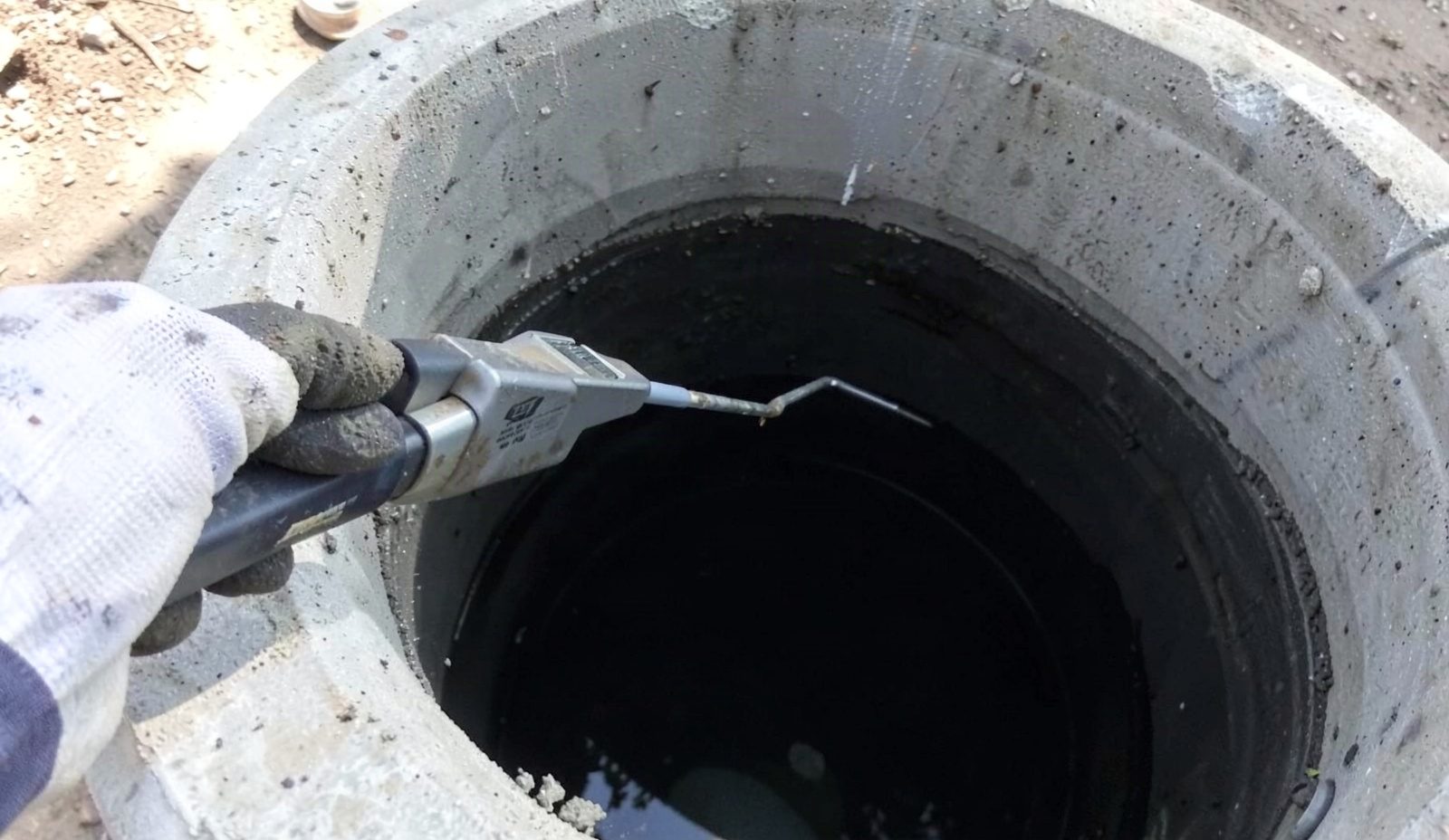
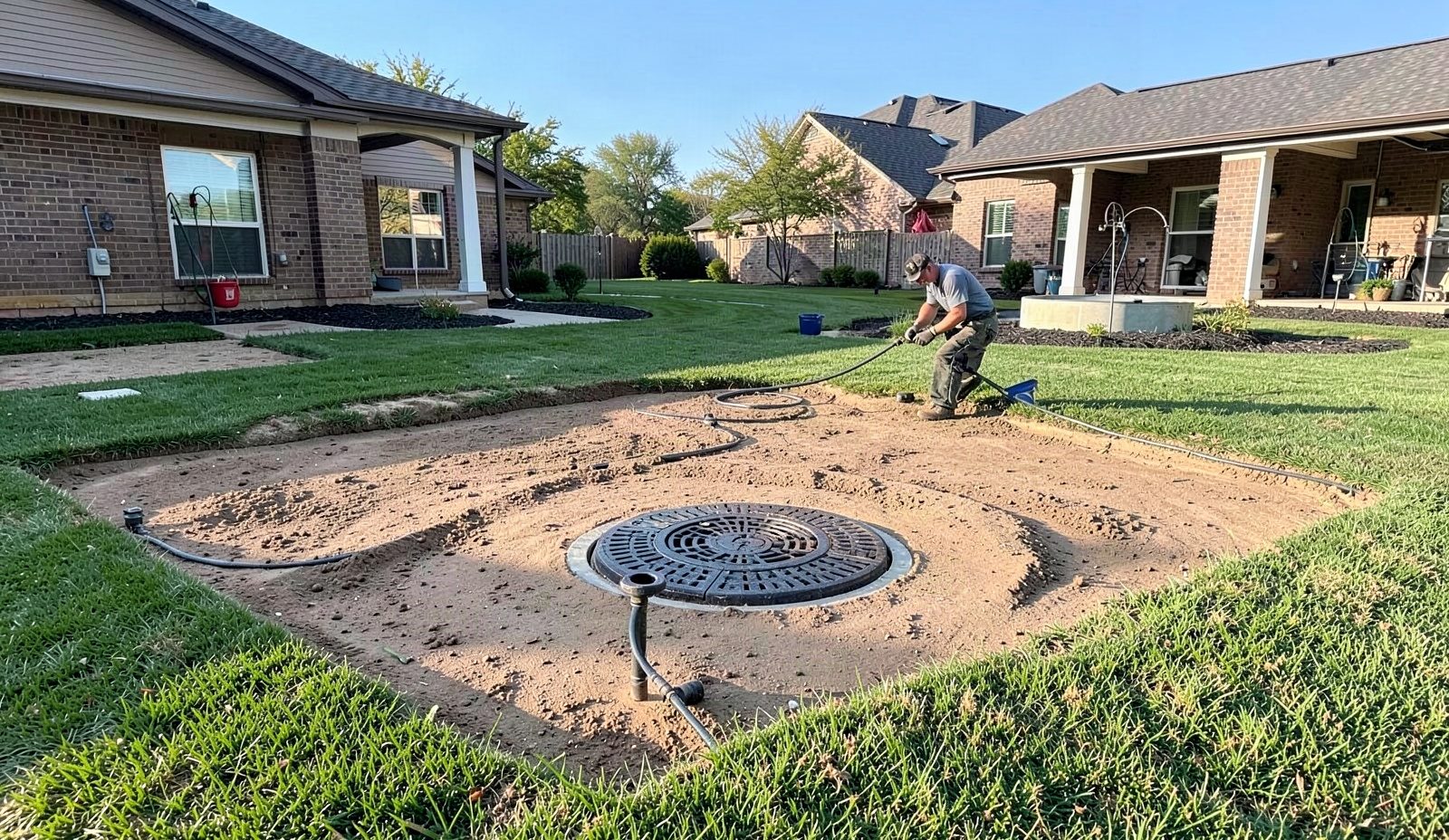
A technician does not guess at what is inside a buried tank. After locating the tank through an existing riser or a probe rod, the crew opens the lid and lowers a sludge judge, a marked PVC pole with a hooked or velcro tip, straight through the liquid to the bottom and back up. The pole comes up showing two bands: a scum layer of floating fats and grease at top, and a sludge layer of settled solids at the bottom. The call to pump is made right there, on the reading, when the bottom edge of the scum mat sits within a few inches of the outlet tee, or when the sludge layer alone takes up more than a third of the tank's total liquid depth. Either reading means solids are close enough to the outlet to start moving into the drain field on the next heavy flush.
Effluent filters matter just as much as the tank itself, and not all filters behave the same. A Zabel A100 filter uses a finer mesh and handles higher flow, common on newer installs, while a Polylok PL525 runs a coarser mesh that is easier to hose off but lets more fine solids pass downstream. Whichever filter sits in the outlet tee gets pulled and hosed clean during every pump-out, because a clogged filter is often the real reason a tank reads full again only weeks after a partial pump. Skipping that step is the most common shortcut that sends a homeowner back into an overflow within a season.
The last check has nothing to do with the tank directly and everything to do with how fast it fills. A pressure gauge screwed onto an outdoor spigot reads static water pressure, and anything above 80 psi triggers a real code requirement, Section 604.8 of the International Plumbing Code, which calls for a pressure-reducing valve at that pressure. High static pressure fills fixtures faster than a household notices, which pushes more gallons per day into a tank that is already stressed, shortening the months between pump-outs. Flagging that reading and recommending a PRV is part of a full diagnostic, not an upsell tacked onto the invoice.
Our page on 24/7 emergency plumbing services covers that side of the work in more depth.
Your local utility, Payment options, publishes service and water-quality information every Fort Worth homeowner should know.
The dispatcher asks where sewage is showing, how bad the smell is, and whether the yard is wet over the drain field, then routes a truck based on severity. On arrival the technician locates the tank through an existing riser or a probe rod, opens the lid, and lowers a sludge judge to read the scum and sludge layers. You see the pole come up marked in inches, and the technician explains whether the reading calls for a full pump or points to a different problem, like a clogged filter or a shifted baffle.
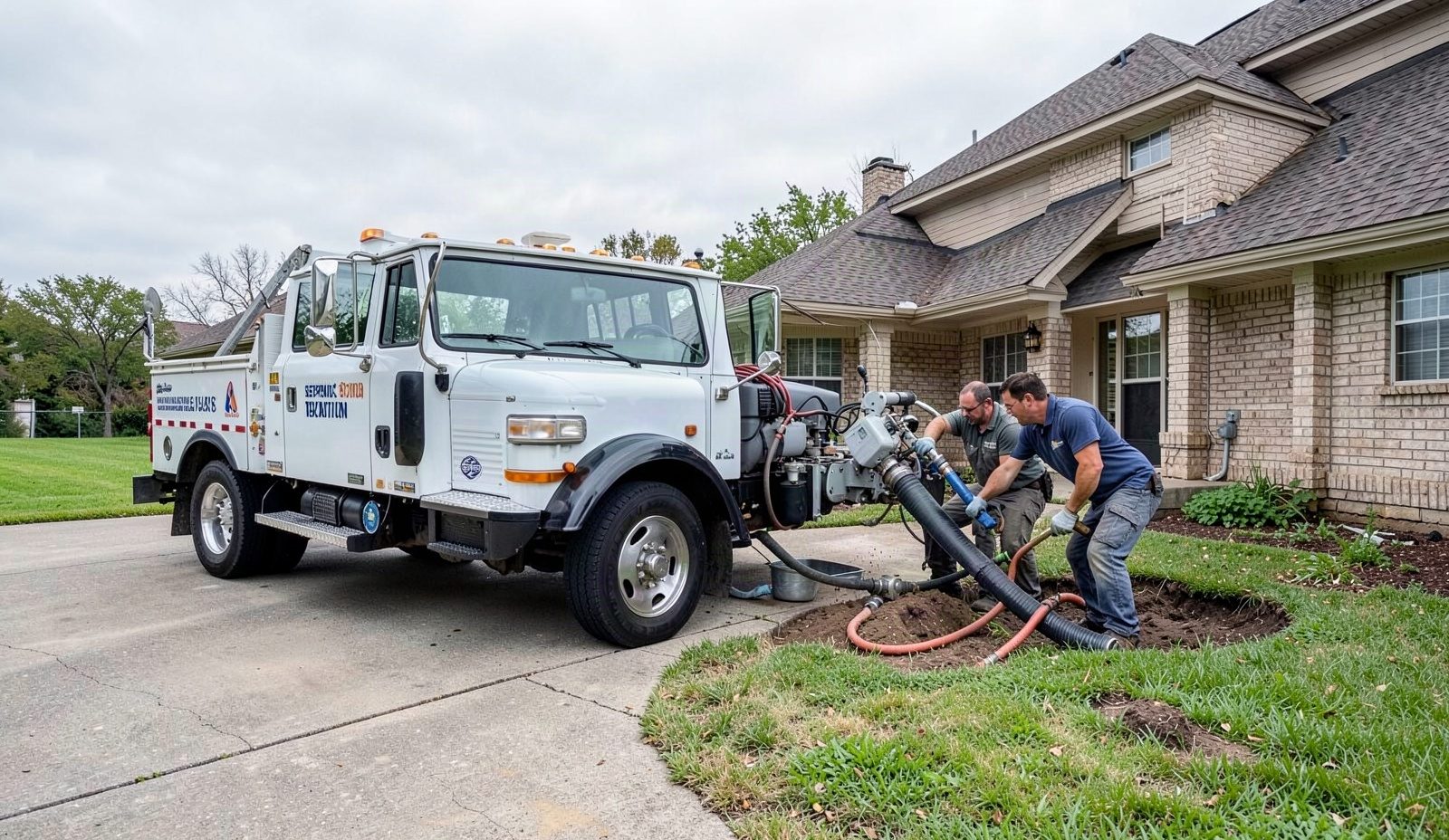
Once the sludge and scum readings confirm the tank needs pumping, the crew lays containment mats and plywood along the hose path before the vacuum truck starts drawing down the tank. While the level drops, the technician inspects the inlet and outlet baffles and pulls the effluent filter for cleaning. Any cracked fitting or damaged baffle gets priced on the spot as a written quote, and you approve it before that repair work begins. Pumping continues only after you sign off on the full scope.
Before the truck leaves, the technician confirms the tank is drawn down to a minimal sludge layer, reseats the effluent filter, and checks that the inlet and outlet baffles sit secure before resetting the lid or riser cap. You get a walkthrough covering what was found underground, roughly how many gallons came out, and when to expect the next pump-out based on household size and tank condition. That record is worth keeping for any future septic inspection tied to a home sale.
Septic work in Fort Worth answers to the City of Fort Worth plumbing code, based on the International Plumbing Code, and a routine pump-out generally does not need a permit while a baffle replacement, riser installation, or drain field repair typically does. The final decision on what needs paperwork belongs to the City of Fort Worth Development Services Department for addresses inside city limits, and to Tarrant County for properties outside it. A crew that skips that step, or does not know which authority applies to your address, leaves the homeowner holding an unpermitted repair at resale.
Housing stock changes what a technician expects to find underground. Pockets of older lots near Ridglea Hills were platted and plumbed before sewer lines reached every block, and pre-1970 construction across the metro commonly used galvanized steel supply lines and cast iron drains, both now at or past the end of their service life. A cast iron drain feeding an aging septic tank corrodes from the inside, narrowing the pipe and slowing flow long before the tank itself shows a problem, which is exactly the kind of detail an out-of-town operator unfamiliar with Fort Worth's older neighborhoods tends to miss.
Response logistics matter as much as code knowledge on an active overflow. A crew that does not know which Tarrant County roads flood during a downpour, or how far a hose has to reach from a driveway to a buried tank on a typical Fort Worth lot, loses time a homeowner with sewage in the house does not have. Call (817) 710-3766 to talk through what you are seeing before the truck even leaves, so the crew arrives already knowing what to expect.
If this sounds close but not quite your situation, emergency sewer backup cleanup may be the better starting point.
The U.S. Department of Energy's water heating guide is a solid primer on operating costs if you want to dig into the numbers yourself.
Call (817) 710-3766 and the dispatcher asks where the backup is showing, how strong the smell is, and whether the yard is wet over the drain field. That determines how the call gets routed. For an active overflow inside the house, the truck moves ahead of scheduled maintenance calls, and you get a real arrival window based on where the crew already is in Tarrant County. If a prior emergency runs long and that window shifts, the dispatcher calls with an updated time instead of leaving you checking the driveway.
Containment mats go down along the path from the truck to the tank access point before any hose gets pulled across the lawn. The vacuum hose runs on plywood where it crosses grass or a flower bed edge, so nothing gets rutted or crushed. Every gallon pulled from the tank goes straight into the sealed vacuum truck for off-site disposal, none of it sits in the yard. The lid gets reset, the soil around the riser gets tamped back down, and the crew checks for standing puddles or lingering odor before pulling out.
What drives the number on your invoice is tank size, sludge depth measured with the sludge judge, and how far the hose has to reach from the truck's parking spot to the riser. A tank buried under three feet of soil with no riser costs more time to open than one with an accessible lid. If the baffle or a fitting is cracked, that repair gets priced separately and shown to you before any additional work starts. You approve the written quote before the truck engages the vacuum, not after.
Every technician goes through a background check before working a job site alone. Crews review changes to the current plumbing code cycle on a set schedule, not once at hire and never again. New techs shadow a senior crew member through multiple pump-outs, watching how sludge readings translate into decisions, before they run a truck by themselves. A field supervisor spot checks completed jobs, checking the same sludge and scum readings the tech logged to confirm the call was correct.
A septic emergency is any sewage backup, standing overflow, or strong sewage odor inside the home that signals the tank cannot hold or process more waste. That includes sewage rising in a tub or floor drain, water pooling over the drain field in dry weather, or toilets that gurgle and back up on every flush. Any of those means the system needs emergency septic pumping the same day, not a scheduled visit next week.
A 500 gallon tank serving a household of four usually needs pumping every 12 to 18 months, longer for two occupants and shorter for a larger family or a garbage disposal in heavy use. Tank size and daily wastewater volume drive the interval far more than the calendar does. A sludge reading during a maintenance visit gives a far more accurate answer than any general rule for your specific household.
Cost depends on tank size, sludge depth, and how far the hose has to reach from the truck to the access point, not a flat rate. A tank with an accessible riser costs less to open than one buried under soil that needs digging first. Disposal distance and any damaged baffle found during pumping also factor into the written quote you approve before work starts.
Estimates get set on site, after the technician measures sludge depth and checks tank access, before any pumping begins. Shield Plumbing Fort Worth presents that number as a written quote for your approval, and any repair found during the pump-out, like a cracked baffle, gets priced separately and shown to you before the crew touches it. Nothing gets added to the invoice without your sign-off first.
Ignoring an overflowing septic tank leads to solids moving into the drain field and clogging the soil around the pipes, a failure that pumping alone cannot reverse. Once that happens, the fix becomes excavation and new drain field lines instead of a routine pump-out. Sewage backing repeatedly into the lowest drains in the house also raises contamination risk for anyone in contact with that water or the yard above the field.
No, pumping a septic tank requires a vacuum truck rated for septic solids and a permitted facility to legally dispose of what comes out. Beyond the equipment, an open tank releases methane and hydrogen sulfide gas that can overcome a person leaning over the opening without ventilation. That combination of equipment and gas risk is why this stays a job for a crew with the right truck, not a homeowner with a rented pump.
Septic systems across the Fort Worth metro sit under conditions that push maintenance schedules harder than average. The February 2021 freeze burst pipes across Tarrant County by the tens of thousands, and pump-assisted septic systems with exposed risers and electrical float switches took similar damage that winter, cracking fittings and knocking out effluent alarms right when homeowners least expected it. Heavy spring rain saturates the expansive clay that dominates local soil, and a saturated drain field cannot absorb effluent as fast as a dry one, which pushes some households into pump-outs sooner than the calendar would suggest. Planning a pump-out schedule here means accounting for both the freeze risk in winter and the saturation risk every spring, not just counting years since the last service.
Routine pump-outs generally move without a permit, but repairs that involve digging, replacing a baffle, or installing a new riser cross into work the City of Fort Worth Development Services Department has a say over for addresses inside city limits, with Tarrant County holding that authority outside them. Homeowners near Arlington Heights, the Near Southside, and the Cultural District who call an out-of-area crew for repair work often find out too late that the permit was skipped, a problem that surfaces during a home inspection or a title search years later. A crew working these neighborhoods regularly knows which repairs trigger that paperwork and which do not, and pulls the permit before starting rather than after a question comes up at closing.
Explore our service area and locate Shield Plumbing Fort Worth with ease. We're proudly local and serve the surrounding neighborhoods with fast response and honest pricing. Use the map to check our coverage area, or call us and we'll confirm in seconds.
Address:
Shield Plumbing Fort Worth, 210 W 7th St, Fort Worth, TX 76102
5 Signs Your Ridglea Hills Home Has a Slab Leak, practical local guidance from Shield Plumbing Fort Worth, Fort Worth's trusted plumbing tea…
Read More
What Wedgwood Residents Should Know Before a Whole-Home Repipe, practical local guidance from Shield Plumbing Fort Worth, Fort Worth's trust…
Read More
How Fort Worth's Hard Water Is Quietly Destroying Your Water Heater, practical local guidance from Shield Plumbing Fort Worth, Fort Worth's …
Read More
The Hidden Cost of Ignoring a Dripping Faucet in Fort Worth, practical local guidance from Shield Plumbing Fort Worth, Fort Worth's trusted …
Read More