
June 20, 2026
5 Signs Your Ridglea Hills Home Has a Slab Leak
5 Signs Your Ridglea Hills Home Has a Slab Leak, practical local guidance from Shield Plumbing Fort Worth, Fort Worth's trusted plumbing tea…
Read More




Rendon is unincorporated Tarrant County, and that single fact changes how plumbing works here. Many properties run on private septic systems and water wells instead of a municipal sewer and water main, which means a clogged drain or a pressure problem can trace back to a septic tank, a lift station, or a well pump rather than a city line. A technician working here has to know how to read a well pressure gauge and a septic riser, not just a city meter box.
Development along Rendon Road runs from older acreage homesteads to newer construction on subdivided lots, and the mix matters. Older homesteads often still carry the original galvanized supply piping and a well system installed decades ago, with a pressure tank that has never been swapped. Newer construction on the same road usually ties into PEX supply lines and a modern pressure tank, but the septic field and drain layout still has to account for a big lot and a long run back to the house.
Well water in this part of Tarrant County commonly carries iron and sulfur that city water customers never deal with. That mineral load builds up inside aerators, cartridge filters, and water heater elements faster than treated municipal water does, and it shows up as reddish staining in sinks and tubs or a rotten-egg smell at the hot tap. A technician who does not test the water source first will misdiagnose a fixture problem as a water heater problem, or the reverse.
Need something specific? Our plumbing services page breaks down exactly how we handle it in Rendon.
Shield Plumbing Fort Worth treats a service call on a Rendon acreage lot the same way it treats a call in a dense Fort Worth subdivision: diagnose first, quote in writing, then work. That discipline matters more out here, where a wrong guess means digging up the wrong stretch of yard or pulling the wrong access panel on a septic system that isn't laid out like a city sewer tap.
Every technician who handles a Rendon call goes through the same internal checklist before touching a wrench: confirm the water source (well or metered supply), confirm the waste system (septic or sewer), and check static pressure before diagnosing anything downstream. That order catches problems a rushed technician misses, like a failing pressure tank that looks like a slab leak because both drop house pressure the same way.
A plumber who only works inside Fort Worth city limits does not get regular practice reading a septic system or sizing a well pressure tank, and that gap shows up in misdiagnoses.
The four points below cover the specific advantages that come from that approach: how we operate day to day, what equipment we bring, how compliance gets verified, and what local knowledge actually means on a Rendon property.
One of our most-requested services here is shower & bathtub plumbing, see that page for pricing and process.
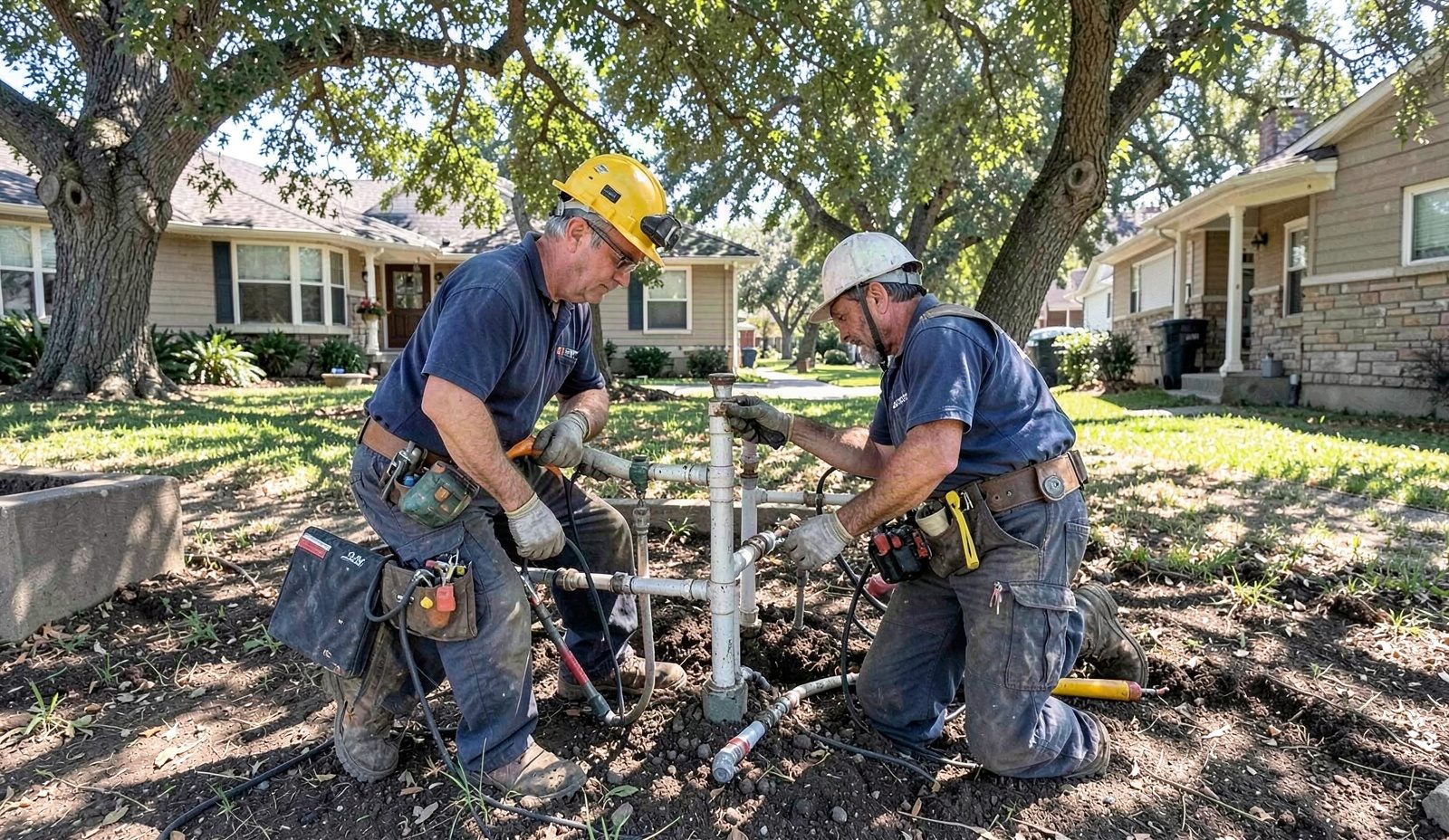
A technician gives you a written price before cutting into drywall, opening a slab, or digging toward a septic line. There is no call center reading a script. You talk to the person doing the work, and that person explains what they found and why the fix costs what it costs before anything gets started.
Every diagnostic starts with a pressure gauge threaded onto an outdoor spigot. A reading above 80 psi points to a failed or missing pressure-reducing valve, not a mystery leak, and it changes the whole repair plan. Guessing at pressure problems wastes a homeowner's money on parts that were never the actual cause.
Installation work on Rendon properties follows the same plumbing code framework Fort Worth uses, including Section 604.8 of the International Plumbing Code, which requires a pressure-reducing valve wherever static pressure at the fixture tops 80 psi. That threshold gets checked and documented, not assumed, on every repiping or fixture job.
Rural acreage plumbing is a different trade than subdivision plumbing. Long service runs, private pressure tanks, and septic-side drain layouts take a different diagnostic order than a city-connected home. Technicians working Rendon calls carry that experience into every visit instead of treating a well or septic property like a smaller version of a city house.
Rendon calls split into three categories, and each one runs on a different clock. Residential work covers the day-to-day repair, replacement, and maintenance calls that come from wells, septic-connected drains, water heaters, and fixtures across acreage and newer subdivided lots alike. Commercial work covers the smaller number of businesses and outbuildings along the corridor that need code-compliant backflow prevention, grease management, or drain capacity sized for actual use, not guesswork.
Emergency work sits apart from both because it runs on containment first, repair second. A burst supply line under a slab or a failed pressure tank spraying into a utility closet does not wait for a scheduled window, and the response has to match that urgency. The three service cards below break down what each category actually includes and who it is built for.
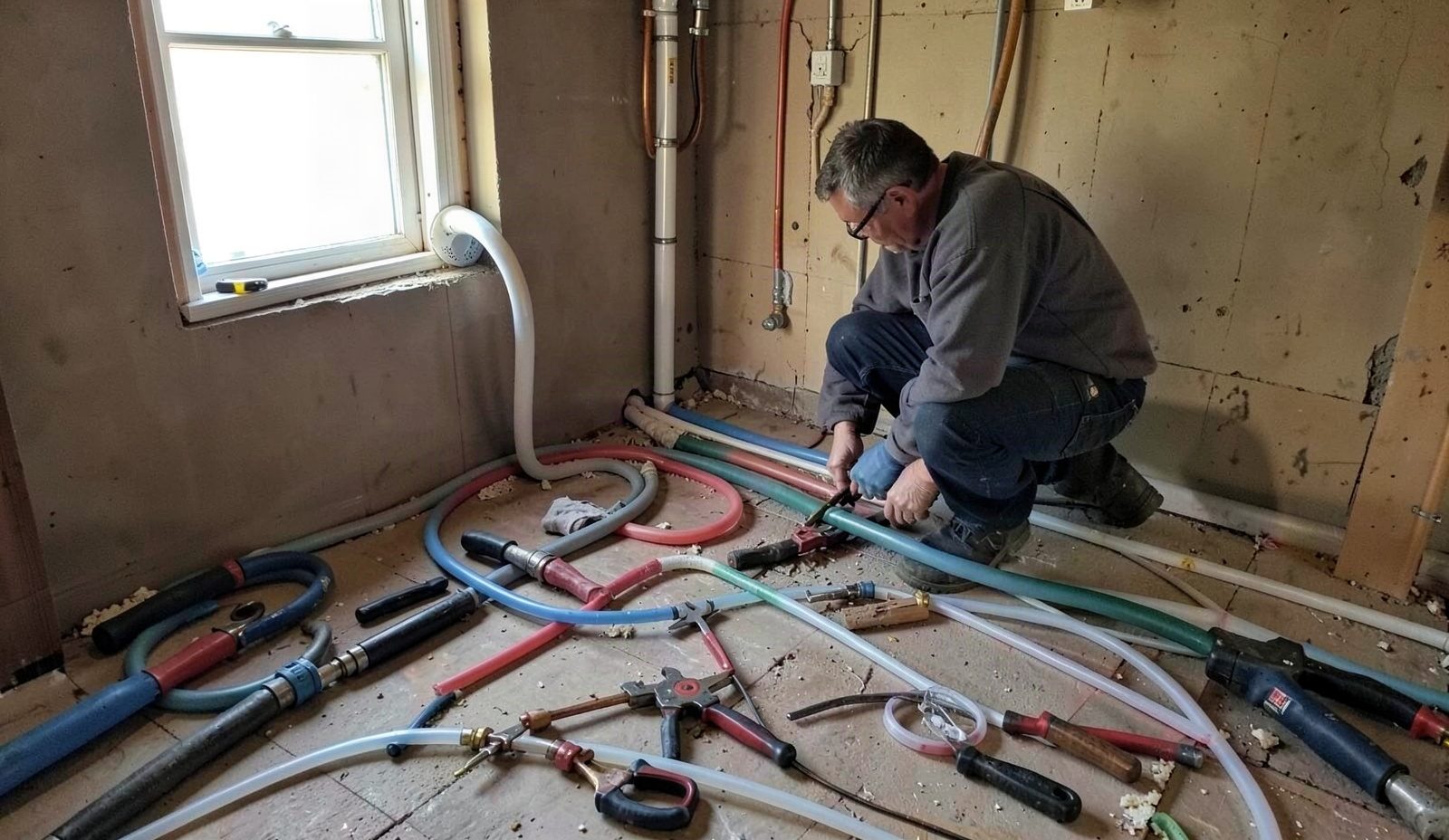
Residential work covers fixture repair, drain clearing, water heater service, and full or partial repiping for homes on both well and metered water. It is built for homeowners dealing with anything from a slow bathroom drain to a pressure tank that has started short-cycling. One recent example: swapping out a corroded pressure tank at an acreage property so the well pump stopped kicking on every few minutes, a problem the homeowner had misread as a plumbing leak inside the walls. Work includes diagnosis, a written quote, the repair itself, and a pressure check before the crew leaves, so the fix gets verified on-site rather than assumed.
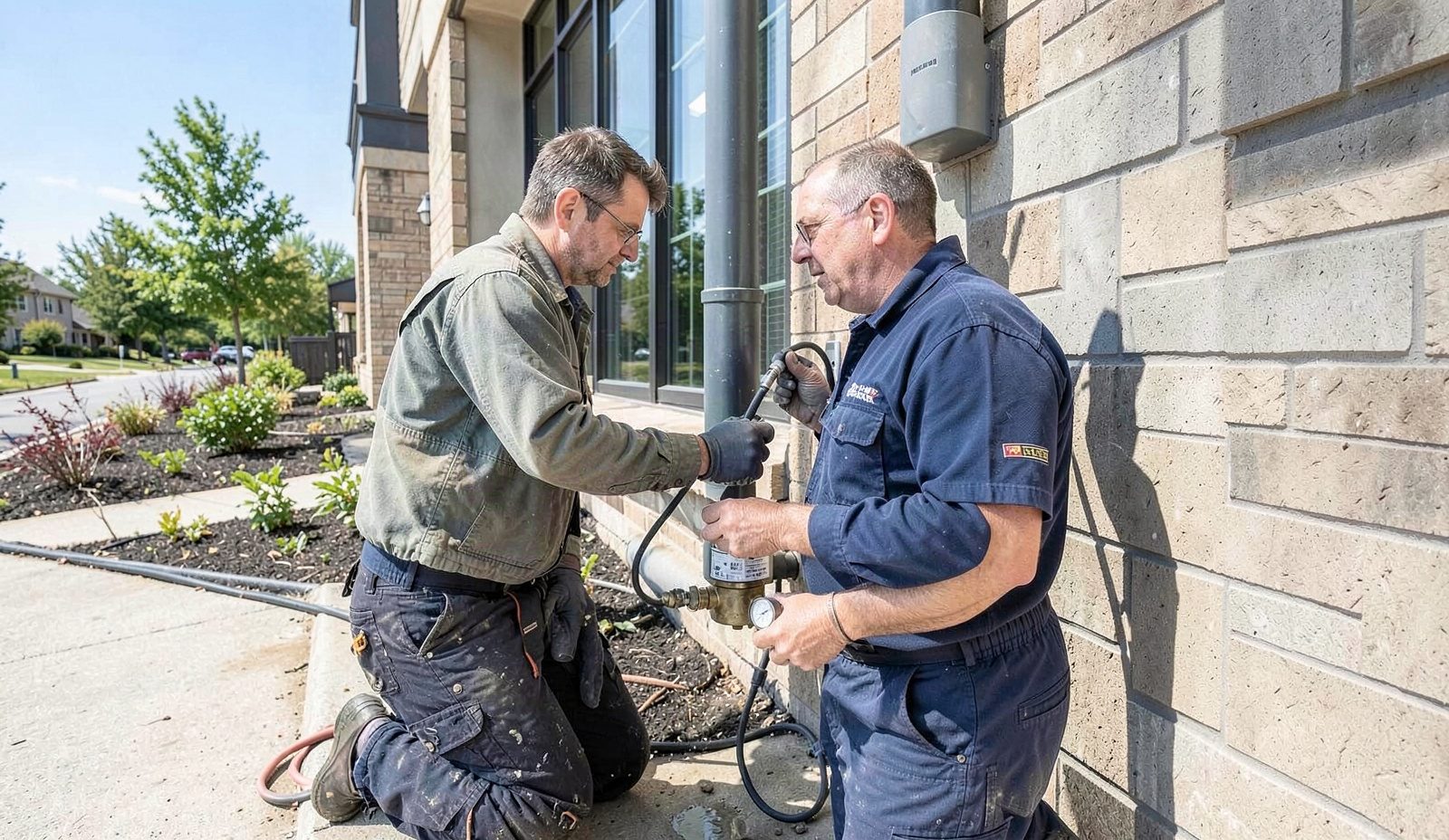
Commercial work for businesses along the corridor focuses on code compliance and uptime, not just repair. That means backflow prevention testing, grease interceptor service for food-service tenants, and drain line sizing that matches actual usage rather than the original build-out from years ago. A typical scenario: a small retail or service business finds its floor drain backing up during peak hours, and the fix requires camera inspection of the line, a capacity assessment, and documentation the owner can hand to an insurer or a landlord showing the system now meets code. Downtime gets scheduled around business hours whenever the scope allows it.
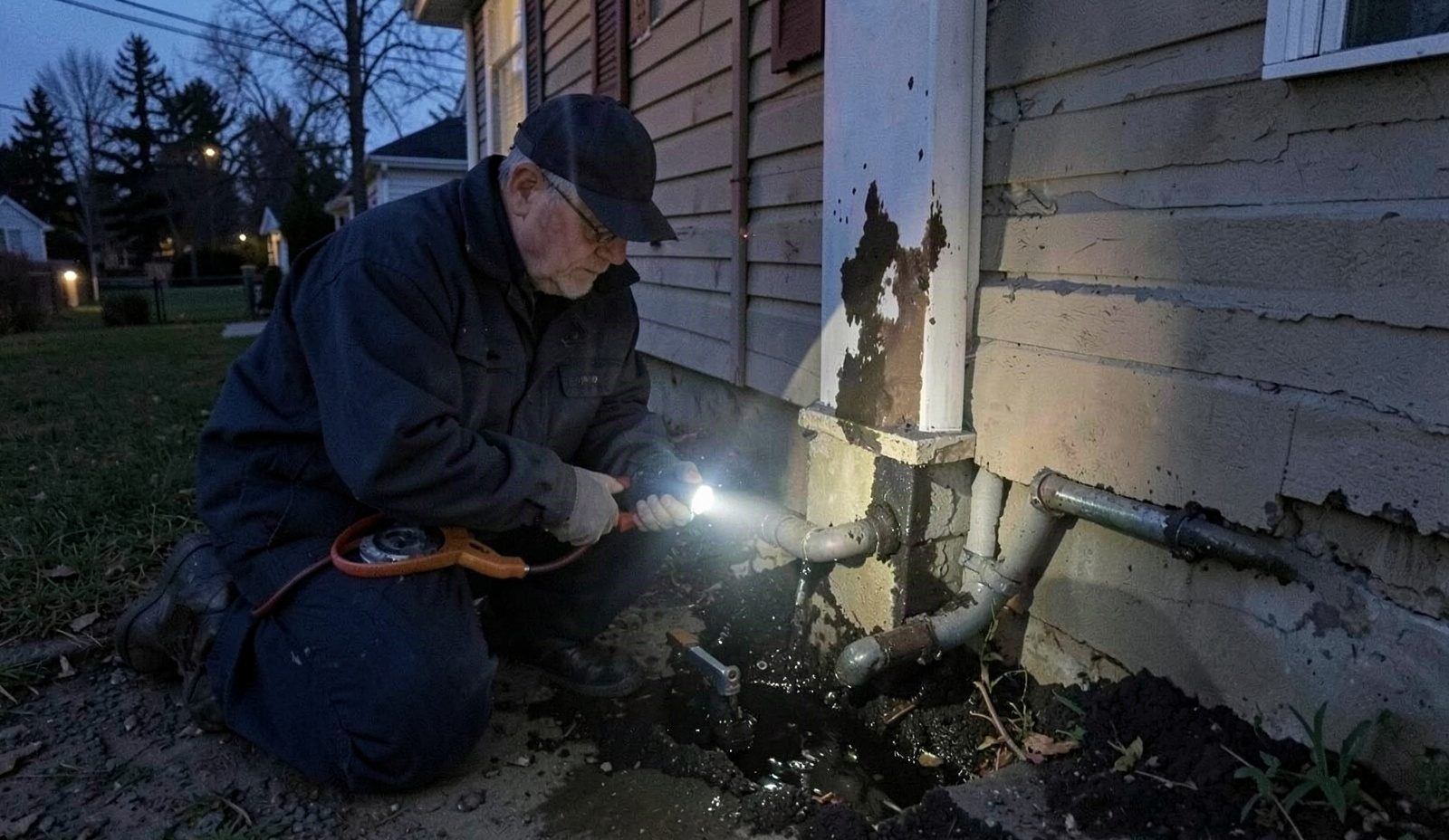
Emergency dispatch handles burst pipes, active slab leaks, and failed pressure tanks that cannot wait for a normal appointment window. The priority on arrival is containment: shutting off the affected line, stopping active water intrusion, and assessing what else is at risk before starting repair. One example: a homeowner calls after midnight because water is pooling under a slab-on-grade home near an interior wall. The crew isolates the line at the nearest shutoff, confirms the leak location, and begins the repair that night rather than leaving the water source active until morning.
Four problems account for most of the repair calls this area generates, and each one has a distinct cause. Weather, pipe material, ground movement, and deferred maintenance all play a role, often in combination on the same property.
Catching any of these early avoids the bigger repair. A slow drip behind a wall or a slightly low hot water temperature rarely stays minor for long once the underlying cause keeps working on the pipe or fixture.
Permit and inspection questions? Development Services is the office we coordinate with on every permitted Fort Worth job.
The February 2021 freeze burst pipes across Tarrant County by the tens of thousands, and most failures traced back to supply lines run through attics and exterior walls, not underground mains. A hard freeze warning followed by no water pressure at any fixture, or a wet ceiling stain after a cold snap, means a line failed in an unheated space. Call before the drip becomes standing water.
Properties built before 1970 across the metro were plumbed with galvanized steel supply lines and cast iron drains, both now at or past their service life. Rust-colored water at first flush, shrinking pressure over the years, or a slow-draining tub that a plunger no longer fixes point to interior pipe corrosion narrowing the line from the inside. Call before a galvanized line closes off completely.
North Texas expansive clay swells with rain and shrinks in drought, moving the slab enough to shear copper supply lines and separate drain joints under the house. A sudden spike in the water bill with no visible leak, or a sewer smell near a slab expansion joint, usually means a line broke somewhere under the foundation. Call before that hidden leak undermines more of the slab.
Fort Worth-area water runs moderately hard, and the mineral scale it leaves on heating elements is a leading reason water heaters here fail years before their rated life, especially units that never get flushed. A popping or rumbling sound from the tank, or hot water that runs out faster than it used to, signals sediment buildup insulating the element. Call before the tank fails outright.
A first visit starts with the water source and waste system, not the symptom you called about. A technician confirms whether the property runs on a well or a metered supply, checks static pressure, and only then traces the specific complaint back to a cause. Most diagnostic visits take under an hour before you get a written quote.
Have your water heater's age, any recent well pump service, and access to your septic riser or cleanout ready if you know where they are. It saves diagnostic time and lets the technician skip straight to testing.
We install and service equipment from major manufacturers like Rheem to manufacturer specifications.
After the initial call, you get a scheduled arrival window rather than an all-day guess. A technician calls or texts when they are dispatched to your address and again if traffic or a prior job runs long. For rural addresses off Rendon Road without clear house numbers, the office confirms gate codes, driveway length, or landmark directions ahead of time so the technician does not waste time finding the property once they arrive.
The technician who arrives is the one who does the work, in a marked vehicle and company identification. Before touching anything, they walk the affected area with you, ask when the problem started, and lay down floor protection near any work zone involving a slab cut, wall access, or septic riser. Pets and gate access get confirmed before anyone starts, since acreage properties often have livestock or dogs that need to be secured first.
Before the crew leaves, the technician walks you through what was fixed, runs the fixture or line to confirm the repair holds, and shows you the pressure or flow reading that proves it. Any access panels, slab patches, or septic covers get reset and the work area gets cleared of debris and old parts. You get a written summary of the repair for your records or for an insurance file if the damage warranted one.
The process runs in three stages from the first call to a finished repair, and each stage produces something you can see before the next one starts. Nothing gets cut into, dug up, or replaced without a written quote you approve first.
Scheduling windows run in blocks rather than open-ended promises, and you get a call ahead of arrival rather than a guessing game. Cleanup and a final check happen before the crew calls the job done.
Call (817) 710-3766 and describe the symptom: no pressure, a wet spot, a slow drain, a running toilet. The person on the phone logs your address, water source (well or metered), waste system (septic or sewer), and the exact symptom so the technician arrives already knowing what to test first.
On-site, the technician tests pressure, traces the drain or supply issue, and identifies the actual cause rather than the obvious symptom. You get a written quote covering parts, labor, and any access work like a wall or slab cut before anyone picks up a tool.
Work proceeds to the plumbing code framework Fort Worth uses for the region, with connections and pressure rechecked once the repair is complete. The technician documents the fix, resets any access points, and clears debris before leaving, so the site looks the way it did before the problem started.
Plumbing work across the Fort Worth metro, including unincorporated areas like Rendon, follows the City of Fort Worth plumbing code, which is based on the International Plumbing Code. That framework governs everything from pipe sizing and venting to fixture clearances and backflow prevention, and it applies whether the property sits on a city sewer main or a private septic field.
Verification on a real job happens through direct testing, not paperwork alone. A rough-in pressure test on new supply lines confirms the system holds pressure before a wall or trench closes over it, and a final walk-through checks that fixtures, traps, and vents are sized and vented the way the code requires. Drain work on older cast iron or galvanized systems gets scoped with a camera where the run is long enough that a visual inspection alone would miss a partial blockage or a joint separation.
Permitting works differently here than it does inside city limits, and that distinction matters for anyone planning a repipe or a major fixture relocation. The four factors below cover the technical challenges, cost drivers, timelines, and permit specifics that shape a plumbing project on a Rendon property.
Communities like r/Plumbing are full of homeowners comparing notes on exactly this problem, worth a read before a major project.
Acreage lots in Rendon mean long private service lines running between a well or meter and the house, and those runs freeze in cold snaps and get expensive to trench blindly. Locating the line before digging matters more here than on a standard city lot, since a wrong guess means re-digging through more yard.
Scope depends on access, not just the size of the fix. A line buried under a slab or routed through a finished wall costs more in labor than an exposed crawlspace run, and pipe material condition, whether galvanized, cast iron, or copper, determines whether a spot repair holds or the whole run needs replacing.
A single fixture repair or water heater swap typically finishes in one visit. A partial repipe or septic-side drain repair runs longer depending on access. Every job gets verified the same way regardless of size: a pressure or flow test confirming the repair holds before the crew calls it finished.
Since Rendon has no city building department, permit authority for plumbing work here falls to the Texas State Board of Plumbing Examiners rather than a municipal office. Full replacements and structural changes generally require a permit; minor like-for-like repairs often do not, and the final determination belongs to that authority.
Same-day service is available for most calls placed before early afternoon. Rendon's rural addresses take a little extra scheduling for driveway length and gate access, but that gets confirmed on the intake call, not on arrival, so the technician still shows up in the same window as anywhere else in the metro.
Simple fixture swaps like a toilet flapper or faucet aerator are fine to handle yourself. Anything touching a supply line, a drain joint, or a septic connection carries more risk on a well or septic property than on city utilities, since a mistake there can contaminate a water source instead of just causing a leak. Call before opening a septic riser or a pressure tank you have not serviced before.
It depends on the scope of the work. Full replacements and structural changes like a repipe or a relocated fixture typically need a permit, while minor like-for-like repairs often don't. Since Rendon has no city hall of its own, that determination goes through the county-level permitting process rather than a municipal building department, and the final call belongs to that authority.
Estimates are diagnosis-based, not phone guesses. A technician inspects the fixture, line, or pressure issue on-site, then writes up a price covering parts, labor, and any access work before starting anything. On acreage properties, longer service line runs and septic access can add labor time that a standard city-lot estimate would not account for.
Most visits take between one and three hours from arrival to pressure test sign off. A simple fitting swap on an exposed connector can close out in under an hour once the leak is confirmed. A full reroute through the attic in corrugated stainless tubing, or a repair that requires opening drywall, runs longer because the pressure test has to hold for its full window before anything gets closed up. The technician gives you a realistic estimate once the leak is located, not before.
Diagnosis usually takes under an hour once a technician is on site running the fixture sequence and pressure check. The repair itself ranges from a same-visit fix, like an anode rod swap, to a multi-day project if a full section of galvanized line needs replacement. We give you a time estimate as part of the written quote, before work starts.
Explore our service area and locate Shield Plumbing Fort Worth with ease. We're proudly local and serve the surrounding neighborhoods with fast response and honest pricing. Use the map to check our coverage area, or call us and we'll confirm in seconds.
Address:
Shield Plumbing Fort Worth, Rendon, TX 79226
5 Signs Your Ridglea Hills Home Has a Slab Leak, practical local guidance from Shield Plumbing Fort Worth, Fort Worth's trusted plumbing tea…
Read More
What Wedgwood Residents Should Know Before a Whole-Home Repipe, practical local guidance from Shield Plumbing Fort Worth, Fort Worth's trust…
Read More
How Fort Worth's Hard Water Is Quietly Destroying Your Water Heater, practical local guidance from Shield Plumbing Fort Worth, Fort Worth's …
Read More
The Hidden Cost of Ignoring a Dripping Faucet in Fort Worth, practical local guidance from Shield Plumbing Fort Worth, Fort Worth's trusted …
Read More